1876 25C BG-799B, PL (Regular Strike)
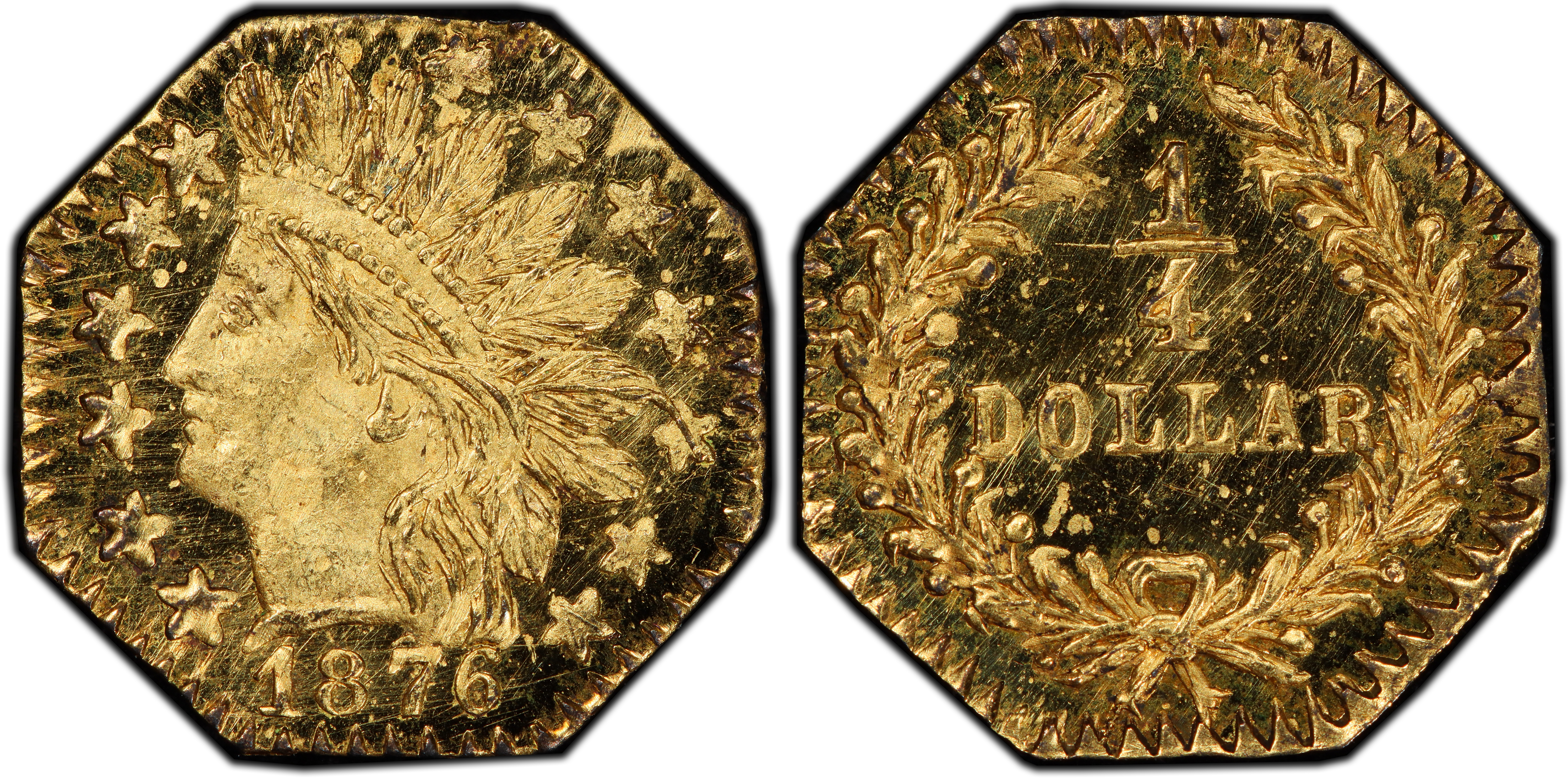
Obverse & Reverse
The 1876 25C BG-799B is a quintessential example of a 'Period Two' California Fractional Gold piece, an era (1859-1882) where the purpose of these miniature gold coins had shifted dramatically from their 'Period One' predecessors. The initial wave of fractional gold (1852-1857) arose from a genuine and acute shortage of small change in Gold Rush California. However, by the 1870s, the San Francisco Mint was in full operation and commerce was well-supplied with federal coinage. The later fractional pieces were therefore not created to satisfy a monetary need, but to cater to a burgeoning tourist trade and a national fascination with the 'Wild West.' Jewelers, primarily in San Francisco, produced these pieces as souvenirs, keepsakes, and jewelry items. Christopher Ferdinand Mohrig, a San Francisco jeweler, was a known producer of these popular gold tokens. His operations, however, ran afoul of the United States Secret Service, which, under the direction of its zealous chief James J. Brooks, began a crackdown on private coinage in the mid-1870s. The government argued these pieces, while often underweight, mimicked federal coinage and could potentially defraud the public. The pivotal event sealing the fate and ensuring the rarity of the BG-799B occurred on August 10, 1876. On that day, Secret Service agent Henry F. Fineglass arrested Mohrig and seized his stock of fractional gold pieces. These confiscated coins, numbering in the hundreds, were subsequently melted down at the mint. This seizure and destruction are the primary reason for the BG-799B's legendary rarity. The event highlights the legal gray area these minters operated in; while private coinage was made illegal by the Act of April 22, 1864, enforcement was sporadic until the Secret Service intensified its efforts, effectively ending the era of fractional gold production by 1883. The BG-799B is not just a souvenir, but a direct artifact of this conflict between private enterprise and federal monetary authority.
Associated EventCalifornia Gold Rush (Later Souvenir Period)
Reason For MintingPrimarily produced for sale as souvenirs and jewelry items for tourists and collectors, not for general circulation.
Minter HistoryChristopher Ferdinand Mohrig was a jeweler operating in San Francisco during the 1870s. He was one of several private manufacturers creating souvenir fractional gold pieces to meet public demand. His numismatic legacy is defined by his arrest on August 10, 1876, by the U.S. Secret Service for illegal coining, and the subsequent destruction of his inventory, which rendered his surviving issues, like BG-799B, extremely rare.
Historical SignificanceThe coin is a significant artifact from the 'Period Two' or 'Jeweler's Issue' era of California Fractional Gold. Its extreme rarity is a direct result of U.S. government action against private minters, making it a tangible piece of evidence of the legal battles that ended the long tradition of private and territorial coinage in the United States.
BG-799B
Denomination25 Cents
Minting Period1876
Assayer/MinterChristopher Ferdinand Mohrig
Geographic OriginSan Francisco, California
Obverse DescriptionAn octagonal planchet featuring a stylized Indian Head facing left, reminiscent of contemporary federal designs but of a cruder, local style. The portrait is surrounded by thirteen five-pointed stars, representing the original colonies.
Obverse Inscription[None, pictorial]
Reverse DescriptionA wreath composed of two branches tied with a bow at the bottom. The denomination '1/4 DOL.' is in the center, and the date '1876' is located below the bow, outside the wreath.
Reverse Inscription1/4 DOL. 1876
CompositionGold
Stated Fineness Actual FinenessVariable, typical for Period Two issues to be of lower fineness than their stated value, often in the 14-20 Karat range.
Weight0.25 grams
Diameter9.50 mm
EdgePlain
Unknown, but extremely small; part of a larger batch seized and melted by the U.S. Secret Service.
Survival Estimate2 known examples.
Rarity ScaleR-8 (2 or 3 known)
The BG-799B is one of the ultimate rarities in the California Fractional Gold series. Its appeal is multi-faceted: it has a direct, dramatic history tied to a government seizure, an identifiable minter, an infinitesimally small surviving population, and a beautiful design. It represents a pinnacle for the advanced collector of private gold.
Key VarietiesThere are no known varieties of the BG-799B from the original minting period. The entire issue is a single die marriage of extreme rarity. No later restrikes or patterns are known to exist.
Authentication TipsAuthentication is paramount and relies on comparing to the known genuine specimens. The finest known example, graded MS67 DPL by NGC, has a key diagnostic: a small, roundish planchet flaw or strike-through on the jaw of the Indian Head. The strike style, fabric, and specific die characteristics must match high-resolution photos of this coin or the other known (holed) example. Given its rarity, any newly discovered piece would require rigorous examination and certification by a top-tier grading service.
Shopping ConsiderationsAcquisition of this coin is a major event. With only two known specimens, one of which is impaired (holed), the opportunity to purchase is exceedingly rare. The finest known piece is a well-struck, sun-gold Superb Gem with deeply mirrored, prooflike fields. A premium quality example is defined solely by the condition of the single known unimpaired coin. Any potential buyer should focus on its provenance and physical characteristics, such as the identifying strike-through. For a piece of this magnitude, eye appeal and originality of the surfaces are critical, and the value is largely independent of standard market levels, being determined by the few collectors who can pursue such a rarity.
A coin's grade is its condition, rated on a 1-70 scale. For rare coins, this is the most critical factor in determining value, as a tiny difference in preservation can mean a huge difference in price.
Relevant Grade TypesAll original examples of BG-799B were struck as business strikes, though the surviving gem was prepared with such care as to be designated 'Deep Prooflike' (DPL). They would be found in Circulated (1-58) and Mint State (MS, 60-70) grades. However, as only two are known—one holed (impaired) and one MS67—circulated examples are unknown and likely non-existent. No true Proofs were struck, and no later-date restrikes are known.
Mint State CharacteristicsThe single known Mint State example defines the issue's characteristics. It is well-struck for a fractional piece, with sharp details in the headdress and wreath. The surfaces are deeply mirrored and reflective, a hallmark of carefully prepared planchets and dies, earning it the DPL designation. The fields are pristine, and the coin exhibits a vibrant, original 'sun-gold' luster. A small, round strike-through on the jawline is a unique characteristic of this specific specimen.
Circulated Wear PatternsAlthough no circulated examples are confirmed to exist, wear would first appear on the highest points of the design. On the obverse, this would include the cheek and the details of the feathered headdress. On the reverse, the high points of the wreath's leaves and the bow would show the first signs of friction. In lower grades, the delicate denomination and the date would begin to weaken.
Key Factors For ValueFor the BG-799B, value is determined almost exclusively by its status as one of only two known examples. For the single unimpaired specimen, its superb MS67 DPL grade places it in a class of its own. Key factors are its pristine, original surfaces, the depth of its prooflike fields, and its exceptional eye appeal. The presence of a CAC sticker on such a rarity would provide ultimate confirmation of its premium quality for the grade. Its value is less a function of a standard price guide and more about what one of the world's top collectors is willing to pay to acquire a legendary rarity.
PCGS Price Guide
| Grade | Price | Population |
|---|---|---|
| 66 | $16,500.00 | 1 |