1875 G25C BG-782 (Regular Strike)
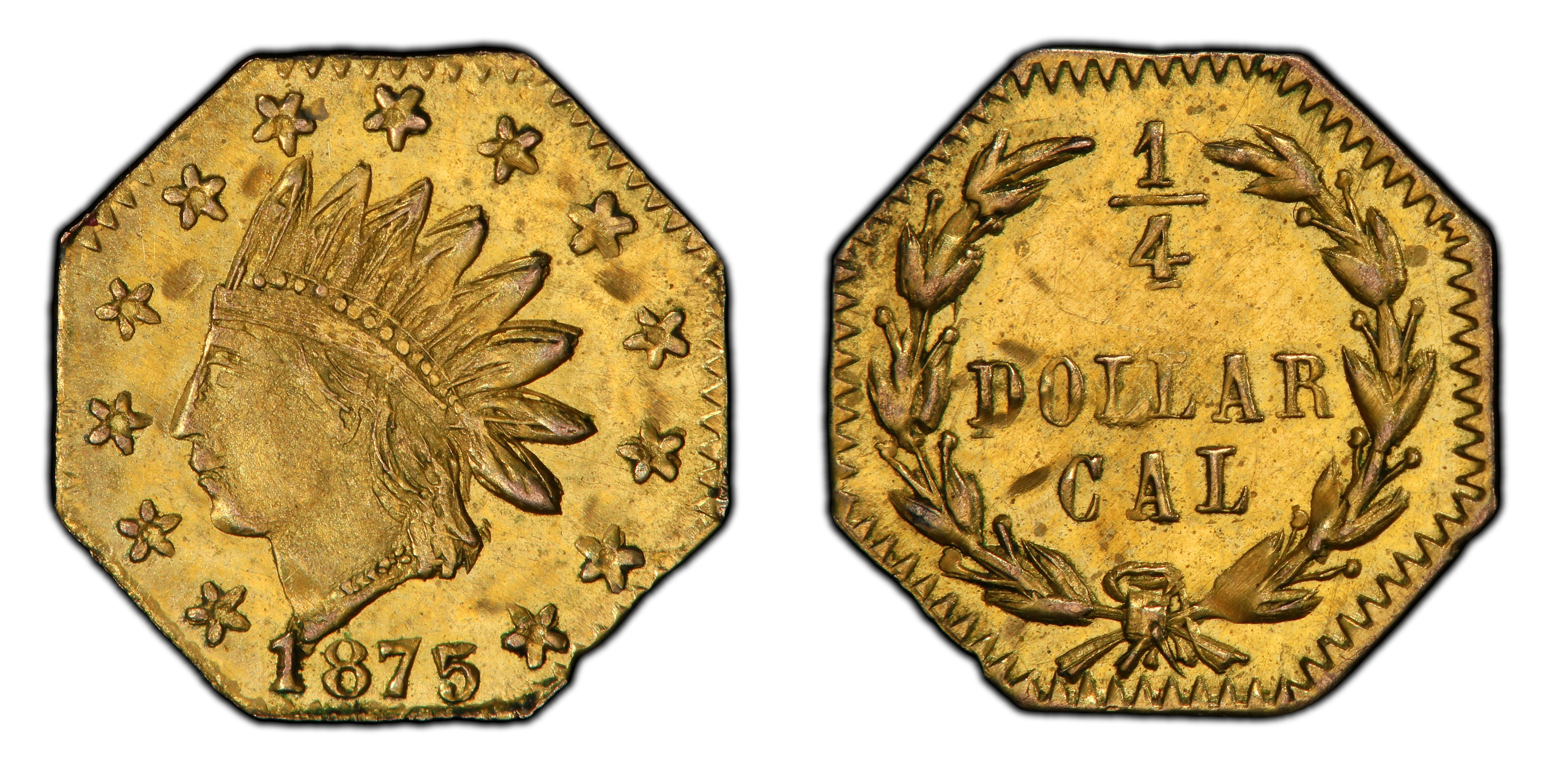
Obverse & Reverse
The 1875 BG-782 25 Cent piece emerges from the second great era of California Fractional Gold production, a period numismatically distinct from the frantic necessity that birthed the initial issues of 1852-1857. By the mid-1870s, the acute shortage of small change that plagued California during the Gold Rush had been largely resolved by the output of the San Francisco Mint, which began full-scale operations in the mid-1850s. Consequently, the impetus for private fractional gold coinage shifted from utilitarian commerce to the burgeoning souvenir and jewelry trade. These 'Period Two' pieces, struck from roughly 1858 to 1882, were primarily the work of San Francisco's jewelers and artisans, many of whom remain anonymous. They created these miniature gold coins as mementos of the Gold Rush and as novel gift items. Despite the Coinage Act of 1864, which made private coinage illegal, enforcement was lax until the early 1880s, allowing this production to flourish. The BG-782 is a quintessential example of this later period. It was not intended to facilitate the purchase of daily goods but to capture the romance of the now-legendary gold fields for tourists and locals alike. These pieces were often intentionally underweight relative to their face value, a fact that mattered little since they were sold at a premium as curios. Their tiny size and intricate designs were a testament to the skill of the die sinkers. The extreme rarity of the BG-782 variety today, rated R-7, suggests a very small original production, likely a single batch made by one specific jeweler. Its survival is a fragile link to a time when California was solidifying its mythos, a period where gold was no longer just a raw commodity for survival but a powerful symbol of the state's identity and allure.
Associated EventPost-Gold Rush California Economic Expansion
Reason For MintingPrimarily created as souvenirs and novelty items for the jewelry trade, not to alleviate a coin shortage.
Minter HistoryThe specific minter for BG-782 is unknown, which is characteristic of 'Period Two' California Fractional Gold. These pieces were typically produced by various San Francisco jewelers who did not sign their work, unlike some of the earlier 'Period One' minters. Their primary business was jewelry and precious metal work, with the creation of these gold tokens being a profitable sideline.
Historical SignificanceThe BG-782 represents the evolution of California Fractional Gold from a necessary medium of exchange to a commercial souvenir. Its existence demonstrates the continued cultural and economic resonance of the Gold Rush long after the initial fever had subsided, serving as a tangible artifact of California's burgeoning tourism and identity as 'The Golden State'.
N/A
Denomination25 Cents
Minting Period1875
Assayer/MinterUnknown Private Minter
Geographic OriginSan Francisco, California
Obverse DescriptionFeatures a stylized Indian Head facing left, adorned with a feathered headdress. The portrait is encircled by thirteen five-pointed stars, representing the original colonies.
Obverse Inscription[None]
Reverse DescriptionA simple wreath design encircles the denomination and date. The date '1875' is in the center, with '1/4' directly above it. The inscription 'CALIFORNIA GOLD' surrounds the wreath along the upper octagonal border.
Reverse Inscription1/4 1875 CALIFORNIA GOLD
CompositionGold
Stated Fineness Actual FinenessVariable, but generally lower than official U.S. Mint gold coinage of the era.
EdgePlain
Extremely Low
Survival Estimate4-12 pieces known
Rarity ScaleR-7
This coin is highly sought after for its extreme rarity (R-7) and classic 'Indian Head' design on an octagonal planchet. As a dated 'Period Two' issue, it is a key piece for specialists completing Breen-Gillio variety sets of California Fractional Gold.
Key VarietiesThe BG-782 is itself a specific die marriage variety. No major sub-varieties from the original minting period are known due to its rarity. No known restrikes or pattern pieces exist for this specific variety.
Authentication TipsGenuine examples are very thin and struck on solid gold planchets. Look for sharpness in the stars and feathers, though some central weakness is common. Counterfeits are often thicker, have a soapy or cast-like appearance, incorrect lettering style, or may be gold-plated base metal. Authentic pieces will not feature a bear on the reverse, a common motif on modern replicas. The planchet quality of originals can be imperfect, sometimes showing small voids or striations from the manufacturing process.
Shopping ConsiderationsFor a premium quality example, seek out a specimen with sharp central details on the Indian Head and the '1/4' on the reverse, as these areas can be weakly struck. Original, undisturbed surfaces with proof-like or reflective fields command a significant premium; some examples are known with attractive deep reddish-gold toning. Avoid examples that have been harshly cleaned, bent, or used as jewelry, as this severely impacts value. Pay close attention to planchet quality; while some minor original flaws are acceptable, large, distracting planchet voids or scratches should be factored into the price.
A coin's grade is its condition, rated on a 1-70 scale. For rare coins, this is the most critical factor in determining value, as a tiny difference in preservation can mean a huge difference in price.
Relevant Grade TypesOriginal period issues of BG-782 were business strikes, although many were sold as novelties and preserved in high grade. They are found in both Circulated (1-58) and Mint State (MS, 60-70) grades. No true Proofs were struck during the original period of issue. Any coin described as 'Proof' is more accurately a Prooflike (PL) business strike, noted for its mirror-like fields.
Mint State CharacteristicsAn uncirculated BG-782 is defined by its luster, which can range from satiny to deeply proof-like. High-end examples exhibit shimmering, reflective fields. Strike quality varies, but superior examples will show clear definition in the feathers of the headdress and the numerals of the date. Due to the rudimentary minting process, small, as-made planchet flaws or minor die cracks do not necessarily preclude a high grade. Contact marks, even small ones, can be distracting on such a tiny coin and will significantly impact the grade.
Circulated Wear PatternsWear first appears on the high points of the design: the cheek and feathers of the Indian Head on the obverse, and the central fraction '1/4' on the reverse. On more heavily circulated examples, the stars will begin to lose their points and the wreath will become flat. In lower grades, the date and legends will start to merge with the fields.
Key Factors For ValueRarity is paramount for this R-7 variety. Beyond that, surface quality is the key value driver. An example with original, lustrous, and uncleaned surfaces will always be worth multiples of a cleaned or damaged coin of the same technical grade. Eye appeal is crucial; coins with bold strikes, reflective fields, and attractive toning are highly prized. A CAC sticker indicating premium quality for the grade would add a significant premium for this specific issue.
PCGS Price Guide
| Grade | Price | Population |
|---|---|---|
| 58 | $275.00 | 1 |
| 58+ | $310.00 | N/A |
| 60 | $375.00 | N/A |
| 61 | $420.00 | 1 |
| 62 | $500.00 | 5 |
| 62+ | $545.00 | N/A |
| 63 | $675.00 | 13 |
| 63+ | $750.00 | N/A |
| 64 | $900.00 | 9 |
| 64+ | $1,050.00 | N/A |
| 65 | $1,350.00 | N/A |
| 65+ | $1,750.00 | N/A |
| 66 | $2,500.00 | 1 |