1874 G25C BG-773 (Regular Strike)
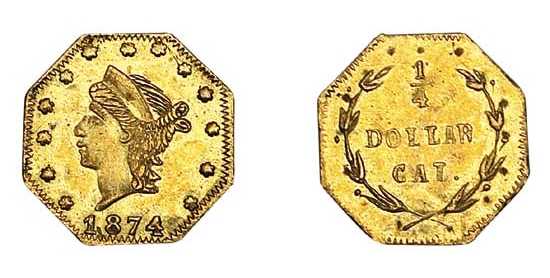
Obverse & Reverse
The 1874 G25C BG-773 is a quintessential example of 'Period Two' California Fractional Gold, a series born from the California Gold Rush but which evolved into a distinct numismatic souvenir trade. By the 1870s, the initial, desperate need for small circulating coinage that prompted the 'Period One' issues (1852-1857) had largely subsided. The San Francisco Mint, opened in 1854, was in full production, supplying the region with official federal silver and gold coins. However, the allure of the Gold Rush and the romance of California remained potent, creating a robust market for mementos. Jewelers and private minters, primarily in San Francisco, stepped in to fill this demand by producing beautifully crafted, miniature gold coins. These Period Two issues, including the BG-773, were not intended to and did not seriously function as circulating currency. They were sold as keepsakes, charms for bracelets, and waistcoat pocket pieces for tourists and locals alike. This purpose is reflected in their physical characteristics; they were often intentionally underweight and sometimes of lower fineness compared to their Period One predecessors. The legal environment had also shifted. The Private Coinage Act of 1864 explicitly outlawed private minting, but enforcement was inconsistent. The U.S. Secret Service, under its zealous chief James J. Brooks, viewed these pieces with suspicion, believing they could be passed fraudulently, even if not intended to be. This led to periodic crackdowns and seizures, forcing minters to operate discreetly. The profusion of varieties from this era, often made with re-used or slightly altered dies, speaks to a competitive and somewhat clandestine market. The 1874 BG-773, likely struck by San Francisco jeweler Herman J. Brand, represents the peak of this souvenir trade, a tangible piece of post-Gold Rush romanticism produced under the ever-watchful eye of federal authorities.
Associated EventPost-California Gold Rush Souvenir Trade
Reason For MintingTo serve a thriving tourist and local market for Gold Rush-themed souvenirs and jewelry charms.
Minter HistoryHerman J. Brand was a prominent San Francisco jeweler and die sinker active in the latter half of the 19th century. He was a prolific producer of 'Period Two' and 'Period Three' California Fractional Gold pieces. Unlike the earlier Period One minters who were addressing a genuine currency shortage, Brand's business was focused on the lucrative souvenir market. He created a wide variety of designs, including the popular Liberty and Indian head motifs. His operations eventually drew the attention of the U.S. Secret Service, which sought to suppress the manufacture of any private issue that resembled legal tender. To circumvent prosecution, Brand and his contemporaries would sometimes use ambiguous denominations or backdate their creations. His work is central to the story of the later fractional gold series.
Historical SignificanceThis coin is historically significant not as a monetary instrument, but as a cultural artifact of post-Gold Rush California. It represents the commercialization of the Gold Rush legend and the transition of private minting from a necessity of commerce to a novelty and souvenir industry, existing in a legally gray area under threat of government suppression.
N/A
Denomination25 Cents
Minting Period1874
Assayer/MinterHerman J. Brand
Geographic OriginSan Francisco, California
Obverse DescriptionA small, classic Liberty Head facing left, her hair tied in a bun. She is surrounded by thirteen five-pointed stars arranged in a circle near the octagonal border. The date '1874' is below the bust.
Obverse Inscription1874
Reverse DescriptionA central wreath composed of two branches tied with a bow at the bottom. Inside the wreath, the denomination is expressed on two lines as '1/4' and 'DOLLAR'. The word 'CAL' appears below the denomination, still within the wreath.
Reverse Inscription1/4 DOLLAR CAL
CompositionGold
Stated Fineness Actual FinenessVaries, often between .500 and .800 fine, intentionally less than monetary standard.
Weight0.25 grams
Diameter9.50 mm
EdgePlain
Unknown
Survival EstimateFewer than 75
Rarity ScaleR-5 (Very Scarce)
The BG-773 appeals to collectors for its connection to the romantic 'Old West,' its miniature artistry, and its status as a Period Two fractional. The octagonal shape is particularly desirable, evoking the iconic fifty-dollar 'slugs.' Its scarcity and attribution to a known San Francisco jeweler add to its allure.
Key VarietiesThe primary variations in this series are the die varieties cataloged by Breen and Gillio (BG). For 1874 alone, there are multiple BG numbers for octagonal 25C pieces, differing in die characteristics such as the placement of stars, date, or reverse lettering. No special proof or presentation strikes are known for this specific variety; all are considered business strikes, though some may exhibit prooflike surfaces from polished dies.
Authentication TipsGenuine pieces are struck in gold, not plated brass. Look for sharpness in the stars and lettering, though some weakness from a soft strike is common. Replicas often have a soapy, cast-like appearance with mushy details and may have incorrect lettering or design elements not matching the BG-773 die state. Edges should be plain and relatively sharp, not rounded or showing casting seams. Genuine pieces often have a slightly irregular 'hammered' look, unlike modern machine-made copies. Weight and size should be close to the established norms for the type.
Shopping ConsiderationsA premium quality example for its grade will possess a sharp strike, especially on Liberty's hair details and the numerals of the date. Seek out coins with original, uncleaned surfaces, often displaying a deep, reddish-gold or olive-gold patina. Luster is a key value determinant; even circulated pieces can retain some gleam in protected areas. Avoid examples that have been harshly cleaned, polished, or used as jewelry, paying close attention to the rims for evidence of mounting or removal from a bezel. Weakness on the highest points of the design is common, but a coin with an overall bold impression commands a significant premium.
A coin's grade is its condition, rated on a 1-70 scale. For rare coins, this is the most critical factor in determining value, as a tiny difference in preservation can mean a huge difference in price.
Relevant Grade TypesAll original 1874 BG-773 coins were struck as business strikes, intended for sale as souvenirs. They are found in Circulated grades (AU-58 and below) and Mint State (MS, 60-70). Although some examples may have prooflike (PL) surfaces from polished dies, no true Proofs were struck during the original period of issue. Any claims of a 'Proof' striking should be treated with extreme skepticism, as they would not be contemporary to the 1874 issue.
Mint State CharacteristicsUncirculated examples of BG-773 are defined by their luster, which is typically soft and satiny. Strike quality varies; many were made with manual screw presses, leading to inconsistencies. A sharp strike on the stars and the wreath on the reverse is desirable but not always present. The highest points of the design, like Liberty's cheek and hair, are susceptible to contact marks due to the softness of the gold. A premium MS coin will have minimal marks, strong luster, and good eye appeal.
Circulated Wear PatternsWear first appears on the highest points of the design. On the obverse, check for flatness on Liberty's cheek, the hair above her eye, and the top of her ear. On the reverse, the highest points of the wreath's leaves and the bow will show wear first. In lower grades (VF and below), the stars will begin to lose their points and the fine details of the wreath will merge.
Key Factors For ValueThe primary drivers of value for an 1874 BG-773 are grade and surface quality. An example with original, uncleaned 'skin' is far more valuable than a cleaned or polished piece of the same grade. Strike sharpness is critical; a well-struck coin with full details will command a substantial premium over a weakly struck one. Eye appeal, encompassing attractive toning and minimal distracting marks, is also key. Certification by a top-tier service (PCGS or NGC) is standard for this series, and a CAC sticker indicating premium quality for the grade adds significant value.
PCGS Price Guide
| Grade | Price | Population |
|---|---|---|
| 55 | $900.00 | 1 |
| 55+ | $950.00 | N/A |
| 58 | $1,000.00 | N/A |
| 58+ | $1,100.00 | N/A |
| 60 | $1,200.00 | N/A |
| 61 | $1,350.00 | N/A |
| 62 | $1,750.00 | 2 |
| 62+ | $1,900.00 | N/A |
| 63 | $2,250.00 | N/A |
| 63+ | $2,650.00 | N/A |
| 64 | $3,250.00 | 2 |