1882 25C BG-799CC (Regular Strike)
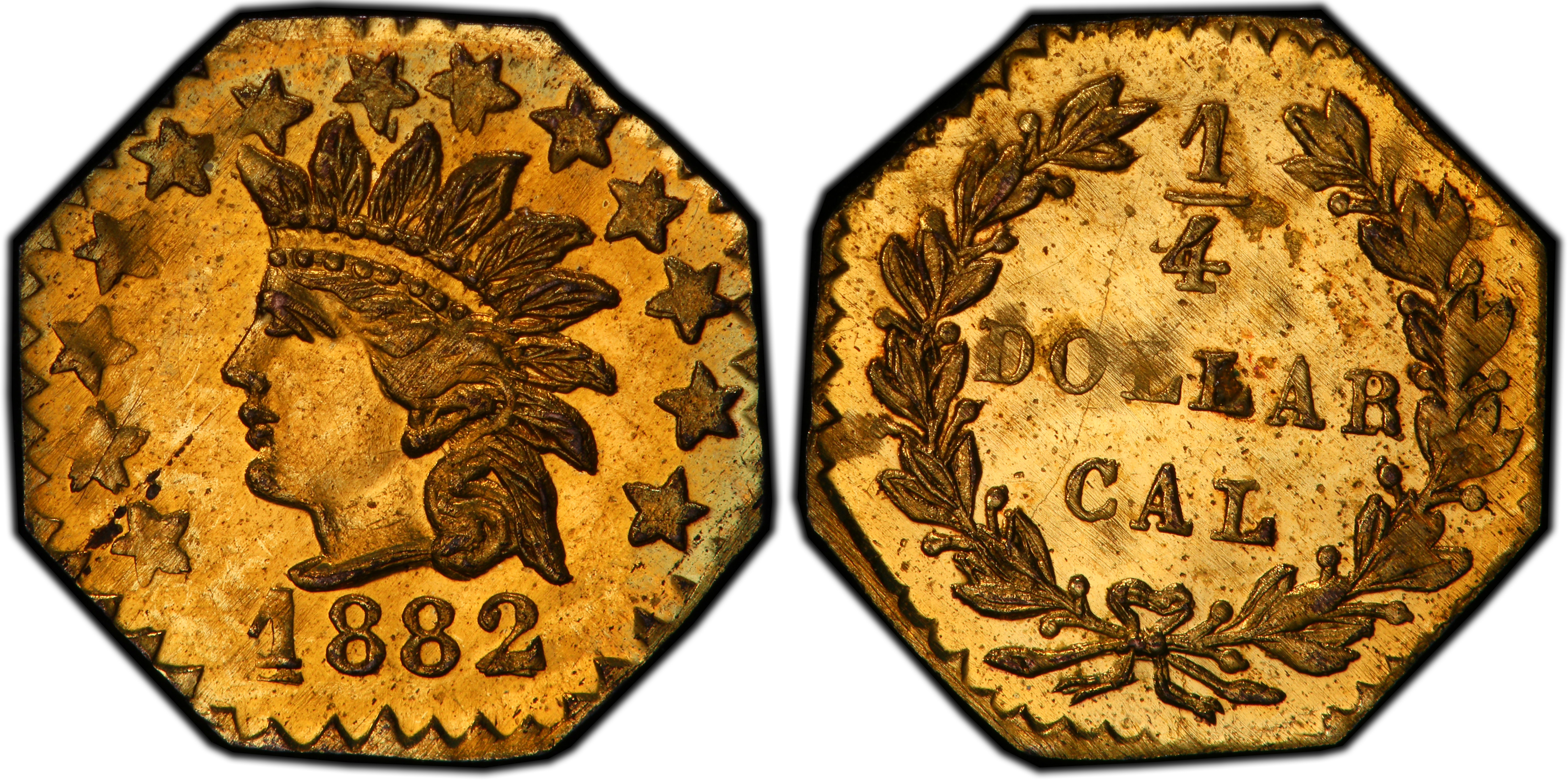
Obverse & Reverse
The 1882 25C BG-799CC represents the final chapter of the fascinating and complex series of California Fractional Gold. It is a 'Period Two' (1858-1882) issue, a distinct class of private coinage born not from a dire need for small change as its 'Period One' predecessors were, but from a burgeoning souvenir and jewelry market. By the 1880s, the initial chaos of the Gold Rush had subsided, and the San Francisco Mint was in full operation, obviating the need for private fractional currency. However, the allure of California and the Gold Rush was a powerful marketing tool. San Francisco jewelers, many of whom had produced the earlier, functional pieces, adapted their operations to create these small, attractive gold tokens for tourists and for use in jewelry. These pieces were often intentionally underweight relative to their face value, functioning more as gilded tokens than true coinage. The year 1882 is particularly significant as it marks the last year of tolerated production. The Coinage Act of 1864 had already made private coinage illegal, but the law was not strictly enforced against these small souvenir pieces until 1883. At that point, the U.S. Secret Service, under the direction of the zealous James J. Brooks, launched a crackdown, seizing dies and equipment from the jewelers and effectively ending the era of denominated private gold. Pieces produced after this date are typically undenominated 'charms' to circumvent the law. The BG-799CC, therefore, stands as one of the very last of its kind, a final expression of a uniquely Californian numismatic tradition before federal authority closed the chapter for good. Its existence is a testament to the enduring romanticism of the Gold Rush and the entrepreneurial spirit of the San Francisco artisans who catered to it.
Associated EventPost-California Gold Rush Souvenir Trade
Reason For MintingPrimarily struck for sale as souvenirs, keepsakes, and jewelry items for tourists and locals, not for monetary circulation.
Minter HistoryWhile the specific maker of the BG-799 series is not definitively known, the style and period of manufacture are consistent with the work of several prominent San Francisco jewelers. Robert B. Gray & Co. was a major producer of Period Two fractionals, having purchased the business and dies of Antoine Louis Nouizillet around 1859. Gray and his successors continued producing a wide variety of these pieces until the government crackdown. The dies for the numerous BG-799 varieties were likely created and used by one of these established firms that specialized in the profitable souvenir gold trade.
Historical SignificanceThe BG-799CC is significant as it represents the very end of a 30-year tradition of privately issued gold coinage in California. It bridges the gap between the necessity-driven coinage of the early Gold Rush and the federally-enforced monetary standardization of the late 19th century, existing in its final years as a nostalgic souvenir of a bygone era.
BG-799CC
Denomination25 Cents
Minting Period1882
Assayer/MinterUnknown Jeweler, possibly Robert B. Gray & Co. or successor
Geographic OriginSan Francisco, California
Obverse DescriptionAn Indian Head portrait facing left, likely modeled after the contemporary U.S. Indian Head cent. The portrait is typically surrounded by 13 six-pointed stars arranged along the octagonal border. The date '1882' is below the bust truncation.
Obverse Inscription1882
Reverse DescriptionThe denomination '25 CENTS' is enclosed within a wreath. The wreath is typically composed of two branches tied together by a bow at the bottom. The style of the wreath and font can vary between different die states of the BG-799 series.
Reverse Inscription25 CENTS
CompositionGold
Stated Fineness Actual FinenessVariable, typically debased and less than their stated face value, consistent with Period Two souvenir issues.
EdgePlain
Unknown
Survival Estimate19-24 known specimens.
Rarity ScaleR-6
This coin is highly sought after due to its status as a final-year issue, its high rarity (R-6), and its connection to the romantic history of the California Gold Rush. The small size and octagonal shape add to its charm and distinctiveness within U.S. numismatics.
Key VarietiesThe BG-799 designation covers multiple die pairings from 1876 through 1882, identified by letter suffixes (e.g., BG-799A, BG-799K, BG-799CC). BG-799CC is a specific die marriage from 1882. No later-date Proof restrikes are known to exist for this specific variety, as the practice was shut down by the federal government. Any such pieces would be considered modern fantasy items.
Authentication TipsAuthentic Period Two fractionals must bear a denomination (e.g., 'CENTS' or 'DOLLAR'). Replicas often feature a bear on the reverse and lack a denomination; these are fantasy pieces. Genuine pieces were often crudely hammer-struck, resulting in areas of weak strike, especially at the periphery, which contrasts with the typically sharp, uniform strike of modern fakes. The planchets are characteristically thin. The ultimate authority for attribution is the Breen-Gillio reference, 'California Pioneer Fractional Gold'.
Shopping ConsiderationsA premium quality example for its grade will exhibit a sharp strike on the central devices, particularly the details of the Indian's hair and the lettering of the denomination. Look for original, undisturbed luster, which is often satiny or semi-prooflike. Many surviving examples are ex-jewelry and may show signs of being holed, mounted, or harshly cleaned; coins free from such damage command significant premiums. Avoid specimens with tooling, significant rim damage, or harsh cleanings that have stripped the original surface. Attractive, reddish-gold toning that is consistent with decades of storage can also add to the eye appeal.
A coin's grade is its condition, rated on a 1-70 scale. For rare coins, this is the most critical factor in determining value, as a tiny difference in preservation can mean a huge difference in price.
Relevant Grade TypesOriginal 1882 BG-799CC issues were business strikes, although they were intended for souvenir sales rather than circulation. They are found in Circulated grades (1-58) though this is less common, and more frequently in Mint State (MS, 60-70). The term 'Prooflike' (PL) is often applied to specimens with mirrored surfaces from polished dies. No official Proofs were struck during the original period of issue, and no known authorized restrikes exist.
Mint State CharacteristicsUncirculated examples are defined by their luster. High-grade specimens often display semi-prooflike or prooflike surfaces resulting from the jewelers' use of polished dies. Strike quality is a key differentiator; many are softly struck, particularly on the stars and wreath details. A coin with a bold, complete strike is highly desirable. Due to being sold as souvenirs and kept as keepsakes, contact marks can be minimal, but are not uncommon.
Circulated Wear PatternsIf circulated, wear would first appear on the high points of the design. On the obverse, this includes the cheek, the eyebrow, and the feathers in the headdress. On the reverse, the highest points of the wreath's leaves and the numerals of the denomination would show the first signs of friction. In lower grades, the stars and peripheral lettering will become weak and merge with the fields.
Key Factors For ValueRarity is paramount for this R-6 variety. Beyond that, a coin's value is driven by its surface preservation and eye appeal. An example with original, lustrous surfaces will always be worth more than a cleaned or polished one of the same technical grade. Strike sharpness is critical; a fully struck specimen can command a substantial premium over a weakly impressed example. Finally, a CAC sticker, indicating premium quality for the grade, adds significant value and liquidity to this rare issue.
PCGS Price Guide
| Grade | Price | Population |
|---|---|---|
| 55 | $900.00 | 1 |
| 55+ | $950.00 | N/A |
| 58 | $1,000.00 | N/A |
| 58+ | $1,050.00 | N/A |
| 60 | $1,125.00 | N/A |
| 61 | $1,200.00 | N/A |
| 62 | $1,300.00 | 5 |
| 62+ | $1,450.00 | N/A |
| 63 | $1,750.00 | 10 |
| 63+ | $2,000.00 | N/A |
| 64 | $2,650.00 | 6 |
| 64+ | $3,000.00 | N/A |
| 65 | $3,500.00 | N/A |
| 65+ | $4,000.00 | N/A |
| 66 | $4,750.00 | N/A |
| 67 | N/A | N/A |