1870 G25C BG-763 (Regular Strike)
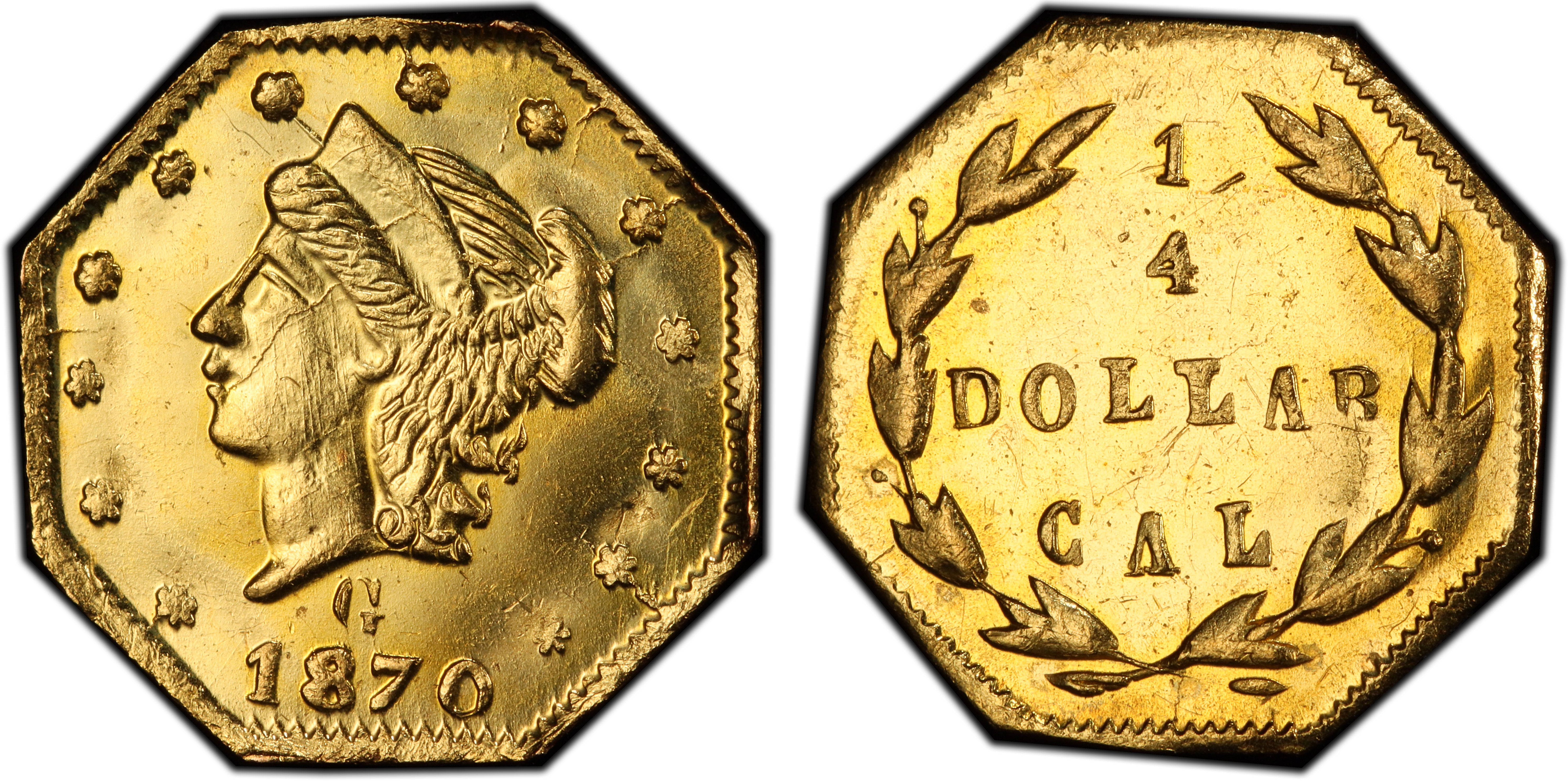
Obverse & Reverse
The 1870 G25C BG-763 is a product of the second period (1859-1882) of California Fractional Gold production, a fascinating and complex era of private coinage in American history. Following the initial California Gold Rush boom, the state still faced a chronic shortage of small denomination coinage for everyday transactions. While the San Francisco Mint, opened in 1854, produced federal gold and silver coins, the output of small change was often insufficient to meet the demands of the bustling economy. In the early years (1852-1856), private minters struck fractional gold that was intended to circulate and genuinely fill this monetary gap. However, by the 1870s, the landscape had shifted. The U.S. government passed the Coinage Act of 1864, which made the private issuance of coinage illegal. Despite this, enforcement by the Secret Service was not stringent until the early 1880s. This legal gray area allowed for the continued production of 'jeweler's issues,' like the BG-763. These later-period pieces were less about serving a critical monetary need and more about catering to a growing market for souvenirs, keepsakes, and curiosities for tourists and collectors. Jewelers, with their expertise in working with precious metals on a small scale, were the primary manufacturers. They often used a simple but effective 'hammer method' of striking: a planchet was placed on an anvil die, and the obverse die was struck with a sledgehammer, a process that accounts for the frequent variability in strike quality. While no specific minter is known for BG-763, it is stylistically consistent with other San Francisco issues of the time. These tiny gold pieces, though no longer essential for commerce, captured the romantic spirit of the Gold Rush and remain tangible links to an era of entrepreneurial ingenuity and economic adaptation in the American West.
Associated EventPost-Gold Rush Economic Expansion
Reason For MintingPrimarily struck as souvenirs or 'jeweler's pieces' during a period of lax enforcement of private coinage laws, rather than to alleviate a critical coin shortage.
Minter HistoryThe specific minter for BG-763 is unknown, as is common for many California Fractional Gold varieties from this period. Production is attributed to various San Francisco jewelers who took advantage of the continued demand for gold souvenirs. These artisans used their metallurgical skills to create a wide array of small-denomination gold pieces, often with Liberty Head motifs similar to federal coinage, but without official sanction. Notable producers of the era included firms like Deriberpe & Nouizillet (D.N.) and Frontier & Deviercy (F.D.), though no direct link to this specific variety has been established.
Historical SignificanceThe BG-763 represents the transition of California Fractional Gold from necessary circulating currency to commercial keepsakes. Its existence highlights a unique period in U.S. monetary history where private manufacturing of coin-like objects persisted despite federal laws, illustrating the lasting cultural and economic impact of the Gold Rush on California.
N/A
Denomination25 Cents
Minting Period1870
Assayer/MinterUnknown private minter, often attributed to jewelers in San Francisco.
Geographic OriginSan Francisco, California
Obverse DescriptionA Liberty Head facing left, similar in style to contemporary U.S. gold coinage, but cruder in execution. The portrait is encircled by 13 stars.
Obverse Inscription Reverse DescriptionThe denomination '1/4' and 'CALIFORNIA GOLD' are enclosed within a wreath of leaves. The date '1870' is positioned below the wreath.
Reverse Inscription1/4 CALIFORNIA GOLD 1870
CompositionGold
Stated Fineness Actual FinenessVaries, often between 14 to 22 karats.
Diameter9.60 mm
EdgePlain
Unknown
Survival Estimate150-200 (Breen & Gillio Low Rarity-4)
Rarity ScaleR-4-
The BG-763 is popular due to its affordability relative to earlier issues, its classic octagonal shape, and its direct connection to the romantic lore of the California Gold Rush era. It serves as an accessible entry point into the complex and historically rich series of California Fractional Gold.
Key VarietiesThe primary variety is the regular business strike. No known proof strikings, patterns, or official restrikes from the original period exist. All genuine BG-763 pieces are considered 'jeweler's issues' from the 1870s. Collectors should be aware that the broader field of California Fractional Gold is rife with 20th-century replicas and fantasy pieces, often unlisted in the Breen-Gillio reference, which are not considered part of the original series.
Authentication TipsGenuine pieces must have a stated denomination (e.g., '1/4 CALIFORNIA GOLD'). Replicas often feature a bear on the reverse, a design element not found on any authentic 19th-century issues. Genuine coins frequently exhibit weakness in the strike due to the hammer-striking process, particularly in the center or on peripheral details; counterfeits are often sharply and uniformly struck. The surfaces of authentic pieces may show fine die polishing lines or a slightly uneven, non-uniform field. Weight and fineness can vary, so expert authentication by a third-party grading service (PCGS or NGC) is highly recommended.
Shopping ConsiderationsA premium quality BG-763 will exhibit a sharp strike for the variety, particularly on the stars and the details within the wreath. Seek out examples with smooth, lustrous surfaces that have not been harshly cleaned or polished. Original, unblemished 'skin' is highly desirable. Check for planchet imperfections, such as small laminations or fissures, which are common due to the crude manufacturing process but should not be distracting. Avoid pieces that are bent, holed, or show signs of having been used in jewelry, unless purchased at a significant discount. Eye appeal is paramount; a well-struck coin with pleasing original color will always command a premium.
A coin's grade is its condition, rated on a 1-70 scale. For rare coins, this is the most critical factor in determining value, as a tiny difference in preservation can mean a huge difference in price.
Relevant Grade TypesAll original 1870 G25C BG-763 coins were produced as business strikes intended for sale as souvenirs, not circulation. They are found in Circulated grades (AU-50 to AU-58 are common) and Mint State grades (MS-60 to MS-70). No true Proofs were struck during the original period. While some examples may have reflective, prooflike (PL) surfaces due to polished dies, they are not a distinct striking type and are designated as PL by grading services when applicable.
Mint State CharacteristicsIn Mint State, the BG-763 typically displays a soft, satiny luster. The strike is often somewhat weak in the centers, particularly on Liberty's hair and the leaves of the wreath. Contact marks are common due to the softness of the gold and their small size, which made them prone to being handled together. A premium MS example would have minimal marks, a relatively sharp strike for the issue, and bright luster.
Circulated Wear PatternsWear first appears on the highest points: Liberty's cheek, hairline, and the high points of the wreath leaves on the reverse. As wear progresses, the stars on the obverse will begin to lose their definition, and the finer details of the wreath will merge. In lower grades (VF and below), the legends and date can become soft and difficult to read.
Key Factors For ValueFor the BG-763, value is driven by three main factors: 1) Surface Preservation: An example with original, undisturbed luster and minimal contact marks is far more valuable than one that has been cleaned, polished, or damaged. 2) Strike Quality: While some weakness is expected, specimens with an unusually sharp and well-defined Liberty portrait and wreath command a significant premium. 3) Eye Appeal: Coins with a pleasing, even color and strong luster are highly sought after. Certification by PCGS or NGC is standard for this series and a CAC sticker indicates premium quality for the grade, adding further value.
PCGS Price Guide
| Grade | Price | Population |
|---|---|---|
| 40 | $240.00 | 1 |
| 45 | $250.00 | N/A |
| 45+ | $255.00 | N/A |
| 50 | $275.00 | 4 |
| 50+ | $285.00 | N/A |
| 53 | $300.00 | 2 |
| 53+ | $315.00 | N/A |
| 55 | $325.00 | 16 |
| 55+ | $335.00 | N/A |
| 58 | $350.00 | 27 |
| 58+ | $375.00 | N/A |
| 60 | $400.00 | 7 |
| 61 | $425.00 | 18 |
| 62 | $450.00 | 46 |
| 62+ | $475.00 | N/A |
| 63 | $550.00 | 20 |
| 63+ | $700.00 | N/A |
| 64 | $1,100.00 | 6 |