1876 G25C BG-799B (Regular Strike)
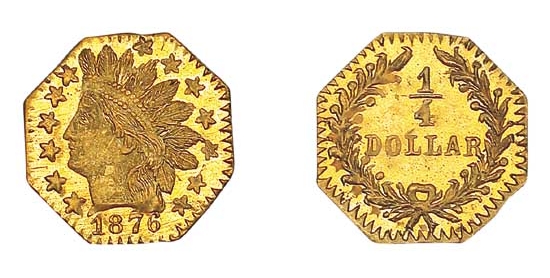
Obverse & Reverse
The 1876 G25C BG-799B octagonal 25-cent piece represents one of the final and most storied chapters in the saga of California Fractional Gold. These small denomination coins, born of necessity during the initial gold rush to alleviate a chronic shortage of small change, had by the 1870s transitioned into a popular souvenir trade. San Francisco jewelers like Christopher Ferdinand Mohrig catered to tourists and easterners who desired a tangible, affordable piece of the romanticized Gold Rush era. These later issues, designated as 'Period Two' (1858-1882) by researchers Walter Breen and Ronald J. Gillio, were not intended for robust circulation. Their gold content was often below their face value, rendering them tokens rather than true coinage, and their designs, like the Indian Head motif, were chosen for commercial appeal rather than to mimic federal issues. The existence of BG-799B is inextricably linked to its creator's downfall. On August 10, 1876, Secret Service agent Henry F. Fineglass arrested Mohrig for violating the Coinage Act of 1864, which prohibited private coinage. Fineglass seized Mohrig's inventory of fractional gold pieces, along with his dies and equipment. These confiscated items were subsequently destroyed, effectively halting Mohrig's production and creating instant rarities of his final issues. The BG-799B is a direct artifact of this enforcement action. Its extreme rarity suggests it was part of the very batch of coins confiscated and melted, with perhaps only one or two examples escaping this fate. Its story is therefore not just one of commerce or souvenir trade, but a poignant final act in the era of private minting in California, abruptly ended by federal intervention.
Associated EventPost-Gold Rush Souvenir Trade & Federal Crackdown on Private Coinage
Reason For MintingPrimarily produced as a souvenir or curio for the tourist trade, not to alleviate a currency shortage as earlier issues had.
Minter HistoryChristopher Ferdinand Mohrig was a San Francisco-based jeweler and one of the more prolific producers of 'Period Two' California Fractional Gold. Active from the early 1870s, his issues are cataloged in the Breen-Gillio reference from BG-790 through BG-799V. His operations came to an abrupt end on August 10, 1876, when he was arrested by the U.S. Secret Service. The confiscation and destruction of his stock and tools by federal agents is the primary reason for the rarity of many of his 1876-dated varieties.
Historical SignificanceThis coin is a prime example of a 'suppressed' jeweler's issue and a testament to the federal government's final enforcement of the 1864 Coinage Act. Its great rarity is a direct result of the minter's arrest and the destruction of his products, making it a significant artifact of the end of the private minting era in California.
BG-799B
Denomination25 Cents
Minting Period1876
Assayer/MinterChristopher Ferdinand Mohrig
Geographic OriginSan Francisco, California
Obverse DescriptionThe obverse features a stylized portrait of a Native American (Indian Head) facing left, wearing a feathered headdress. The portrait is encircled by thirteen six-pointed stars. The date, 1876, appears below the bust.
Obverse Inscription1876
Reverse DescriptionThe reverse features the denomination '1/4' and the word 'DOLLAR' within a wreath composed of two olive branches. The wreath is open at the top and tied with a bow at the bottom.
Reverse Inscription1/4 DOLLAR
CompositionGold
Stated Fineness Actual FinenessVariable; 'Period Two' issues ranged from approximately 14 to 22 karats, and were typically underweight for their face value.
Weight0.25 grams
Diameter9.50 mm
EdgePlain
Extremely low; likely only a handful were struck before the minter's arrest.
Survival Estimate2-3 known
Rarity ScaleR-8
The BG-799B is a legendary rarity in the California Fractional Gold series. Its appeal is immense, driven by its R-8 rating, direct connection to the historic arrest of minter C.F. Mohrig, and the fact that only one of the known specimens is unimpaired (the other being holed). It is a trophy coin for the most advanced specialists.
Key VarietiesThe BG-799 designation encompasses several die marriages (BG-799A, BG-799B, etc.) struck by C.F. Mohrig, differing in the specific obverse and reverse dies used. BG-799B is distinguished by its unique die pairing. No special collector restrikes or patterns are known to exist for this specific variety.
Authentication TipsAuthentication requires expert examination and comparison to the known genuine examples. The primary diagnostic for the finest known specimen of BG-799B is a small, roundish strike-through mark on the jawline of the Indian Head portrait. General authenticity checks for fractional gold apply: look for sharp, albeit sometimes uneven, details consistent with hammer striking, rather than the soft, mushy look of common cast counterfeits. Replicas are often thicker and have incorrect luster.
Shopping ConsiderationsAcquiring a BG-799B is an exceedingly rare event, likely only possible through a major auction of a top-tier collection. For any potential buyer, provenance is paramount. A 'premium quality' example would be the single known unimpaired, high-grade specimen, which exhibits deep prooflike, mirrored fields and a strong strike. Any example offered should be certified by a top-tier grading service (PCGS or NGC). Given its rarity, even the known holed example would be a significant acquisition. A buyer should focus entirely on the coin's authenticity and known history rather than minor grade differences.
A coin's grade is its condition, rated on a 1-70 scale. For rare coins, this is the most critical factor in determining value, as a tiny difference in preservation can mean a huge difference in price.
Relevant Grade TypesOriginal issues of BG-799B were business strikes, although likely produced with polished dies for souvenir sales, resulting in prooflike surfaces. They would be found in Circulated (1-58) and, more likely, Mint State (MS, 60-70) grades. No true Proofs were struck during the original period of issue, and no later-date restrikes are known. The finest known example is graded as a deep prooflike (DPL) Mint State coin.
Mint State CharacteristicsAn uncirculated BG-799B is characterized by its surface quality. The known high-grade example has deeply mirrored, prooflike fields, a result of being struck from highly polished dies. Luster is therefore reflective rather than satiny. Strike quality can be sharp, though many fractional gold pieces exhibit some unevenness due to the manual hammer-striking process. Small planchet imperfections or strike-throughs, like the one on the jaw of the known specimen, are not uncommon and serve as important pedigree markers.
Circulated Wear PatternsWhile circulation was unlikely, any wear would first appear on the highest points of the design. On the obverse, this would include the cheek and the feathers in the headdress. On the reverse, the high points of the leaves and the numerals of the fraction would show the first signs of friction. In lower grades, the delicate stars and lettering would begin to lose their sharpness.
Key Factors For ValueFor the BG-799B, rarity is the overwhelming driver of value. With only 2-3 examples known, any specimen is a treasure. The primary value determinant between them is the presence of damage; the holed example is significantly less valuable than the unimpaired MS DPL coin. For the top specimen, eye appeal is critical: the depth of the mirrored fields, the lack of distracting marks or hairlines, and the sharpness of the strike define its quality. A CAC sticker on such a piece would provide ultimate confirmation of its premium quality for the assigned grade.
PCGS Price Guide
| Grade | Price | Population |
|---|---|---|
| 63 | $6,250.00 | 1 |
| 63+ | $6,750.00 | N/A |
| 64 | $8,000.00 | N/A |
| 64+ | $9,250.00 | N/A |
| 65 | $11,000.00 | 1 |
| 67 | N/A | N/A |