1873 G25C BG-772 (Regular Strike)
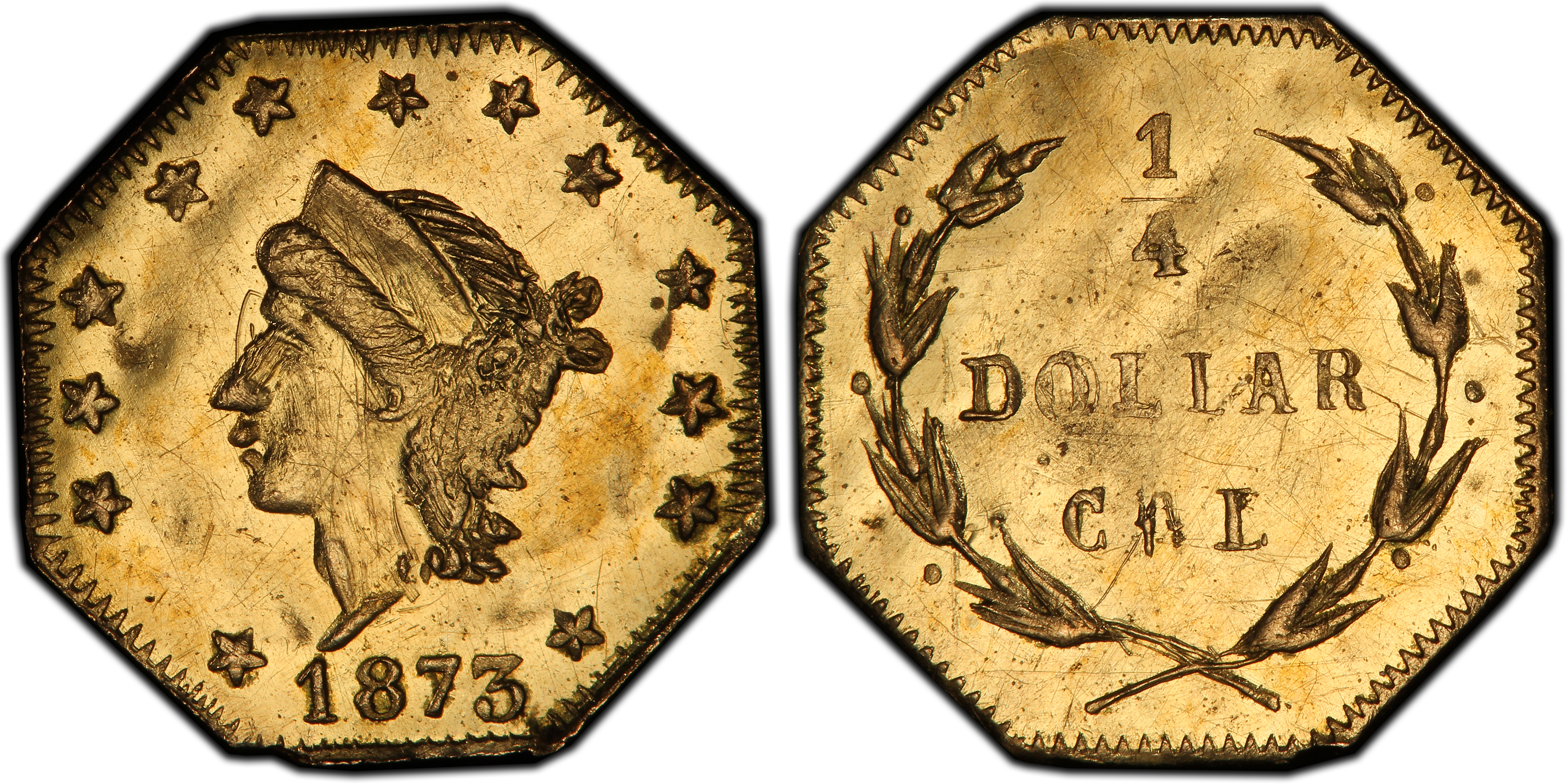
Obverse & Reverse
The 1873 BG-772 25 Cents represents a fascinating chapter in the evolution of California's privately issued gold coinage. By 1873, the original impetus for these tiny coins—a severe shortage of small-denomination circulating money during the Gold Rush—had long since passed. The San Francisco Mint, operating since 1854, was producing ample quantities of official federal silver and gold coinage, satisfying the needs of daily commerce. Consequently, the production of fractional gold pieces had transitioned from a utilitarian necessity to a profitable souvenir and jewelry trade. These 'Period Two' issues (1858-1882), as cataloged by Walter Breen and Ronald Gillio, were primarily created by San Francisco jewelers to sell to tourists and locals as mementos of the Golden State and the romanticized Gold Rush era. These pieces were often significantly underweight and of lower fineness compared to their 'Period One' predecessors, a fact that was of little concern to buyers who prized them as keepsakes rather than currency. The Coinage Act of 1864 had technically made such private minting illegal, but enforcement was lax in California for many years, allowing the trade to flourish. Production of fractional gold actually increased in the 1870s. However, the tide was turning. The Coinage Act of 1873, while primarily known for demonetizing silver (the 'Crime of '73'), signaled a broader federal effort to standardize and control the nation's currency. This renewed focus eventually led James J. Brooks, Chief of the Secret Service, to crack down on the production of private gold pieces, viewing them as a potential source of fraud. By 1883, federal pressure had effectively shuttered the remaining manufacturers, bringing the era of California Fractional Gold to a close. The BG-772, therefore, was struck during the zenith of the souvenir period, just before the industry's final decline, and stands as a tangible link to San Francisco's vibrant post-Gold Rush economy and burgeoning tourism.
Associated EventCalifornia Gold Rush Aftermath & Souvenir Trade
Reason For MintingPrimarily struck for use as souvenirs, jewelry, and keepsakes for tourists and residents of California.
Minter HistoryThe specific minter of the BG-772 variety is unknown, which is characteristic of many 'Period Two' California Fractional Gold pieces. These were often produced anonymously by various jewelers centered in San Francisco who capitalized on the demand for Gold Rush souvenirs. Unlike the earlier Period One minters who sometimes identified their work, the makers of these later issues were less concerned with acting as private assayers and more focused on commercial sales of novelties. They operated in a legal gray area and produced a wide variety of designs, often mimicking federal coinage but with their own distinct, and sometimes crude, artistry.
Historical SignificanceThe BG-772 is significant not as a circulating coin, but as a cultural and economic artifact of its time. It represents the commercialization of the Gold Rush legacy and the growth of tourism in California. Its existence highlights a period when private manufacturing of coin-like objects continued despite federal laws, showcasing the unique economic conditions of the American West. Numismatically, it is one of over 450 distinct varieties, illustrating the diverse and competitive nature of the private jewelers' market in 1870s San Francisco.
N/A
Denomination25 Cents
Minting Period1873
Assayer/MinterUnknown Private Jeweler
Geographic OriginSan Francisco, California
Obverse DescriptionA head of Liberty facing left, with LIBERTY inscribed on her coronet. Her hair is tied in the back with some curls flowing down her neck. The portrait is surrounded by 13 six-pointed stars, representing the original colonies. The date, 1873, is positioned below the bust truncation.
Obverse Inscription1873
Reverse DescriptionThe denomination '1/4 DOLLAR' is enclosed within a wreath. The wreath is composed of two branches tied together at the bottom with a bow. The design is octagonal in shape.
Reverse Inscription1/4 DOLLAR
CompositionGold
Stated Fineness Actual FinenessVariable, but generally lower than the .900 fineness of federal gold coinage of the era.
EdgePlain
Unknown
Survival Estimate13-18 known (per Breen-Gillio rarity scale)
Rarity ScaleHigh R-6
The BG-772 is sought by specialists in the extensive and popular California Fractional Gold series. Its appeal lies in its defined rarity (High R-6), classic octagonal shape reminiscent of the larger pioneer slugs, and its status as a genuine 'Period Two' issue. Completing a set of all Breen-Gillio varieties is a monumental task, making any scarce variety like this highly desirable.
Key VarietiesThe BG-772 itself is a specific die marriage. Within the broader 1873 series of 25-cent pieces, there are multiple other Breen-Gillio varieties (e.g., BG-727, BG-728, BG-811, BG-874) with differences in design, shape (round vs. octagonal), and die characteristics. No special collector restrikes or patterns are known for this specific variety.
Authentication TipsGenuine Period Two pieces like the BG-772 must bear a denomination (e.g., 'DOLLAR' or 'CENTS'); pieces marked 'CAL GOLD' without a denomination are typically later tokens or charms. The reverse should not feature a bear, which is a common motif on modern replicas. The strike is often somewhat crude, but the details should be reasonably distinct, not mushy or cast-looking. Weight can be a key indicator; genuine pieces are very light, but many contemporary counterfeits are made of gilt base metal and may feel even lighter or have an incorrect specific gravity. Comparing die markers to known genuine examples is the most reliable method of authentication.
Shopping ConsiderationsA premium quality BG-772 will exhibit a sharp strike for the issue, with full details on Liberty's hair and the wreath's leaves. Look for examples with original, lustrous surfaces, often displaying a slightly reddish or greenish-gold hue. Many surviving pieces have been cleaned or damaged due to their use in jewelry; avoid examples with obvious scratches, rim dings, or evidence of being mounted. A smooth, attractive surface free of distracting marks is paramount. Given their small size, even minor imperfections are magnified. Prooflike (PL) or Deep Mirror Prooflike (DMPL) surfaces are sometimes encountered on Period Two fractionals and command a significant premium.
A coin's grade is its condition, rated on a 1-70 scale. For rare coins, this is the most critical factor in determining value, as a tiny difference in preservation can mean a huge difference in price.
Relevant Grade TypesOriginal 1873 BG-772 coins were business strikes, although intended as souvenirs rather than for circulation. They are found in Circulated grades (1-58) but are more commonly seen and collected in Mint State (MS, 60-70) grades. Due to their purpose, many were preserved in high grade. No official Proofs were struck during the original period of issue, and no later-date Proof restrikes are known to exist for this specific variety.
Mint State CharacteristicsUncirculated examples of BG-772 often exhibit a soft, satiny luster, though some possess reflective, prooflike fields. Strike quality varies; a typical piece may show some weakness on the highest points, such as the stars on the obverse or the bow on the reverse. The fields are prone to tiny planchet flaws or light adjustment marks, which are common for privately-produced issues. High-end MS examples will have a strong strike, vibrant luster, and minimal contact marks.
Circulated Wear PatternsFor circulated examples, wear first appears on the high points of Liberty's hair, cheek, and the coronet. On the reverse, the highest points of the wreath's leaves and the loops of the bow will show the first signs of friction and flattening. In lower grades (VF and below), the stars and date will begin to lose their sharpness, and the finer details of the wreath will merge.
Key Factors For ValueThe primary value driver for a BG-772 is its certified grade and surface quality. An example with original, uncleaned surfaces commands a significant premium over a cleaned or polished coin of the same grade. Strike sharpness is critical; a fully struck specimen is far more desirable than a weakly struck one. Eye appeal, including attractive original toning and any prooflike contrast, adds to the value. Finally, certification by a top-tier grading service (PCGS or NGC) is essential for market acceptance and value realization. A CAC sticker for this issue would indicate superior quality for the grade and would bring a strong premium.
PCGS Price Guide
| Grade | Price | Population |
|---|---|---|
| 55 | N/A | 1 |
| 58 | $450.00 | 2 |
| 58+ | $480.00 | N/A |
| 60 | $525.00 | N/A |
| 61 | $600.00 | 2 |
| 62 | $800.00 | 3 |
| 62+ | $900.00 | N/A |
| 63 | $1,175.00 | 3 |
| 63+ | $1,350.00 | N/A |
| 64 | $1,650.00 | 3 |