1871 G25C BG-766 (Regular Strike)
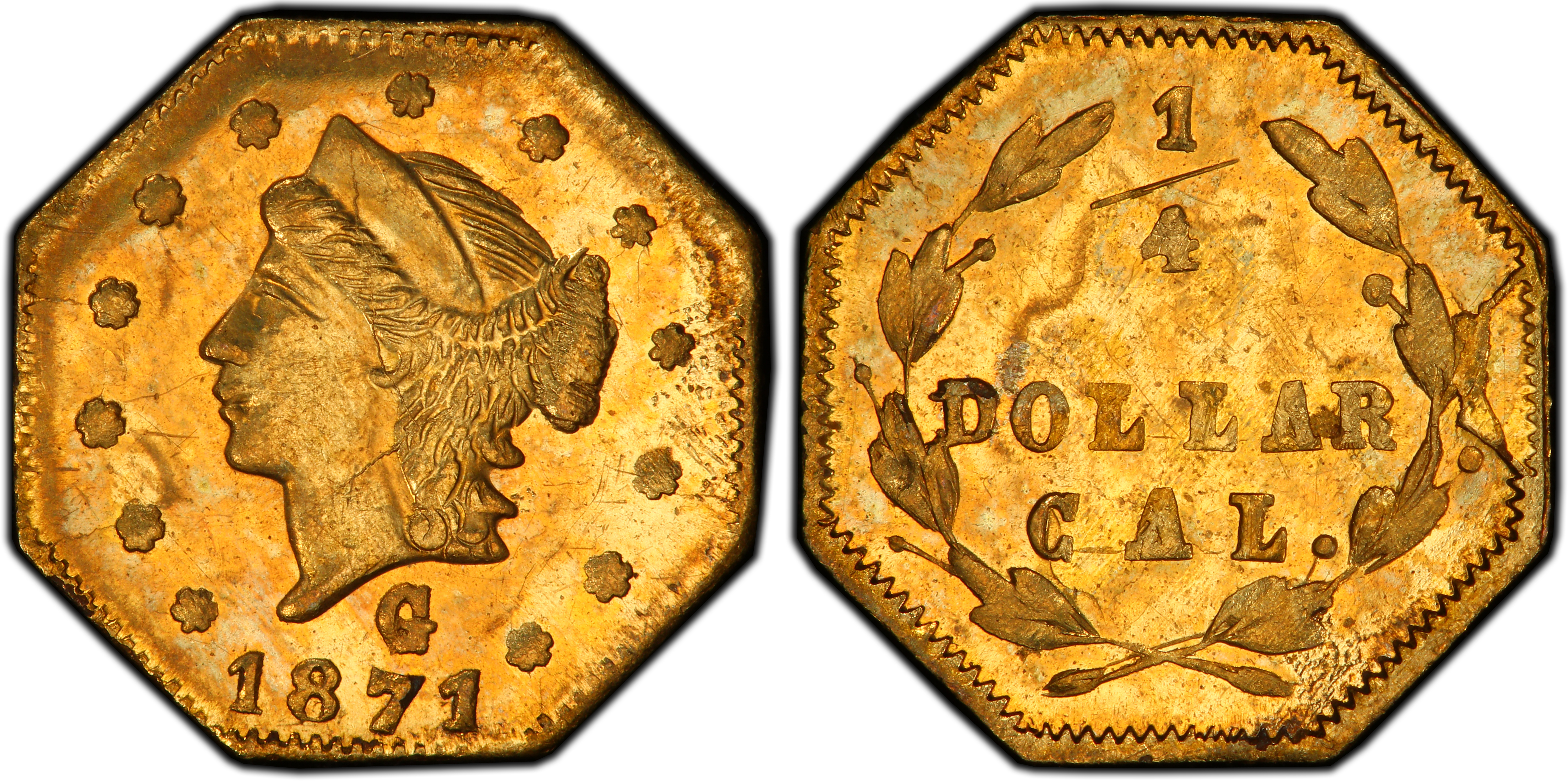
Obverse & Reverse
The 1871 G25C BG-766 is a product of the second period of California's private gold coinage, a fascinating era that followed the initial chaos of the Gold Rush. By the 1870s, the acute shortage of small change that prompted the earliest 'Period One' issues (1852-1856) had largely been resolved by the full-scale operation of the San Francisco Mint. However, a robust market persisted for miniature gold coins, driven now by a different demand: souvenirs and keepsakes. San Francisco jewelers, leveraging their metallurgical skills, stepped in to fill this niche. These 'Period Two' pieces, often called 'jeweler's issues,' were not primarily intended to function as circulating currency but were eagerly purchased by tourists, miners sending gifts home, and local citizens as novelty items. Unlike their predecessors, which were accepted in commerce despite often being underweight, these later issues were understood to be tokens whose value lay more in their charm and material than their stated denomination. The Act of 1864 had prohibited private coinage, but enforcement was lax, and production continued by backdating coins or omitting the word 'dollar.' The BG-766, struck in 1871, falls squarely into this category. It was produced by Robert B. Gray & Co., a prominent San Francisco jewelry firm that had acquired the business and equipment of another fractional gold producer, Antoine Nouizillet, in the late 1850s. Gray's issues are noted for being of generally higher quality and weight than many of their contemporaries. Nonetheless, these tiny, octagonal gold pieces represent the sunset of a uniquely Californian numismatic tradition, transitioning from a practical solution to a commercial enterprise catering to nostalgia for the now-legendary Gold Rush.
Associated EventPost-Gold Rush California Commerce
Reason For MintingPrimarily created to satisfy a burgeoning market for souvenirs and novelty items, rather than to alleviate a shortage of circulating small change.
Minter HistoryRobert B. Gray & Co. was a significant San Francisco jewelry concern that became a key producer of 'Period Two' California fractional gold. In late 1858 or 1859, Gray purchased the business of Antoine Louis Nouizillet, one of the earlier private minters, acquiring his dies, hubs, and punches. After a period of using Nouizillet's old equipment, Gray introduced new obverse dies in 1870, prominently featuring his initial 'G' as a hallmark between the date and Liberty's portrait. Gray's coinage is generally regarded by numismatists as being of higher intrinsic value and better workmanship than many other jeweler's issues of the period.
Historical SignificanceThe BG-766 is significant not as a coin of commerce, but as a cultural artifact representing the commercialization of the Gold Rush legend. It embodies the transition of fractional gold from a necessity of a specie-starved frontier economy to a desirable memento for a growing tourist trade and a settled populace, serving as a tangible link to the romanticism of the '49er era.
N/A
Denomination25 Cents
Minting Period1871
Assayer/MinterRobert B. Gray & Co.
Geographic OriginSan Francisco, California
Obverse DescriptionA beaded border encloses a Liberty Head facing left, her hair tied in a bun. The legend 'CALIFORNIA GOLD' is typically above, with the date '1871' below. On varieties from this minter, the initial 'G' for Gray is located in the field, usually between the date and the portrait. Thirteen stars encircle the central device.
Obverse InscriptionCALIFORNIA GOLD 1871
Reverse DescriptionA simple beaded border surrounds a wreath composed of two branches tied with a ribbon at the bottom. The denomination '1/4' is in the center.
Reverse Inscription1/4
CompositionGold
Stated Fineness Actual FinenessVariable, typically around .800 to .900 fine.
Weight0.24 grams
Diameter9.60 mm
EdgePlain
Unknown
Survival EstimateFewer than 15 known
Rarity ScaleHigh R-7
The BG-766 is highly sought after due to its extreme rarity (High R-7), octagonal shape, and association with the well-regarded minter Robert B. Gray. It appeals to specialists in the vast and complex series of California fractional gold who appreciate the challenge of acquiring such elusive varieties.
Key VarietiesThe primary variety is the regular business strike. No proof or special presentation strikings from the period of issue are known to exist for this Breen-Gillio number. Collecting focuses on die states and minor die markers that distinguish it from similar varieties by the same maker, such as BG-765.
Authentication TipsGenuine pieces are die-struck, not cast, and should exhibit sharp details under magnification, especially in the hair and stars. The fabric should be thin and lightweight. The 'G' mintmark should match known genuine examples from Robert B. Gray. Surface texture should be consistent with period originals, often showing a soft, satiny luster, not the granular or overly brilliant surfaces of modern fakes. Many replicas are gold-plated and will show base metal on points of wear or may have incorrect design details, such as a bear on the reverse, which is not found on genuine 19th-century issues.
Shopping ConsiderationsFor a premium quality BG-766, a potential buyer should seek an example with a sharp, well-centered strike on both obverse and reverse. Given the small size, even minor planchet flaws or strike weakness can be distracting. Look for original, uncleaned surfaces with some remaining mint luster. High points on Liberty's hair and the wreath on the reverse should show minimal friction. Avoid specimens that are holed, bent, or show signs of being mounted in jewelry, as was common for these pieces. Certification by PCGS or NGC is highly recommended for a coin of this rarity and value to ensure authenticity and accurate grading.
A coin's grade is its condition, rated on a 1-70 scale. For rare coins, this is the most critical factor in determining value, as a tiny difference in preservation can mean a huge difference in price.
Relevant Grade TypesOriginal issues were business strikes intended for sale as souvenirs, not circulation, so they are found in both Circulated (1-58) and, more commonly for this type, Mint State (MS, 60-70) grades. High-grade circulated examples exist, likely from brief pocket carry. No Proof (PR/PF) examples were struck during the original period of issue, and no later restrikes are known.
Mint State CharacteristicsAn uncirculated BG-766 is defined by the presence of original mint luster. The quality of this luster can range from frosty to semi-prooflike. Strike quality varies, but a premium MS example will show strong definition on the individual hair strands and the stars. As these were made by a jeweler, the overall quality can be high. Small planchet flaws or adjustment marks are not uncommon and should be evaluated for their impact on eye appeal. Contact marks, even small ones, can be significant on such a tiny canvas and will dictate the numerical grade.
Circulated Wear PatternsWear first appears on the highest points of the design: Liberty's cheek, the hair above her ear, and the coronet. On the reverse, the high points of the wreath's leaves and the ribbon bow will show the first signs of friction. As wear progresses, the finer details of the hair will merge, and the stars will begin to lose their sharpness. In lower grades (VF and below), the date and legends can become weak.
Key Factors For ValueRarity is the paramount factor for BG-766. Beyond that, a sharp strike is critical, as many fractional pieces are softly struck. Surface preservation is next; an example with clean, original surfaces and attractive luster will command a significant premium over one that has been harshly cleaned, polished, or damaged. Eye appeal, encompassing toning and overall visual harmony, is also a key consideration. Given the prevalence of counterfeits in this series, third-party certification from a top-tier service like PCGS or NGC is nearly essential for market acceptance and realizing the coin's full value.
PCGS Price Guide
| Grade | Price | Population |
|---|---|---|
| 60 | $2,250.00 | N/A |
| 61 | $2,500.00 | N/A |
| 62 | $2,750.00 | 2 |
| 62+ | $3,000.00 | N/A |
| 63 | $3,500.00 | 3 |
| 63+ | $4,000.00 | N/A |
| 64 | $5,500.00 | 1 |