1880/70 25C BG-799H (Regular Strike)
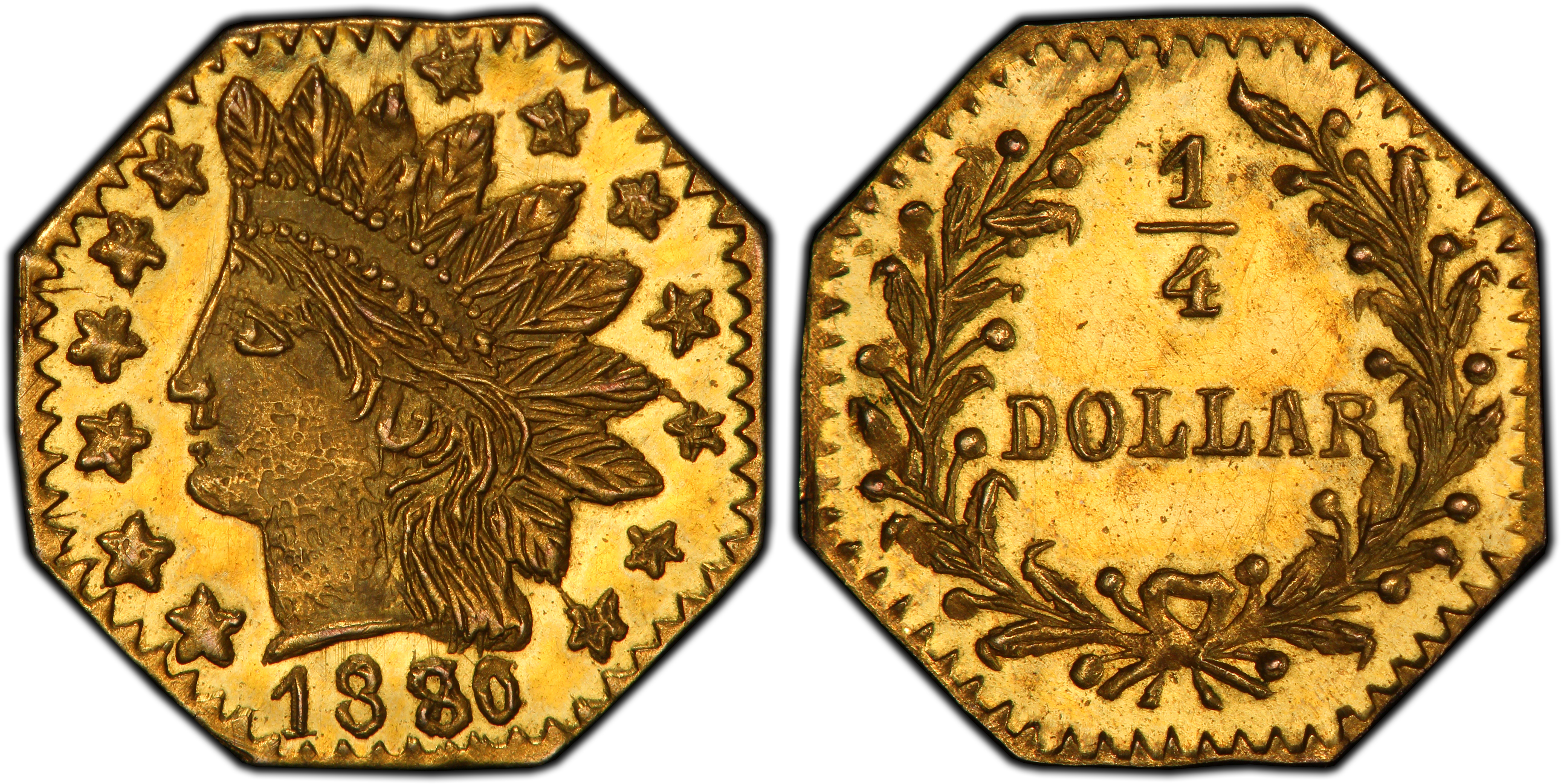
Obverse & Reverse
The 1880/70 25C BG-799H is a fascinating product of the second period of California Fractional Gold production (1859-1882), often termed the 'Jeweler's Issue' era. By this time, the acute shortage of small change that characterized the Gold Rush's peak had been largely resolved by the output of the U.S. Mint in San Francisco. The impetus for producing these miniature gold pieces had shifted from commercial necessity to commercial novelty. San Francisco jewelers, many of German or French origin, recognized a burgeoning market for these tiny gold coins as souvenirs, keepsakes, and jewelry items for a populace still captivated by the romance of the Gold Rush and for tourists visiting the West. The Coinage Act of 1864 had officially prohibited private coinage, but enforcement was lax, allowing this cottage industry to flourish for nearly two more decades until a federal crackdown in 1883. This specific variety, BG-799H, is an overdate, created by re-punching an 1880 date over a die from 1870, likely as an act of thrift by the die sinker. This piece is attributed to Christoph Mohrig, a German-born jeweler and diesinker active in San Francisco. A particularly telling feature of this variety is its 'No CAL' reverse, indicating it was specifically intended for sale to the broader national market in the East and Midwest, where the allure of California gold was strong but the legal nuances of state-specific coinage were less relevant. An anecdote in the Breen-Gillio reference mentions one such piece being taken back to Sweden by a returning native in 1890, confirming their role as traveler's mementos. Their production quality was often high, with many struck on polished planchets to enhance their appeal as novelties, resulting in the survival of many high-grade and prooflike specimens. These pieces were never intended to satisfy a monetary need but instead capitalized on the enduring mystique of the California Gold Rush, making them tangible links to the era's cultural and economic legacy.
Associated EventPost-Gold Rush Souvenir Market
Reason For MintingPrimarily created as souvenirs and novelty items for the jewelry and tourist trade, not for general circulation.
Minter HistoryChristoph Mohrig was a German-born diesinker and jeweler who was active in San Francisco during the latter period of fractional gold production. He is noted for producing a number of 'Jeweler's Issues' in the 1870s and early 1880s. His work is characteristic of the period, often featuring popular motifs like the Indian Head and struck with a focus on aesthetic appeal rather than intrinsic value. The 'No CAL' reverse seen on BG-799H is a known diagnostic of issues he produced for a market outside of California.
Historical SignificanceThis coin is significant not as a circulating medium of exchange, but as a representation of the commercialization of the Gold Rush legacy. It demonstrates the shift from utilitarian private coinage to souvenir production and highlights the national fascination with California's gold. The overdate feature offers insight into the frugal practices of private diesinkers, while the 'No CAL' reverse provides evidence of a targeted, national marketing strategy for these numismatic novelties.
BG-799H
Denomination25C
Minting Period1880
Assayer/MinterChristoph Mohrig
Geographic OriginSan Francisco, California
Obverse DescriptionAn octagonal planchet featuring a Native American female portrait facing left, often referred to as an 'Indian Head'. The portrait is adorned with a feathered headdress. Thirteen stars encircle the portrait along the angled rims. The date, 1880, is below the bust. On this variety, clear remnants of the underlying '70' from the original 1870 die are visible under magnification, most prominently within the final two digits of the date.
Obverse Inscription[None, design features only]
Reverse DescriptionA simple wreath composed of two branches tied at the bottom with a bow. Inside the wreath is the denomination '1/4'. Uniquely, this variety is known as a 'No CAL' reverse, as the typical 'CALIFORNIA GOLD' legend is absent, reflecting its intended market outside the state.
Reverse Inscription1/4
CompositionGold
Stated Fineness Actual FinenessVariable, typically between .500 and .750 fine for this period.
EdgePlain
Unknown
Survival EstimateFewer than 30
Rarity ScaleHigh R-6
The 1880/70 BG-799H appeals to advanced specialists due to its combination of features: it is a clear overdate, it is from a known minter (Mohrig), and it possesses the scarce and historically interesting 'No CAL' reverse. High-grade examples often exhibit deeply mirrored prooflike surfaces, making them visually stunning despite their small size. It represents a specific, targeted phase of the late-period fractional gold market.
Key VarietiesThe primary variety is the Regular Strike. A Prooflike (PL) or Deep Mirror Prooflike (DMPL/DMPL) designation is a key variation sought by collectors, representing coins struck on highly polished planchets. There are no known later-date restrikes or patterns associated with this specific Breen-Gillio number.
Authentication TipsAuthentication requires careful examination of the overdate; traces of the underlying '7' should be visible within the '8' and the '0' within the final '0'. The strike style should be consistent with known Christoph Mohrig issues. Genuine pieces have a sharp, wire-rim appearance. Counterfeits are common in this series but often have a soapy, cast look, incorrect weight, or feature a bear on the reverse, a design element never used on authentic 19th-century issues. Reference against a known genuine example in the Breen-Gillio guide or from major auction archives is essential.
Shopping ConsiderationsA premium quality example for this variety is defined by a sharp, full strike, particularly on the feathers of the headdress and the details of the wreath. The most desirable pieces will have deep, watery, jet-black mirrored fields, often earning a DMPL designation. As these were souvenir items, circulation wear is less common than handling marks; inspect carefully for minute scratches, rim bumps, or evidence of having been mounted in jewelry. Original, unmolested surfaces are paramount. Avoid examples that have been harshly cleaned or polished, as this destroys the fragile prooflike surfaces and drastically reduces value.
A coin's grade is its condition, rated on a 1-70 scale. For rare coins, this is the most critical factor in determining value, as a tiny difference in preservation can mean a huge difference in price.
Relevant Grade TypesOriginal period issues of this variety were business strikes, although many were struck on polished planchets to appeal to collectors and tourists, resulting in Prooflike (PL) and Deep Mirror Prooflike (DMPL) examples. They are found in Circulated grades (1-58), though this is uncommon, and more frequently in Mint State (MS, 60-70) grades. No true Proofs were struck during the original period of issue, and there are no known later-date Proof restrikes.
Mint State CharacteristicsUncirculated examples are judged on the quality of their strike, luster, and surface preservation. Strikes can be uneven due to the crude hammer-striking process, with weakness sometimes seen on the highest points of the feathers or the bow on the reverse. The luster on standard strikes is typically satiny. On PL/DMPL examples, the key is the clarity and depth of reflection in the fields, contrasted with the frosty texture of the design elements. Small planchet flaws or contact marks are common and should be evaluated carefully; even a single distracting mark on the cheek or in the mirrored fields can significantly impact the grade and eye appeal.
Circulated Wear PatternsFor the rare circulated examples, wear first appears on the highest points of the design. On the obverse, friction will first dull the luster on the cheek, the eyebrow, and the highest feathers of the headdress. On the reverse, the high points of the bow and the leaves in the wreath will show initial wear. In lower grades (VF and below), the fine details of the feathers will begin to merge and the stars will lose their sharpness.
Key Factors For ValueThe single most important factor for this issue is surface quality, specifically the depth and flawlessness of the mirrored fields on PL/DMPL specimens. A high-grade (MS65 or better) DMPL example will command a massive premium over a standard Mint State coin. The second key factor is the strength and completeness of the strike. Eye appeal is critical; coins with clean, reflective surfaces and strong frost are highly prized. A CAC sticker carries a significant premium, as it confirms the quality for the assigned grade, which is especially important when evaluating subjective attributes like the depth of mirror.
PCGS Price Guide
| Grade | Price | Population |
|---|---|---|
| 62 | $615.00 | 2 |
| 62+ | $650.00 | N/A |
| 63 | $750.00 | 6 |
| 63+ | $800.00 | N/A |
| 64 | $900.00 | 5 |
| 64+ | $1,100.00 | N/A |
| 65 | $1,850.00 | 2 |
| 66 | N/A | N/A |