1876 G25C BG-785 (Regular Strike)
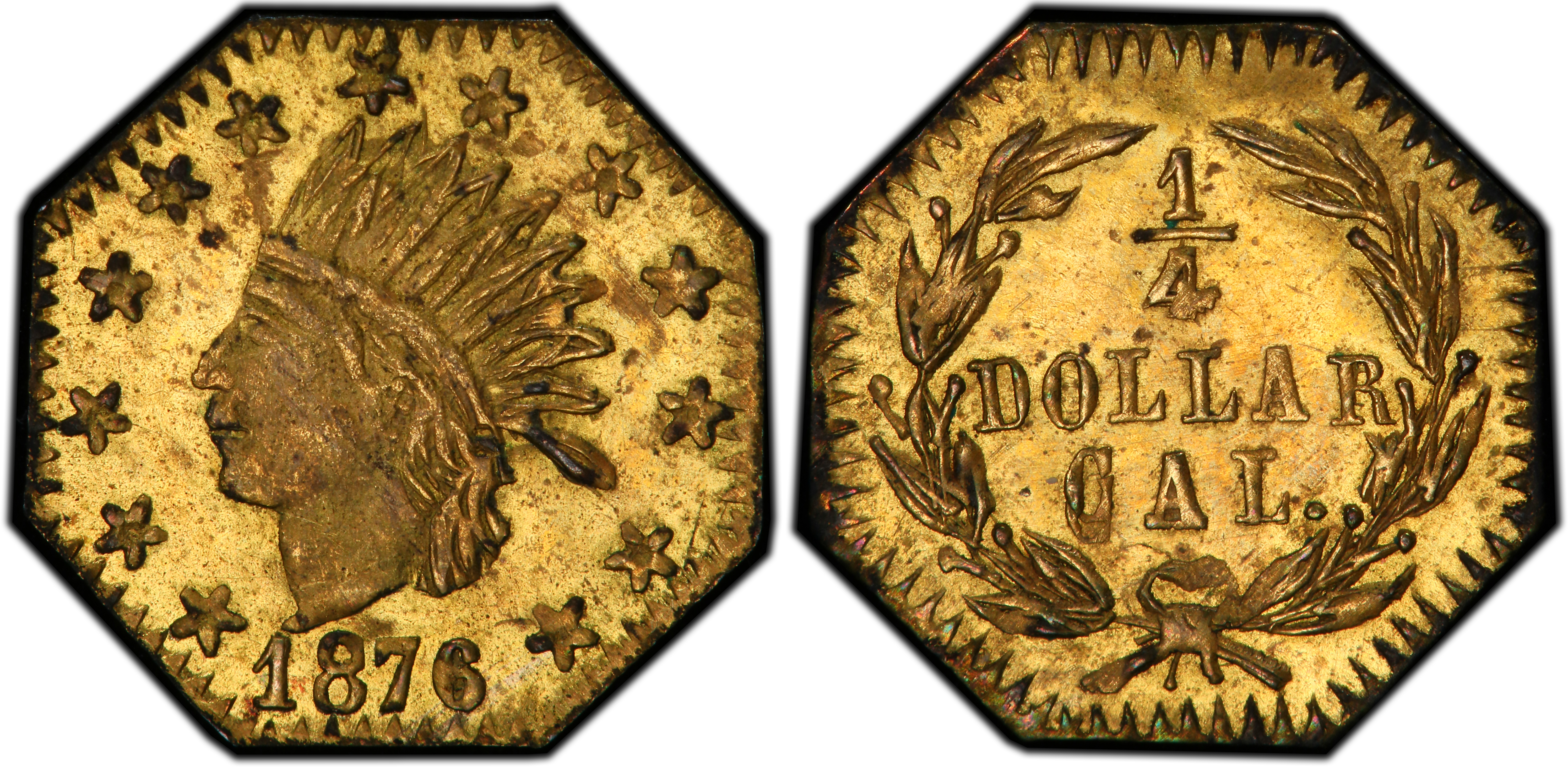
Obverse & Reverse
The 1876 BG-785 25 Cent gold piece emerges from the second great period of California's private minting history, a time when the nature of these miniature gold coins had fundamentally shifted. The initial wave (Period One, 1852-1857) was born of dire necessity, a response to a crippling shortage of small change in the gold fields where gold dust was an impractical medium for minor transactions. By the 1870s, however, the landscape had changed. The San Francisco Mint, operating since 1854, had largely resolved the coinage crisis. Yet, the allure of California gold, particularly for tourists and those back East, remained potent. This demand created a new market, not for circulating currency, but for souvenirs and keepsakes. San Francisco jewelers, many of whom remain anonymous to history, stepped in to fill this niche. The BG-785 is a quintessential example of these 'Period Two' or 'jeweler's issues.' Struck in 1876, the year of the nation's Centennial Exposition in Philadelphia, it would have been a popular memento. Unlike their Period One predecessors, which often attempted to approximate the intrinsic value of their stated denomination, these later issues were known to be significantly underweight and of variable fineness, their value resting in their novelty rather than their metallic content. The United States government took a dim view of private coinage, and the Coinage Act of 1864 expressly forbade it. However, enforcement was lax for many years. It wasn't until a zealous Secret Service crackdown in 1883 that the production of denominated fractional gold was finally extinguished. The BG-785, therefore, represents one of the last iterations of a uniquely American phenomenon, a tangible link to the fading romance of the Gold Rush, produced in its final, commercially-driven phase before federal law closed this chapter of numismatic history.
Associated EventCalifornia Gold Rush (Later Souvenir Period)
Reason For MintingPrimarily produced to be sold as souvenirs and keepsakes for tourists and collectors, capitalizing on the romanticism of the California Gold Rush.
Minter HistoryThe specific minter for the BG-785 variety is unknown, which is characteristic of many 'Period Two' issues. These coins were produced by various jewelers and private manufacturers in San Francisco who often did not apply a maker's mark. Their business was in creating popular and affordable gold novelties rather than establishing a reputation as a formal assaying or minting firm. Common die punches and design elements were often shared or sold among these anonymous producers.
Historical SignificanceThis coin is significant not as a medium of exchange, but as a historical artifact representing the commercialization of the Gold Rush legacy. It marks the transition of fractional gold from a necessary form of currency to a popular souvenir item, produced in the twilight years of private minting before federal enforcement ended the practice.
Not Applicable
Denomination25 Cents
Minting Period1876
Assayer/MinterUnknown Private Minter
Geographic OriginSan Francisco, California
Obverse DescriptionThe obverse features a stylized head of a Native American princess facing left, often referred to as an 'Indian Head.' The portrait is typically simple, with feathered headdress. The field is plain, and the design is enclosed by the eight sides of the octagonal planchet.
Obverse InscriptionNo inscription.
Reverse DescriptionThe reverse is dominated by the denomination '1/4 DOLLAR' and the date '1876' contained within a wreath of leaves and berries. The wreath is open at the top.
Reverse Inscription1/4 DOLLAR 1876
CompositionGold
Stated Fineness Actual FinenessVariable, but generally lower than monetary-issue gold.
EdgePlain
Unknown
Survival Estimate31-75 (per R-5+ rating)
Rarity ScaleR-5+
The BG-785 is sought after for its distinctive octagonal shape, Indian Head design, and its status as a scarce 'Period Two' fractional gold piece. It appeals to specialists in the Cal Gold series and collectors of U.S. private and territorial coinage who appreciate its historical context as a Gold Rush souvenir.
Key VarietiesThe primary reference, 'California Pioneer Fractional Gold' by Breen and Gillio, does not list major die varieties for the BG-785 in its regular production. As a 'Period Two' issue created primarily for sale to the public, there are no known patterns, trial pieces, or official restrikes. All known examples are considered business strikes, though some possess prooflike surfaces from being struck with polished dies.
Authentication TipsAuthentic examples often exhibit a somewhat crude, handmade quality. The strike can be uneven, with some softness in the details of the Indian's hair or the wreath on the reverse. The gold color can vary due to alloy differences. Counterfeits are common in this series; many are gold-plated base metal and feel lighter than expected. Others are modern gold copies that may appear too perfect or have a soapy, artificial luster. Authentication by a major grading service (PCGS or NGC) is highly recommended, as they attribute the specific BG number.
Shopping ConsiderationsA premium quality example for its grade will display a sharp, well-centered strike, especially on the high points of the headdress and the numbers in the date. Original, lustrous surfaces are highly desirable and command significant premiums; many surviving examples have been cleaned or used in jewelry, issues which should be identified and avoided. Look for coins with attractive, undisturbed 'skin' and a deep, prooflike reflectivity in the fields, which is occasionally seen on this variety and is prized by collectors. Check for evidence of being previously mounted in jewelry, such as rim filing or solder remnants.
A coin's grade is its condition, rated on a 1-70 scale. For rare coins, this is the most critical factor in determining value, as a tiny difference in preservation can mean a huge difference in price.
Relevant Grade TypesOriginal period issues were business strikes, though not intended for circulation, and are found in both Circulated (1-58) and Mint State (MS, 60-70) grades. Despite their souvenir nature, some pieces saw minor handling, resulting in circulated examples. No true Proofs were struck during the original period. However, some Mint State examples were struck using polished dies on polished planchets, resulting in a deeply mirrored, prooflike (PL) or deep mirror prooflike (DMPL) appearance, which are highly coveted and carry a separate designation.
Mint State CharacteristicsUncirculated examples of BG-785 are characterized by their mint luster, which can range from satiny to deeply prooflike. Strike quality varies; many pieces are softly struck on the highest points of the Indian's hair and the leaves of the wreath. Due to the primitive minting process, planchet quality can be inconsistent, with minor striations or adjustment marks sometimes visible. Contact marks, even on high-grade pieces, are common due to the softness of the gold and the way these tiny coins were handled in bulk.
Circulated Wear PatternsWear first appears on the high points of the design. On the obverse, check the cheek and the details of the feathers in the headdress. On the reverse, the highest points of the wreath and the digits of the date will show the first signs of friction. In lower grades (VF and below), the finer details of the hair and wreath will merge, and the legends will become soft.
Key Factors For ValueThe primary drivers of value for an 1876 BG-785 are grade and surface quality. An example with original, uncleaned surfaces will always be worth more than a cleaned one of the same grade. Strike sharpness is critical; a fully struck piece with all details present is rare and commands a premium. Eye appeal is paramount for this issue; coins with deep, prooflike, reflective fields and a beautiful, original reddish-gold color are the most desirable. A CAC sticker for this issue indicates premium quality for the grade and typically results in a significantly higher market value.
PCGS Price Guide
| Grade | Price | Population |
|---|---|---|
| 50 | $200.00 | N/A |
| 50+ | $205.00 | N/A |
| 53 | $210.00 | N/A |
| 53+ | $215.00 | N/A |
| 55 | $220.00 | N/A |
| 55+ | $225.00 | N/A |
| 58 | $235.00 | 2 |
| 58+ | $240.00 | N/A |
| 60 | $250.00 | N/A |
| 61 | $300.00 | 1 |
| 62 | $400.00 | 6 |
| 62+ | $425.00 | N/A |
| 63 | $475.00 | 9 |
| 63+ | $525.00 | N/A |
| 64 | $700.00 | 8 |
| 64+ | $825.00 | N/A |
| 65 | $1,100.00 | 4 |
| 65+ | $1,250.00 | N/A |
| 66 | $2,000.00 | N/A |
| 66+ | $3,000.00 | N/A |
| 67 | $5,500.00 | N/A |