1878/6 G25C BG-799G, PL (Regular Strike)
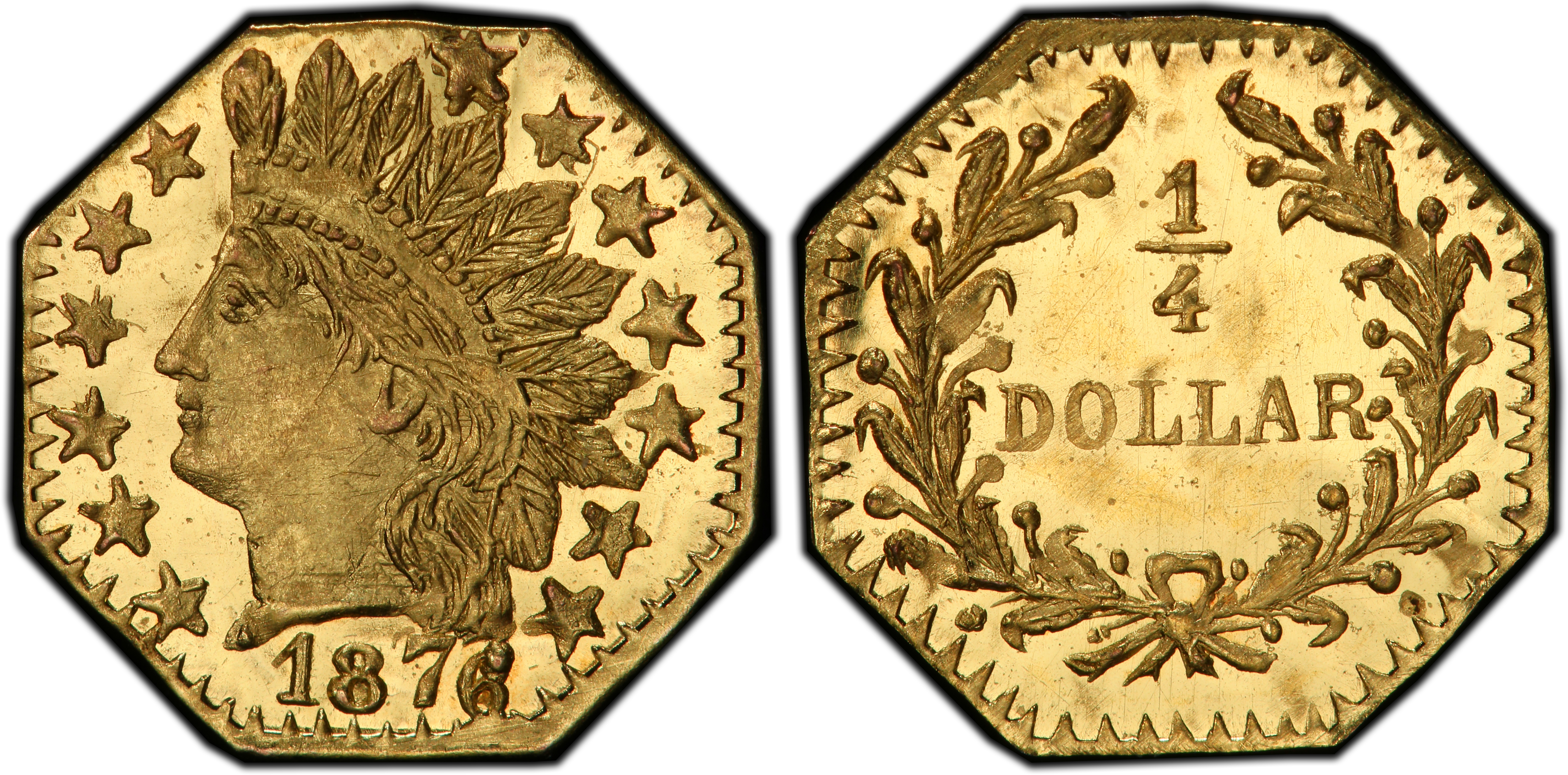
Obverse & Reverse
The 1878/6 BG-799G 25 Cents is a product of the second great era of California Fractional Gold production, often termed 'Period Two' (1859-1882) by numismatists Walter Breen and Ronald J. Gillio. Unlike the 'Period One' issues, which were struck out of genuine commercial necessity to alleviate a shortage of small change during the initial Gold Rush, the Period Two pieces were created in a vastly different socio-economic landscape. By the late 1870s, the San Francisco Mint was in full operation, and the state's economy had matured, with an adequate supply of federal coinage for daily transactions. The reason for minting these tiny gold pieces had shifted from commerce to collectibles. They were primarily 'jeweler's issues,' made by anonymous craftsmen in San Francisco and other cities for sale as souvenirs, keepsakes, and jewelry items to tourists and locals fascinated by the Gold Rush legacy. This context is critical to understanding their physical nature; they were not expected to meet a specific weight or fineness standard and were often significantly underweight for their face value, functioning more as tokens than true coinage. Their production was also legally dubious. The Private Coinage Act of 1864 had explicitly forbidden the creation of private coins. However, enforcement was lax, and the immense popularity of these gold charms ensured their continued production. To circumvent potential legal trouble, minters often used backdated or muled dies, a practice evident in this variety's 1878/6 overdate. The overdate itself tells a story of thrift, where an older 1876 die was repurposed for use in 1878. Secret Service Chief James J. Brooks eventually cracked down on these operations, deeming them a risk for fraud, which led to the cessation of their manufacture by 1883. The BG-799G, therefore, is not a relic of the rugged '49er era but rather a memento of how that era was remembered and commercialized a generation later.
Associated EventPost-Gold Rush California Tourism
Reason For MintingPrimarily created as a souvenir or jewelry item, not for circulation, during a period when the original need for fractional currency had passed.
Minter HistoryThe specific minter of the BG-799G is unknown, a common trait for Period Two issues. The work is attributed to the skilled but anonymous community of San Francisco jewelers who dominated the production of these souvenir tokens after the initial Gold Rush. Unlike Period One minters who sometimes initialed their work, these later producers often remained anonymous to avoid scrutiny under the Private Coinage Act of 1864.
Historical SignificanceThis piece is significant not as a coin used in commerce, but as a tangible link to the romanticism and commercialization of the Gold Rush legend in late 19th-century California. It represents the transition of fractional gold from a necessary form of currency to a popular collectible and souvenir, created in defiance of federal law.
BG-799G
Denomination25 Cents
Minting Period1878
Assayer/MinterUnknown Jeweler
Geographic OriginSan Francisco, California
Obverse DescriptionAn Indian Head motif facing left, wearing a feathered headdress. The portrait is surrounded by thirteen stars representing the original colonies. The prominent 1878/6 overdate is located below the bust.
Obverse Inscription1878/6
Reverse DescriptionThe denomination '25 CENTS' is enclosed within a wreath of leaves and berries. The wreath is open at the top.
Reverse Inscription25 CENTS
CompositionGold
Stated Fineness Actual FinenessVaries, but typically between 14 and 22 karats for Period Two issues.
EdgePlain
Unknown
Survival Estimate46 to 60 known examples.
Rarity ScaleR-5
The BG-799G is highly sought after for its combination of features: it is an interesting overdate (8 over 6), it is an octagonal type, and it is frequently found with attractive, proof-like surfaces. Its defined rarity as an R-5 variety adds to its desirability among specialists in the extensive California Fractional Gold series.
Key VarietiesThe primary variety is the 1878/6 overdate. Within the BG-799 series, there are numerous other die states and dates, but BG-799G is specifically defined by this overdate. No contemporary proof strikings or patterns are known, as these were not official mint products. All known examples are considered 'regular strikes,' though the quality of strike and planchet preparation could vary dramatically, leading to Proof-Like (PL) examples.
Authentication TipsGenuine pieces are typically very thin and lightweight. Counterfeits are often thicker and heavier. Look for the characteristic softness of a genuine gold strike; fakes made of brass are harder and have a different feel and luster. Weakly struck areas are common on genuine specimens, especially on the wreath, whereas modern fakes are often sharply and uniformly struck. The overdate should show clear evidence of the underlying '6' beneath the '8'. Any piece featuring a bear on the reverse is a modern replica and not a genuine 19th-century fractional.
Shopping ConsiderationsFor a premium quality example, a buyer should seek out a specimen with a sharp strike, particularly on the details of the headdress feathers and the digits of the overdate. The 'PL' (Proof-Like) designation, indicating reflective fields, commands a significant premium and is a key determinant of eye appeal for this variety. Luster should be vibrant and unbroken. Common problems include cleaning, which dulls the surfaces and imparts hairline scratches, and previous mounting for use as jewelry, so check rims carefully for evidence of removal. An example with original, undisturbed surfaces and strong proof-like qualities, even with minor contact marks consistent with the assigned grade, would be considered top-tier.
A coin's grade is its condition, rated on a 1-70 scale. For rare coins, this is the most critical factor in determining value, as a tiny difference in preservation can mean a huge difference in price.
Relevant Grade TypesAll original BG-799G pieces are business strikes, though they were not intended for circulation. They are found in both Circulated (1-58, though rare due to their use as souvenirs) and Mint State (MS, 60-70) grades. No true Proofs were struck during the original period. The Proof-Like (PL) designation is a modifier applied to business strikes that exhibit unusually reflective, mirror-like surfaces from being struck with polished dies on polished planchets. This designation is highly relevant and valuable for this specific variety.
Mint State CharacteristicsUncirculated examples are defined by their luster and lack of wear. For the BG-799G, a high-quality MS piece will exhibit frosty luster on the devices (the Indian Head) contrasting with reflective fields if it is proof-like. Strikes are characteristically inconsistent; some softness on the wreath or stars is not uncommon and may not preclude a high grade. Due to the softness of the gold and their handling as keepsakes, even high-grade specimens often show small, scattered contact marks.
Circulated Wear PatternsOn circulated examples, wear first appears on the highest points of the design. For the obverse, this includes the cheek of the Indian Head and the feathers of the headdress. On the reverse, the high points of the wreath leaves and bow will show rubbing and loss of detail first. In lower grades, the stars and legends become progressively faint.
Key Factors For ValueThe single most important factor for this coin's value is the quality of its surfaces. A specimen with deep, original proof-like fields will sell for multiples of a standard mint state piece. Sharpness of the strike, particularly on the overdate and central motifs, is also critical. Eye appeal, which is a combination of luster, strike, and the absence of distracting marks or signs of cleaning, is paramount. A CAC sticker for this issue provides a strong premium, as it confirms both the grade and the superior quality for that grade.
PCGS Price Guide
| Grade | Price | Population |
|---|---|---|
| 66 | $2,250.00 | 1 |