1871 G25C BG-769 (Regular Strike)
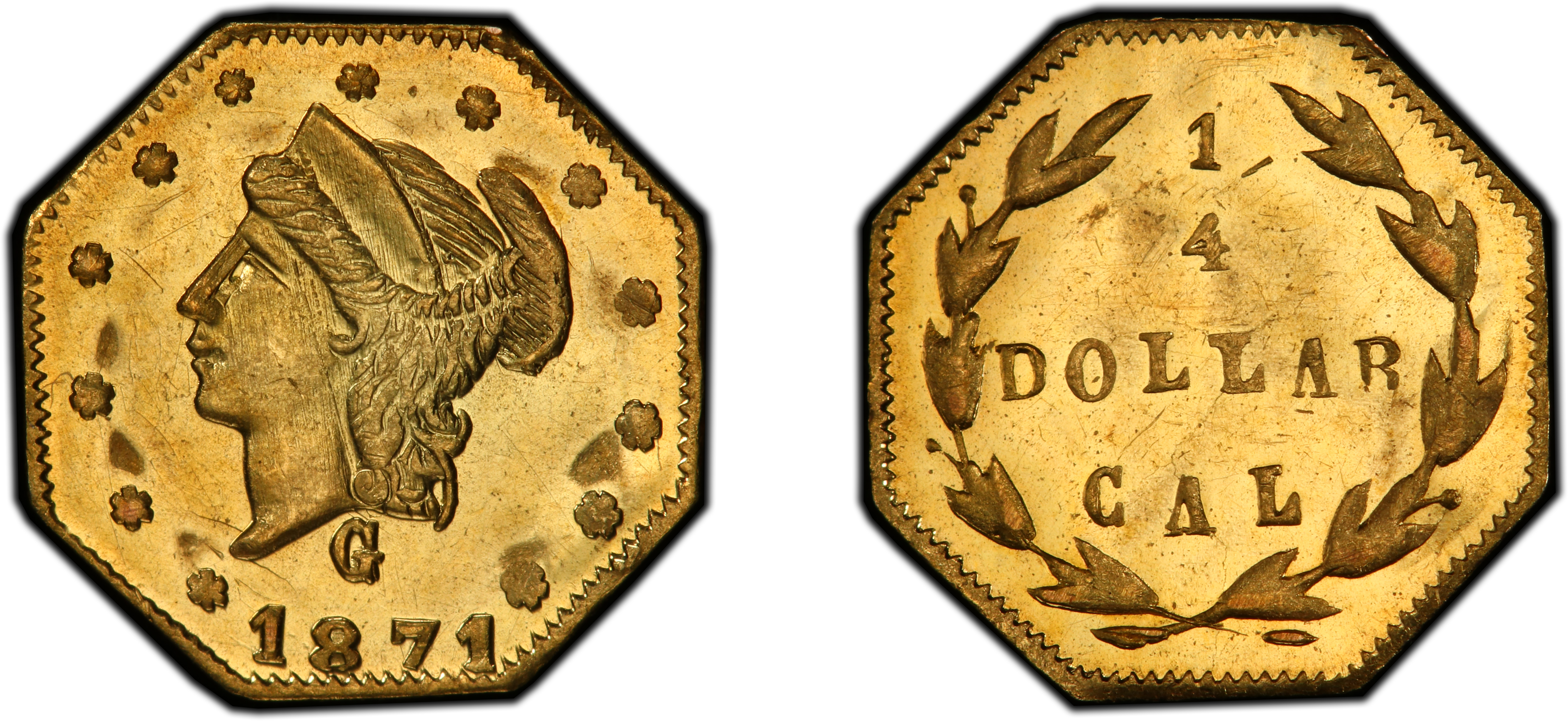
Obverse & Reverse
The 1871 G25C BG-769 is a product of the latter period of private gold coining in California, a fascinating era born out of necessity and entrepreneurial spirit. Following the 1848 gold discovery, the massive influx of population and gold dust created a severe shortage of small-denomination coinage for daily transactions. A pinch of gold dust for a drink was an inaccurate and wasteful system. To fill this monetary void, private jewelers and metallurgists began striking their own coins from native California gold in 1852. These 'California Fractional Gold' pieces, in denominations of 25 cents, 50 cents, and one dollar, became an essential, albeit unofficial, part of the West Coast's economy. By 1871, the landscape had changed significantly. The San Francisco Mint was producing federal coinage, and the Coinage Act of 1864 had explicitly outlawed private currency. However, the law was weakly enforced in the West, and the demand for these convenient gold pieces persisted, particularly as souvenirs and curiosities reflecting the state's gold rush heritage. The coins of this 'Period Two' (1859-1882) were often made for collectors and tourists, characterized by more refined designs and sometimes lower gold content than their Period One predecessors. The BG-769, an octagonal 25-cent piece, is emblematic of this later production. Struck with a classic Liberty Head motif, it echoes federal designs but retains the distinct charm and slightly crude execution of a private issue. These tiny gold coins served as a tangible link to the now-legendary Gold Rush, a memento of an era when California's wealth was transforming the nation. Their continued production, years after being legally prohibited, speaks to a lingering spirit of Western independence and the powerful allure of gold.
Associated EventPost-Gold Rush California Economy
Reason For MintingTo serve as souvenirs and collector items, and to a lesser extent, to satisfy a lingering local demand for small gold currency despite federal prohibition.
Minter HistoryWhile not definitively attributed, the BG-769 variety is stylistically and chronologically consistent with the work of Robert B. Gray & Co. of San Francisco. Gray was a prominent jeweler who became a prolific producer of fractional gold starting in late 1858 or 1859 after purchasing the business of another minter, Antoine Louis Nouzillet. Gray's operation continued well into the 1870s, producing a wide array of octagonal and round pieces. His coins are often identifiable by a small 'G' hallmark, though not all his dies included it. He was a key figure in the second wave of fractional gold production, catering to a market that increasingly viewed these pieces as keepsakes of the golden state.
Historical SignificanceThe BG-769 represents the persistence of a uniquely Californian numismatic tradition in the face of federal law. It is a relic of the transition from a frontier economy to a more established one, where the memory of the Gold Rush was commodified into pocket-sized souvenirs. As a Period Two issue, it highlights the shift in purpose for fractional gold, from essential circulating currency to a nostalgic collectible, while still being a product of the private enterprise that defined early California.
K-N/A
Denomination25 Cents
Minting Period1871
Assayer/MinterProbably Robert B. Gray & Co.
Geographic OriginSan Francisco, California
Obverse DescriptionA beaded border surrounds a central depiction of the head of Liberty facing left, with 13 stars encircling the portrait. The date '1871' is positioned below the bust.
Obverse Inscription1871
Reverse DescriptionA beaded border surrounds a wreath composed of two branches tied with a ribbon at the bottom. The denomination '1/4' is in the center, and the word 'DOLLAR' is inscribed within the lower part of the wreath. The inscription 'CALIFORNIA GOLD' follows the upper curvature of the wreath.
Reverse InscriptionCALIFORNIA GOLD 1/4 DOLLAR
CompositionGold
Stated Fineness Actual FinenessVaries, but typically between .500 and .900 for Period Two issues.
Weight0.25 grams
Diameter9.80 mm
EdgePlain
Unknown
Survival Estimate46-60 (per R-5 rating)
Rarity ScaleR-5 (Rare)
This coin is sought after for its connection to the California Gold Rush, its distinctive octagonal shape, and its specific Breen-Gillio variety number. As an R-5 rarity, it presents a challenge that is attainable for serious collectors, offering scarcity without being prohibitively rare. The classic Liberty Head design adds to its appeal for type collectors.
Key VarietiesThe primary variety is the BG-769 regular business strike. No known proof strikings, restrikes, or patterns are associated with this specific variety. Collecting the broader 1871 series would involve acquiring other BG-numbered varieties from that year, which feature different dies, positions of stars, or lettering quirks.
Authentication TipsAuthentic pieces exhibit sharp, albeit sometimes uneven, striking details. The beads on the border should be distinct. The numerals in the date and the letters in the inscriptions should match the die characteristics illustrated in the Breen-Gillio reference. Counterfeits are common and often have a soapy, cast appearance with weak details, incorrect weight, or a brassy color. Many souvenir tokens were made in this style; genuine pieces must match the known BG-769 die markers precisely. Scrutinize the shape of the stars and the font used in the legends.
Shopping ConsiderationsA premium quality example for its grade will possess a sharp strike, especially on Liberty's hair and the leaves of the wreath. Look for original, uncleaned surfaces with a pleasant satiny luster; some high-grade pieces may even exhibit prooflike fields. Avoid examples that have been used as jewelry, which will show evidence of solder, harsh cleaning, or rim damage. Given their small size, these coins were easily damaged, so check carefully for scratches, rim bumps, or planchet flaws. An example with strong eye appeal and a CAC sticker will command a significant premium, as it confirms both the grade and the quality of the surfaces.
A coin's grade is its condition, rated on a 1-70 scale. For rare coins, this is the most critical factor in determining value, as a tiny difference in preservation can mean a huge difference in price.
Relevant Grade TypesOriginal issues of BG-769 were business strikes intended for souvenir and limited commercial use, and are found in Circulated (1-58) and Mint State (MS, 60-70) grades. No proofs were struck during the original period of issue. Any coin described as 'Proof' from this era is likely a misattribution of a high-quality, prooflike business strike, which is a desirable characteristic but not a separate issue type.
Mint State CharacteristicsUncirculated examples are expected to have some level of mint luster, ranging from satiny to semi-prooflike. Strikes are characteristically uneven; it is common to find weakness on the highest points of Liberty's hair or the wreath, even on high-grade specimens. Due to the private minting process, small planchet flaws or striations are not uncommon and are generally accepted. Contact marks, even small ones, can be distracting on such a tiny coin and will significantly impact the grade.
Circulated Wear PatternsWear first appears on the high points of Liberty's hair, particularly the strands above her eye and ear. On the reverse, the highest points of the leaves in the wreath and the bow ribbon will show initial friction. As wear progresses, the stars will begin to lose their sharpness, and the fine details of the hair will merge. In lower grades (below VF), the legends and date will become soft and may start to blend with the fields.
Key Factors For ValueThe primary drivers of value are rarity and grade. Surface quality is paramount; an example with clean, original, undisturbed luster will be worth multiples of a cleaned or damaged coin of the same grade. Strike sharpness is also a key factor; a coin with a full, bold strike is highly desirable. Eye appeal, including attractive original gold toning, contributes significantly. For this specific issue, a confirmed BG-769 attribution by PCGS or NGC is essential, and the presence of a CAC sticker indicates premium quality for the assigned grade, adding a substantial premium.
PCGS Price Guide
| Grade | Price | Population |
|---|---|---|
| 55 | $250.00 | 4 |
| 55+ | $255.00 | N/A |
| 58 | $265.00 | 4 |
| 58+ | $270.00 | N/A |
| 60 | $285.00 | N/A |
| 61 | $310.00 | 4 |
| 62 | $350.00 | 12 |
| 62+ | $375.00 | N/A |
| 63 | $500.00 | 11 |
| 63+ | $625.00 | N/A |
| 64 | $800.00 | 7 |