1881 25C BG-799AA (Regular Strike)
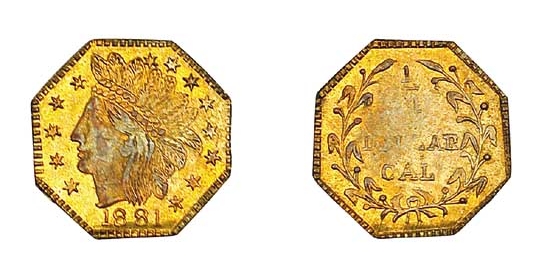
Obverse & Reverse
The 1881 25C BG-799AA is a fascinating and extremely rare artifact from the final chapter of private currency in the American West, known as 'Period Three' (post-1882) of the California Fractional Gold series. Its existence is a direct consequence of federal legislation and the enduring romanticism of the Gold Rush. The initial wave of fractional gold, struck from 1852-1857, served a genuine commercial need during a severe shortage of small change in California. A second wave ('Period Two', 1859-1882) saw production shift towards lighter, often debased pieces sold primarily as souvenirs to tourists and jewelry items. However, the Coinage Act of 1864 made all private coinage illegal. For years, the law was weakly enforced, but by the early 1880s, the U.S. Secret Service began actively suppressing these private mints. This crackdown did not extinguish the demand for these charming gold tokens. Instead, it drove production underground. To circumvent prosecution, minters, who were often skilled jewelers, began producing pieces with backdates, such as the 1881 seen on this coin, to create the illusion they were pre-crackdown issues. The BG-799AA variety, like its brethren, was never intended for circulation in the traditional sense. It was a nostalgic keepsake, a memento of the Wild West era sold to locals and visitors. The crude but charming artistry, the minuscule size, and the very act of its clandestine production make it a compelling numismatic story. Research by Walter Breen and Ronald Gillio suggests that many of these late-period issues can be traced to a handful of jewelers, with Herman Kroll of New York being a primary suspect for many varieties, though definitive attribution for BG-799AA remains elusive. Its immense rarity today, evidenced by the minuscule number of known survivors, suggests an infinitesimally small original mintage, likely produced on a per-order basis or in a very small batch.
Associated EventPost-Gold Rush Nostalgia & U.S. Private Coinage Crackdown
Reason For MintingTo be sold as a souvenir or jewelry charm, backdated to circumvent federal laws prohibiting private coinage.
Minter HistoryThe specific minter is unknown, but Period Three issues are generally attributed to a small number of jewelers who continued production after the Secret Service crackdown of the early 1880s. The most prominent of these was Herman M. Kroll, a New York City jeweler whose dies survived him and were used for later restrikes. While not definitively linked to BG-799AA, his work is characteristic of the style and clandestine nature of these backdated pieces.
Historical SignificanceThis coin represents the final, clandestine phase of a uniquely American currency phenomenon. It is a tangible link to the legal battles between private enterprise and the federal government over the right to produce money, and it showcases the persistent demand for Gold Rush memorabilia well after the rush itself had ended. Its extreme rarity makes it a key piece for advanced specialists.
Not Applicable
Denomination25 Cents
Minting PeriodStruck circa 1883-1900s, bearing a backdate of 1881
Assayer/MinterUnknown Jeweler (Possibly Herman Kroll or associates)
Geographic OriginLikely San Francisco, California or New York, New York
Obverse DescriptionFeatures a stylized Indian Head facing left, a common motif for Period Three fractional gold. The portrait is typically rendered in a simple, almost crude fashion, surrounded by thirteen stars of varying quality and placement. The date '1881' appears below the bust.
Obverse Inscription1881
Reverse DescriptionThe reverse displays the denomination '1/4' surrounded by a wreath. The wreath's design and berry count are key diagnostic points for distinguishing between the numerous BG-799 varieties, though specific details for the 'AA' variety are not widely published.
Reverse Inscription1/4
CompositionGold
Stated Fineness Actual FinenessTypically of lower fineness than earlier issues, often around .500 to .750 fine, but variable.
EdgePlain
Unknown, but presumed to be exceptionally small.
Survival Estimate2-3 pieces. The NGC Census reports grading only 2 examples (one AU-58 and one MS-62).
Rarity ScaleR-8 (Unique or Nearly Unique)
This coin is a 'holy grail' for the advanced specialist of California Fractional Gold. Its appeal lies in its absolute rarity, its connection to the legally-suppressed 'Period Three' of production, and the challenge of acquiring one of the two known graded examples.
Key VarietiesBG-799AA is itself a key variety within the larger BG-799 family of 1881-dated octagonal 25C pieces. Other related varieties from the same year include BG-799, BG-799BB, BG-799M, BG-799N, BG-799O, and others, each distinguished by minute differences in die pairings, star placement, wreath design, and date position. No known restrikes or special collector issues of BG-799AA exist.
Authentication TipsAuthentication requires microscopic examination and comparison to the known genuine examples. Key diagnostics are the precise positions of the stars relative to the Indian's profile and the specific shape and details of the wreath on the reverse. The fabric of the planchet is also critical; genuine pieces often show parallel striations or a slightly uneven surface from crude blank preparation, while modern fakes are often too perfect or have a cast-like appearance. Given its rarity, any newly discovered example should be considered counterfeit until proven otherwise by a top-tier grading service with expertise in the series.
Shopping ConsiderationsAcquiring a BG-799AA is an event-driven purchase that would likely occur only if one of the two known examples came to a major auction. A premium quality example would be one of the two certified pieces, with the MS-62 being the pinnacle. A buyer should prioritize sharpness of the strike (many are weak), originality of the surfaces (avoiding cleaned or tooled examples), and the integrity of the certification. Eye appeal, while subjective, would command a premium; this includes attractive, non-disruptive toning and a lack of distracting planchet flaws. Any purchase must be made through a reputable auction house or dealer specializing in territorial gold.
A coin's grade is its condition, rated on a 1-70 scale. For rare coins, this is the most critical factor in determining value, as a tiny difference in preservation can mean a huge difference in price.
Relevant Grade TypesAll original issues of BG-799AA were business strikes, although they were not intended for circulation and were sold as souvenirs. Therefore, they are found in Circulated grades (AU-58 is the lowest known grade) and Mint State (MS, 60-70). No Proof (PR/PF) examples were struck during the original period of manufacture, and no later-date Proof restrikes are known to exist.
Mint State CharacteristicsAn uncirculated BG-799AA is defined by the presence of original mint luster. The quality of this luster can range from frosty to semi-prooflike. Strikes on Period Three fractionals are notoriously inconsistent; a sharp strike on the high points of the Indian's hair and the details of the wreath would be considered exceptional and highly desirable. Due to the clandestine and hurried nature of their production, minor planchet flaws, laminations, or slight die cracks are often present and should not be considered major deterrents unless they are severe.
Circulated Wear PatternsAlthough not made for circulation, any wear would first appear on the highest points of the design. On the obverse, this would be the cheekbone and the feathers in the headdress. On the reverse, the highest points of the wreath's leaves and bow would show the first traces of friction and flattening of detail.
Key Factors For ValueFor a coin of this rarity, the primary value driver is simply its existence and authenticity. Beyond that, the grade is paramount. The difference in value between the known AU-58 and MS-62 is substantial. Surface quality is the next critical factor; an example with clean, original, and lustrous surfaces will always command a significant premium over one that has been cleaned, polished, or damaged. Any example with a CAC sticker would be highly prized, as it signifies premium quality for the assigned grade.
PCGS Price Guide
| Grade | Price | Population |
|---|---|---|
| 55 | $1,500.00 | 1 |
| 55+ | $1,560.00 | N/A |
| 58 | $1,650.00 | N/A |
| 58+ | $1,825.00 | N/A |
| 60 | $2,000.00 | N/A |
| 61 | $2,250.00 | 3 |
| 62 | $2,650.00 | 2 |
| 62+ | $3,000.00 | N/A |
| 63 | $3,500.00 | 2 |