1872/1 G25C BG-790 (Regular Strike)
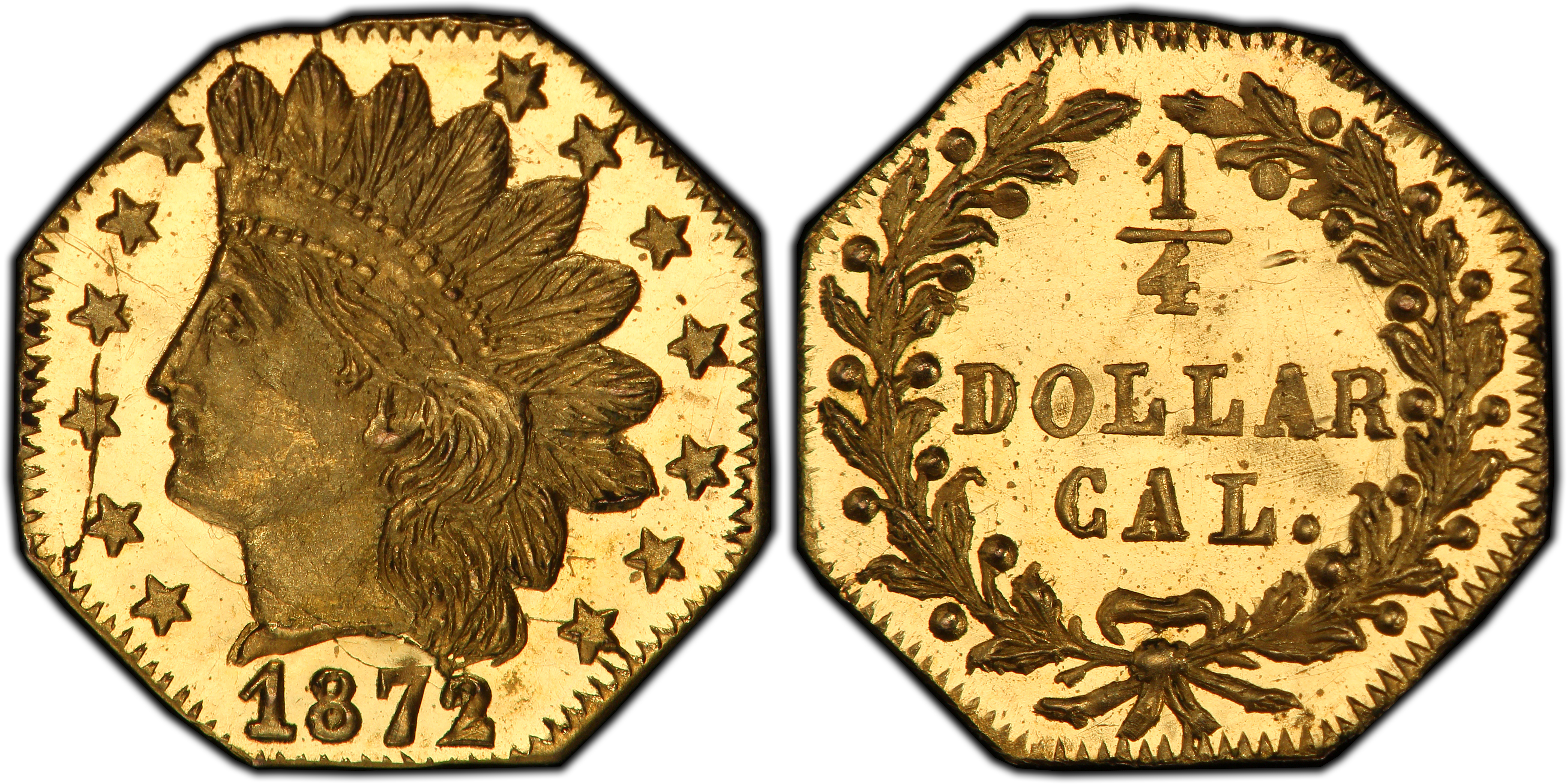
Obverse & Reverse
The 1872/1 G25C BG-790 is a quintessential example of a 'Period Two' California Fractional Gold piece, a series born from a complex interplay of necessity, entrepreneurship, and souvenir commerce. The initial California Gold Rush created an acute shortage of small denomination coinage, a void that private minters began to fill in 1852. These early 'Period One' issues (1852-1857) were often struck with a high intrinsic value and served a genuine commercial need. However, by the late 1850s, the San Francisco Mint was in full operation, alleviating the coin shortage. The nature of fractional gold production shifted dramatically. Enterprising jewelers, primarily in San Francisco, recognized a burgeoning market for these tiny gold pieces as souvenirs and keepsakes that could be easily mailed back East. This new era, from 1858 to 1882, is classified by numismatists Walter Breen and Ronald J. Gillio as 'Period Two' or the 'Suppressed Jewelers' Issues.' These pieces, including the BG-790, were no longer primarily intended to circulate as money. Their gold content was often significantly less than their face value, and their manufacture became a commercial enterprise for jewelers who marketed them as mementos of the romanticized 'Wild West.' The Coinage Act of 1864 technically made all private coinage illegal, but enforcement was lax, allowing jewelers to continue production. Many minters, as a measure of protection, began backdating their issues or, as seen in this variety, re-punching dates over previous years. The 1872/1 overdate is a clear indication of this practice, where an 1872-dated die was created by punching a '2' over the '1' of a leftover 1871 die. This was a pragmatic measure to extend the usable life of costly and labor-intensive dies. The minter of this piece is believed to be the California Jewelry Co., run by the Levison Brothers, who had purchased the fractional gold business of Robert B. Gray & Co. in 1871. This transition of ownership explains the continuation of similar styles and manufacturing techniques. The Indian Head motif was a popular design choice of the era, evoking romantic notions of the American frontier. The octagonal shape was a novelty that harkened back to some of the larger, earlier Assay Office slugs. Production finally ceased around 1882 when the Secret Service began to more aggressively enforce the 1864 Act, bringing an end to one of the most fascinating and complex chapters in American numismatics.
Associated EventPost-Gold Rush Souvenir Trade
Reason For MintingPrimarily created for sale as souvenirs and jewelry items rather than for general circulation, filling a commercial demand for mementos of the California Gold Rush.
Minter HistoryThe Levison Brothers (Herman and Louis) were German immigrant jewelers who founded their San Francisco firm in the late 1850s, growing it into the prominent California Jewelry Co. by the 1870s. In 1871, they acquired the coining equipment and dies of Robert B. Gray & Co., a significant producer of fractional gold. While Gray's pieces were often marked with a 'G', the Levison Brothers' issues were typically unmarked. They continued the practice of striking fractional gold, capitalizing on the lucrative souvenir market. Their business was a major jewelry and watch importing and manufacturing house, and the fractional gold production was a small but notable part of their enterprise during this period.
Historical SignificanceThe BG-790 represents the mature phase of the fractional gold phenomenon, where the pieces transitioned from necessity-driven coinage to commercial souvenir items. The overdate feature provides a tangible link to the manufacturing practices of the era, illustrating the frugal re-use of dies by private jewelers operating in a legally gray area. It is a key artifact of the post-Gold Rush California economy and the burgeoning tourism trade.
BG-790
Denomination25 Cents
Minting Period1872
Assayer/MinterCalifornia Jewelry Co. (Levison Brothers)
Geographic OriginSan Francisco, California
Obverse DescriptionAn octagonal planchet featuring a portrait of a Native American (Indian Head) facing left, wearing a feathered headdress. The portrait is surrounded by 13 five-pointed stars. The date is below the bust, with the '2' clearly struck over a '1'.
Obverse Inscription1872/1
Reverse DescriptionAn octagonal planchet with the denomination '1/4' at the center, surrounded by a wreath composed of two branches tied with a bow at the bottom. The legend 'CALIFORNIA GOLD' is inscribed outside the wreath along the upper border, often abbreviated as 'CAL'.
Reverse InscriptionCALIFORNIA GOLD 1/4
CompositionGold
Stated Fineness Actual FinenessVariable, typically less than .900, as was common for Period Two issues.
Weight0.24 grams
Diameter9.60 mm
EdgePlain
Unknown
Survival Estimate201-500
Rarity ScaleR-3
The BG-790 is highly sought after due to its combination of the popular Indian Head design, the distinctive octagonal shape, and the clear 1872/1 overdate. It is an affordable and historically rich entry point into the collecting of major die varieties within the California Fractional Gold series.
Key VarietiesThe primary variety is the 1872/1 overdate itself, which defines the BG-790 attribution. No other major varieties, patterns, or restrikes from the period of issue are known. Collectors should be aware of modern replicas, which are not considered numismatic varieties.
Authentication TipsGenuine BG-790 pieces often exhibit a somewhat crude, handmade quality. The strike can be uneven, with softness in the stars or wreath details. The numerals of the date, especially the repunched '2', should show characteristic tool marks under magnification. The luster is often flashy but can be slightly dull compared to federal issues. Replicas are often too perfect, with sharp, uniform details, soapy surfaces, and incorrect weight. Genuine Period Two pieces do not feature a bear in the design; pieces with bears are modern tokens or fantasies. Verification against the Breen-Gillio reference photos is crucial.
Shopping ConsiderationsA premium quality example for its grade will show a bold and clear overdate. Look for sharp details on the Indian's headdress and the bow on the reverse wreath, as these are high points that are often weak. Original, lustrous surfaces are paramount; many of these tiny coins were cleaned or used in jewelry, so finding one with undisturbed 'skin' commands a significant premium. Check for planchet flaws or laminations, which are common but should be noted. Avoid examples that are bent, holed, or show evidence of being previously mounted in jewelry, as this severely impacts value.
A coin's grade is its condition, rated on a 1-70 scale. For rare coins, this is the most critical factor in determining value, as a tiny difference in preservation can mean a huge difference in price.
Relevant Grade TypesOriginal period issues were business strikes, although primarily sold as souvenirs rather than for circulation. They are found in Circulated (1-58) and, more commonly, Mint State (MS, 60-70) grades. No true Proofs were struck during the original minting period. While many Period Two issues are found with reflective, 'Proof-Like' (PL) surfaces due to polished dies, these are a characteristic of the business strike manufacturing process and are not true Proofs.
Mint State CharacteristicsUncirculated examples of BG-790 are characterized by their often flashy, semi-prooflike luster resulting from the jewelers' polished dies. However, the quality of the strike is a key differentiator. Many are weakly struck on the high points, such as the feathers and the central details of the wreath. Contact marks, even on high-grade MS coins, are common due to the softness of the gold and the way they were handled in bulk. A truly exceptional piece will combine strong luster with a sharp strike and minimal, well-hidden contact marks.
Circulated Wear PatternsWear first appears on the highest points of the design. On the obverse, this includes the cheek and the feathers of the headdress. On the reverse, the high points of the wreath's leaves and the tie of the bow will show initial friction. In lower grades (VF and below), the stars will begin to lose their sharpness and the finer lines of the portrait will merge.
Key Factors For ValueBeyond the numerical grade, the primary value drivers for a BG-790 are the strength and clarity of the 1872/1 overdate and overall eye appeal. A sharp strike, especially on the Indian Head, is highly desirable. Surface quality is critical; coins with original, uncleaned surfaces and attractive reddish-gold toning are prized. The presence of a CAC sticker indicates a premium quality coin for its assigned grade and often results in a significant price increase, as it validates the eye appeal and originality of the piece.
PCGS Price Guide
| Grade | Price | Population |
|---|---|---|
| 55 | N/A | 1 |
| 58 | $200.00 | 1 |
| 58+ | $210.00 | N/A |
| 60 | $225.00 | N/A |
| 61 | $250.00 | 3 |
| 62 | $300.00 | 15 |
| 62+ | $315.00 | N/A |
| 63 | $385.00 | 49 |
| 63+ | $450.00 | N/A |
| 64 | $625.00 | 52 |
| 64+ | $725.00 | N/A |
| 65 | $950.00 | 26 |
| 65+ | $1,100.00 | N/A |
| 66 | $1,500.00 | 7 |
| 67 | N/A | N/A |