1871 G25C BG-764 (Regular Strike)
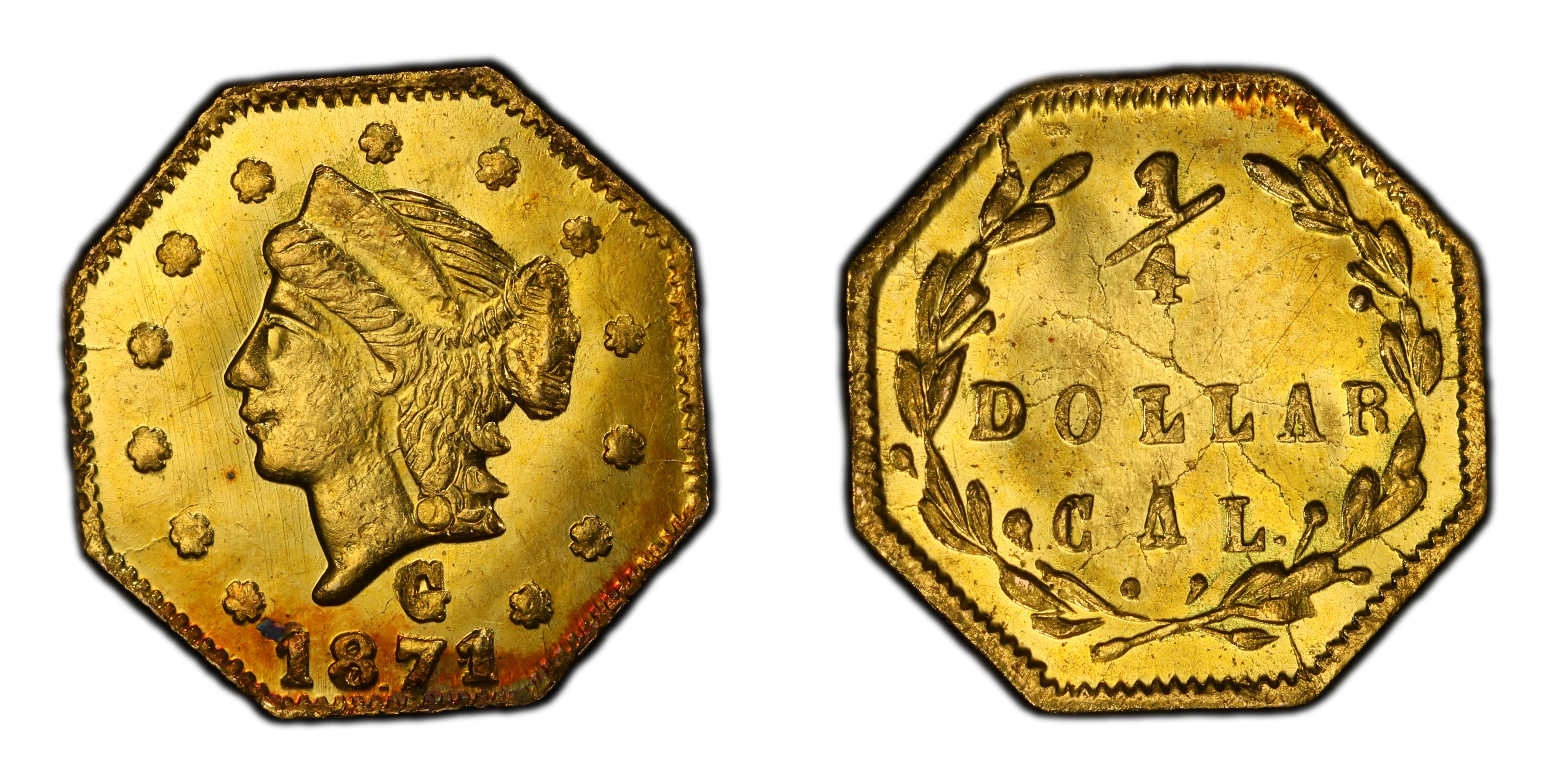
Obverse & Reverse
The 1871 G25C BG-764 is a product of the second period of California Fractional Gold production, a fascinating and complex chapter in American numismatics. Following the initial Gold Rush boom (1849-1856), the small change shortage that plagued California's economy persisted. Federal coinage was scarce on the West Coast, and the smallest circulating U.S. gold coin was the dollar. Daily transactions for small goods and services were cumbersome, often relying on pinches of gold dust or devalued foreign silver. Jewelers and metalworkers, many based in San Francisco, stepped in to fill this void by privately minting small gold coins in 25 cent, 50 cent, and one dollar denominations. These pieces were not legal tender, but their convenience and intrinsic gold value made them indispensable in local commerce. The first period (1852-1857) saw cruder, often underweight pieces. However, by the 1870s, the production quality had significantly improved, with more standardized designs and better manufacturing techniques. The Act of 1864, which prohibited private coinage, was largely ignored in the isolated economy of the West. The 1871 BG-764, with its crisply executed Indian Head design, is a prime example of this later period. These coins were struck by skilled engravers who also produced medals, tokens, and seals. While their primary purpose was circulation, their novel nature also made them popular as souvenirs and keepsakes for locals and tourists. The era of fractional gold came to a definitive end in 1883 when Robert B. Tattrie, a San Francisco producer, was arrested and his equipment seized by the Secret Service, which finally began enforcing the 1864 law on the West Coast. Today, these miniature coins are cherished by collectors for their link to the romanticized 'Old West' and the ingenuity of private enterprise in a frontier economy.
Associated EventPost-Gold Rush Economic Development in California
Reason For MintingTo alleviate a chronic shortage of small-denomination coinage for everyday commercial transactions in California.
Minter HistoryThe specific minter of BG-764 is not definitively known, which is common for many fractional gold issues. However, style and die characteristics link it to the work of prominent San Francisco jewelers and engravers of the period. Antoine Louis Nouizillet is a frequently cited artisan from this era known for high-quality work. These craftsmen operated small, private shops, using hand-operated screw presses to strike coins. They were not large-scale minting operations but rather skilled metallurgists and artists who met a specific market demand while also creating products sold as jewelry and souvenirs.
Historical SignificanceCalifornia Fractional Gold pieces represent a unique solution to a regional economic problem, demonstrating the persistence of private enterprise in coinage long after it was federally prohibited. They are tangible artifacts of daily life in 19th-century California, reflecting the region's isolation and gold-based economy. The BG-764 is a high-quality example from the most prolific period of production, showcasing the numismatic artistry of the time.
N/A
Denomination25 Cents
Minting Period1871
Assayer/MinterCalifornia Gold and Seal Engravers (Likely Antoine Louis Nouizillet or a contemporary)
Geographic OriginSan Francisco, California
Obverse DescriptionA beaded border encloses a left-facing bust of a female figure representing Liberty, wearing a Native American-style feathered headdress. The headdress has 13 feathers. Thirteen stars surround the portrait, seven to the left and six to the right.
Obverse Inscription[No Inscription]
Reverse DescriptionA decorative wreath of leaves and berries, open at the top, surrounds the denomination and date. The fraction '1/4' appears at the top center, just below the opening of the wreath. The date '1871' is at the bottom, and the denomination 'DOLLAR' is in the center. The letter 'G' for Gold is located below the word DOLLAR.
Reverse Inscription1/4 DOLLAR 1871 G
CompositionGold
Stated Fineness Actual FinenessVaries, but typically between .500 and .750 fine gold.
Weight0.25 grams
Diameter9.70 mm
EdgePlain
Unknown
Survival Estimate200-300
Rarity ScaleR-5
The BG-764 is highly popular due to its classic 'Indian Princess' design, its status as a genuine circulating artifact of the Old West, and its relative affordability compared to earlier or rarer fractional gold issues. Its tiny size and intricate detail make it a numismatic curiosity.
Key VarietiesThe BG-764 is a 'Regular Strike' intended for commerce or sale as a souvenir during its period of issue. There are no known major die varieties for BG-764 itself, though it is part of a larger family of similar designs from the 1870s. No contemporary Proofs are known. Collectors should be aware of a large number of modern replicas and fantasy pieces that imitate the style of genuine California Fractional Gold; however, the BG-764 catalog number refers specifically to the original 1871 issue.
Authentication TipsGenuine BG-764 pieces exhibit sharp, well-defined details, especially in the feathers and stars, which are often weak or mushy on counterfeits. The 'G' on the reverse should be correctly formed and positioned. The planchets are typically thin and the weight should be very close to 0.25 grams. Many fakes are overweight or have a brassy, unnatural color. Diagnostics include specific die cracks or markers that can be matched to known genuine examples. Third-party certification by PCGS or NGC is highly recommended for authenticity and buyer protection.
Shopping ConsiderationsA premium quality example for its grade will possess a sharp, well-centered strike. Look for full definition in the feathers of the headdress and the details of the wreath on the reverse. The surfaces should be clean and free of distracting marks, tooling, or evidence of having been mounted in jewelry, which is a common impairment for this series. Original, unconserved surfaces with a hint of reddish-gold toning command a significant premium. Avoid examples that are described as 'harshly cleaned,' as this drastically reduces both eye appeal and value.
A coin's grade is its condition, rated on a 1-70 scale. For rare coins, this is the most critical factor in determining value, as a tiny difference in preservation can mean a huge difference in price.
Relevant Grade TypesOriginal period issues were business strikes intended for circulation and as souvenirs. They are found in Circulated grades (AG-3 to AU-58) and Mint State (MS-60 to MS-70). No Proof (PR/PF) examples were struck during the original period of issue for this variety. Any piece described as a 'Proof' is almost certainly a modern copy or fantasy item and not a genuine BG-764.
Mint State CharacteristicsUncirculated examples of BG-764 typically exhibit a soft, satiny luster. The strike can be variable, but high-end specimens will show sharp details on the highest points of the design, such as Liberty's cheek and the bow of the wreath. Due to the small size and production methods, perfectly struck examples are rare. Small planchet flaws or adjustment marks are not uncommon and should be evaluated for their impact on eye appeal.
Circulated Wear PatternsWear first appears on the high points of the design: Liberty's cheekbone, the feathers in the headdress, and the central bow and leaves of the reverse wreath. On moderately worn examples (VF-XF), the finer details within the feathers will merge. In lower grades (F and below), the stars and letters will begin to weaken, and Liberty's portrait will become noticeably flattened.
Key Factors For ValueFor the BG-764, the primary value drivers are grade and surface quality. An uncirculated piece with minimal marks and strong luster is worth many times more than a circulated one. Strike quality is crucial; a sharply struck coin is always preferred over a weakly struck one of the same grade. Eye appeal, encompassing attractive original color and mark-free fields, is paramount. Coins that have been cleaned, polished, or removed from jewelry will trade at a steep discount. A CAC sticker, indicating a premium quality coin for the grade, adds a significant premium.
PCGS Price Guide
| Grade | Price | Population |
|---|---|---|
| 45 | $200.00 | 1 |
| 45+ | $210.00 | N/A |
| 50 | $235.00 | 1 |
| 50+ | $260.00 | N/A |
| 53 | $285.00 | N/A |
| 53+ | $300.00 | N/A |
| 55 | $350.00 | 2 |
| 55+ | $385.00 | N/A |
| 58 | $425.00 | 1 |
| 58+ | $500.00 | N/A |
| 60 | $625.00 | N/A |
| 61 | $850.00 | 4 |
| 62 | $950.00 | 6 |
| 62+ | $1,000.00 | N/A |
| 63 | $1,075.00 | 5 |
| 63+ | $1,150.00 | N/A |
| 64 | $1,450.00 | N/A |
| 64+ | $1,750.00 | N/A |
| 65 | $2,500.00 | 1 |