1876 25C BG-787 (Regular Strike)
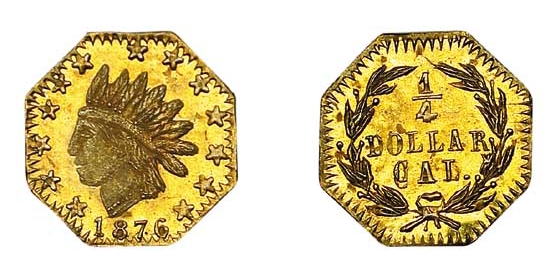
Obverse & Reverse
The 1876 BG-787 25 Cent piece is a product of the second period (1858-1882) of California Fractional Gold production. Unlike the 'Period One' issues (1852-1857), which were struck out of a genuine necessity for small-denomination circulating coinage during the height of the Gold Rush, these later pieces were created primarily as souvenirs and for the jewelry trade. By the mid-1870s, the United States Mint in San Francisco was in full operation, producing ample quantities of federal silver and gold coins, thus obviating the commercial need for private fractional gold. However, the romance of the Gold Rush and the novelty of tiny gold coins sustained a vibrant market for these tokens. Jewelers in San Francisco and other cities continued to strike them, often backdating them to the 1850s to enhance their appeal. The Coinage Act of 1864 had made private coinage illegal, but enforcement was lax, particularly for pieces clearly intended as novelties rather than circulating currency. These 'suppressed jewelers' issues,' as termed by numismatists Walter Breen and Ronald Gillio, often featured new designs, such as the Indian Head motif, which was not used on Period One fractionals but was popular on contemporary federal coinage like the Indian Head Cent. The 1876 date of the BG-787 is significant as it coincided with the nation's Centennial celebration, an event that spurred the creation of numerous medals and tokens. It is highly probable that this piece was struck to capitalize on the patriotic and nostalgic fervor of the time. Production methods remained crude, often employing a simple hammer-striking process, which resulted in coins of varying strike quality and sometimes inconsistent planchet thickness. The gold content was also not standardized and was typically below face value, solidifying their status as tokens rather than true coins. Production of all such pieces ceased by 1883 after the Secret Service began to strictly enforce the 1864 Act, bringing an end to this fascinating chapter of American numismatics.
Associated EventPost-Gold Rush Era / U.S. Centennial
Reason For MintingTo serve the robust souvenir and jewelry market that romanticized the California Gold Rush, particularly during the U.S. Centennial year.
Minter HistoryThe specific minter for the BG-787 variety is unknown, as is common for many 'Period Two' issues. These coins were produced by various jewelers in San Francisco who often did not apply a maker's mark to their products to avoid potential legal repercussions under the Coinage Act of 1864. Prominent jewelers known to have produced fractional gold during this era include Robert B. Gray & Co. and the California Jewelry Co., but a direct link to this specific variety has not been established.
Historical SignificanceThe coin is significant not as a medium of exchange, but as a numismatic artifact representing the commercialization of the Gold Rush legacy. It is a tangible link to the souvenir trade of 19th-century California and demonstrates the continued demand for gold items long after the initial fever had subsided. As a 'Period Two' Indian Head type, it is part of a design evolution that distinguishes it from the earlier, more utilitarian Liberty Head issues.
BG-787
Denomination25C
Minting Period1876
Assayer/MinterUnknown Jeweler
Geographic OriginSan Francisco, California
Obverse DescriptionAn Indian Head portrait facing left, likely modeled after the contemporary U.S. Indian Head Cent. The portrait is surrounded by thirteen stars, representing the original colonies. The date '1876' is below the bust.
Obverse Inscription1876
Reverse DescriptionThe reverse design common to this group features the denomination '1/4 DOLLAR' within a wreath of leaves and berries. The wreath is open at the top.
Reverse Inscription1/4 DOLLAR
CompositionGold
Stated Fineness Actual FinenessVariable, typically between 14k and 22k for Period Two issues.
Weight0.25 grams
Diameter9.80 mm
EdgePlain
Unknown
Survival EstimateVery Few; Likely less than 30
Rarity ScaleR-6 (13-30 known)
This coin appeals to specialists in California fractional gold and collectors of Gold Rush-era exonumia. Its octagonal shape, Indian Head design, and 1876 date make it a historically interesting and visually distinct type. The challenge of acquiring this specific, very rare Breen-Gillio variety is a major draw for advanced collectors.
Key VarietiesThe primary variety is the Regular Strike business issue. No proof strikings or major die varieties from the period of issue are known or cataloged for BG-787. Collectors should be aware that the broader category of 1876 octagonal 25C pieces includes multiple distinct Breen-Gillio varieties (e.g., BG-785, BG-786, BG-799) differentiated by the specific dies used, particularly the positioning and style of the date, stars, and portrait.
Authentication TipsAuthentic 'Period Two' pieces like BG-787 often have a slightly crude, handmade look. The strike may be uneven, with some areas of softness. The surfaces may exhibit a satiny luster rather than a prooflike, mirrored finish. Replicas, often made of brass or thinly plated gold, tend to have mushy details, incorrect weight, and often feature designs never used on genuine pieces (like bears). A key diagnostic is the style of the numerals in the date and the lettering, which should match known exemplars cataloged in the Breen-Gillio reference. Third-party grading by PCGS or NGC is highly recommended for authentication.
Shopping ConsiderationsFor a premium quality example, a potential buyer should seek a coin with a sharp, well-centered strike, particularly on the high points of the Indian Head's feathers and the details of the wreath. Original, uncleaned surfaces with some remaining mint luster are highly desirable. Many surviving examples have been cleaned, used in jewelry, or otherwise damaged; finding a problem-free coin is a significant challenge. Eye appeal is paramount; coins with a pleasing, original reddish-gold or yellow-gold hue command strong premiums. Given the coin's rarity, any certified example is significant, but one with a CAC sticker would indicate superior quality for the grade.
A coin's grade is its condition, rated on a 1-70 scale. For rare coins, this is the most critical factor in determining value, as a tiny difference in preservation can mean a huge difference in price.
Relevant Grade TypesOriginal period issues were business strikes intended for the souvenir market and are found in Circulated (1-58) and, more commonly, Mint State (MS, 60-70) grades. No Proof (PR/PF) examples were struck during the original period of issue, and no later-date restrikes are known to exist for this specific variety.
Mint State CharacteristicsUncirculated examples of this type are typically characterized by a soft, satiny luster. The strike can be inconsistent; a sharply struck coin showing full detail in the headdress feathers and wreath is rare and commands a premium. Due to the rudimentary production and handling, even high-grade Mint State examples will often exhibit minor planchet imperfections or small, scattered contact marks. Deeply prooflike or mirrored surfaces are atypical for this variety and should be scrutinized carefully.
Circulated Wear PatternsAlthough most survivors are uncirculated, any wear would first appear on the highest points of the design. On the obverse, this includes the cheek of the Indian Head and the tips of the feathers in the headdress. On the reverse, the high points of the leaves and berries in the wreath would show initial friction. In lower grades (VF and below), the finer details of the feathers would merge and the legend would begin to soften.
Key Factors For ValueThe primary value drivers for a BG-787 are its authenticity and grade. Surface preservation is critical; an example with original, undisturbed luster will be worth significantly more than one that has been cleaned, polished, or previously mounted in jewelry. Strike quality is the next major factor, with collectors paying a premium for sharp, well-defined details. Finally, eye appeal, encompassing attractive natural toning and a lack of distracting marks, plays a major role. Given its rarity, any certified, problem-free example is highly sought after, with a CAC sticker adding a significant premium for confirming quality within the assigned grade.
PCGS Price Guide
| Grade | Price | Population |
|---|---|---|
| 63 | $2,500.00 | 1 |
| 63+ | $3,000.00 | N/A |
| 64 | $3,500.00 | N/A |
| 64+ | $4,250.00 | N/A |
| 65 | $5,500.00 | 2 |