1880 G25C BG-799J (Regular Strike)
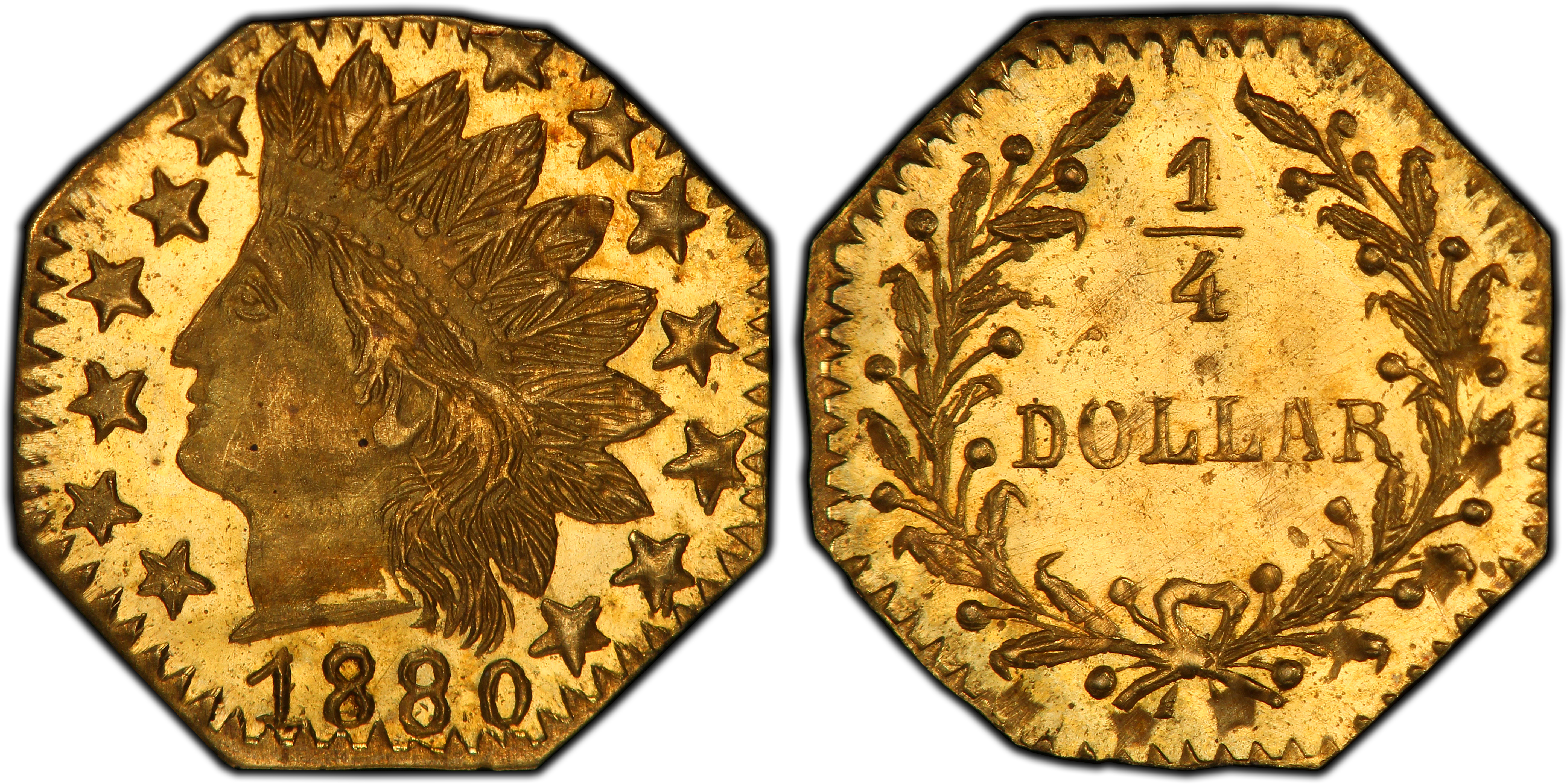
Obverse & Reverse
The 1880 Octagonal Gold 25 Cents, cataloged as BG-799J, represents a fascinating twilight chapter in the story of private California coinage. Its origins lie in the initial chaos of the California Gold Rush, which began in 1848. The massive influx of population and gold dust created a severe shortage of small-denomination coinage for daily transactions. To fill this void, private minters and jewelers began striking their own fractional gold pieces—25 cents, 50 cents, and one dollar—starting in 1852. These initial issues, now known as 'Period One' (1852-1857) coins, were generally of good quality and are believed to have actively circulated to alleviate the change shortage. However, by the time the BG-799J was produced, the landscape had changed dramatically. The San Francisco Mint, opened in 1854, was in full production, supplying the region with ample federal coinage. The original economic necessity for fractional gold had vanished. Consequently, the pieces struck from 1858 to 1882, classified as 'Period Two,' were created not for circulation but as souvenirs and keepsakes. San Francisco had become a major tourist destination, and these diminutive gold tokens were popular mementos of the Gold Rush era. They were often referred to as 'jeweler's issues,' frequently underweight and of varying fineness, designed more for novelty than monetary utility. The Coinage Act of 1864 had officially made private coinage illegal, but lax enforcement by the Secret Service allowed this practice to continue until 1883. The BG-799J, with its popular Indian Head motif—likely inspired by the contemporary U.S. cent—was a product of this souvenir trade. Unlike the earlier Liberty Head designs that mimicked federal gold, the Indian Head design was a purely commercial choice. These pieces were never intended to circulate widely; their purpose was to be sold to tourists, set into jewelry, or kept in curio cabinets. Today, they are prized by collectors not for their monetary role but for their direct connection to the romantic legacy of the Gold Rush and the entrepreneurial spirit of the jewelers who catered to a burgeoning tourist trade.
Associated EventCalifornia Gold Rush Aftermath & Tourism
Reason For MintingPrimarily struck as a souvenir or charm for the growing tourist trade in San Francisco, not for monetary circulation.
Minter HistoryThe specific minter or jeweler responsible for the BG-799J variety is unrecorded, a common trait for many 'Period Two' California Fractional Gold pieces. During this era (1858-1882), numerous San Francisco jewelers, many of French origin, produced these souvenir tokens. Unlike the earlier 'Period One' minters who sometimes identified their work with initials (e.g., 'FD' for Frontier, Deviercy & Co.), the makers of these later issues often remained anonymous to avoid potential, albeit unlikely, legal repercussions from the unenforced 1864 anti-private-coinage law.
Historical SignificanceThe BG-799J is historically significant as a material artifact of the transition from a frontier economy to a commercial and tourist hub in California. It represents the commercialization of the Gold Rush legacy, serving as a tangible souvenir for visitors long after the initial economic need for such coinage had passed. It is a key collectible within the popular and complex 'Period Two' sub-series of California Fractional Gold.
BG-799J
Denomination25 Cents
Minting Period1880
Assayer/MinterUnknown Jeweler
Geographic OriginSan Francisco, California
Obverse DescriptionAn Indian Head portrait facing left, reminiscent of the design on the U.S. Indian Head Cent. The portrait is surrounded by 13 six-pointed stars. The date, 1880, is below the bust. This specific variety is known for its wide date.
Obverse Inscription1880
Reverse DescriptionThe denomination '25 CENTS' is enclosed within a wreath of two olive branches tied with a bow at the bottom. Some references identify the die used for this variety as reverse 'A'.
Reverse Inscription25 CENTS
CompositionGold
Stated Fineness Actual FinenessVaries, typically less than .900 fine.
EdgePlain
Unknown
Survival Estimate501-1250
Rarity ScaleR-3
This issue is highly popular due to the classic Indian Head design, octagonal shape, and its direct link to the California Gold Rush story. As a 'Period Two' piece, it is more affordable and available in high grades than its 'Period One' counterparts, making it an accessible entry point into this fascinating numismatic field. The specific BG-799J variety is a well-defined and collectible part of the extensive series.
Key VarietiesThe primary variety is the regular business strike. A Prooflike (PL) designation is sometimes awarded by grading services to examples with highly reflective, mirror-like fields. No special collector issues, patterns, or official restrikes are known to exist for this specific variety. The broader 1880 G25C series includes numerous other BG-numbered die varieties (BG-799A through BG-799Y) with subtle differences in obverse and reverse dies.
Authentication TipsAuthenticity is a major concern for all California Fractional Gold. Genuine BG-799J pieces will have a denominated value ('25 CENTS'). Replicas and charms made after 1882 often omit the denomination to comply with the law. Look for sharp, albeit sometimes crude, details consistent with private minting techniques. A key diagnostic is the specific die pairing: the 'wide date' obverse with the reverse 'A' die. Mushy details, incorrect weight or size, or a greasy luster can indicate a counterfeit. Third-party authentication and grading by PCGS or NGC is highly recommended for any potential purchase.
Shopping ConsiderationsSince these were souvenir items, most surviving examples are found in Mint State (uncirculated) condition. A premium quality example for its grade will exhibit a sharp strike, especially on the high points of the Indian's hair and the details of the wreath. Luster is a key value determinant; seek out pieces with vibrant, frosty or prooflike luster. Common issues include weak strikes in the center, planchet flaws, and marks from having been previously mounted in jewelry. Carefully inspect the edges and fields for evidence of removal from a bezel. Attractive, original reddish-gold toning is desirable and commands a premium over cleaned or harshly dipped specimens.
A coin's grade is its condition, rated on a 1-70 scale. For rare coins, this is the most critical factor in determining value, as a tiny difference in preservation can mean a huge difference in price.
Relevant Grade TypesOriginal issues of BG-799J were business strikes produced as souvenirs, not for general circulation. Therefore, they are almost exclusively found and collected in Mint State (MS, 60-70) grades. While a few may have entered circulation and would be graded on the Circulated (1-58) scale, such examples would be atypical and less desirable than high-grade pieces. No true Proofs (PR/PF) were struck during the original period of issue. The 'Prooflike' (PL) designation is a business strike characteristic, not a separate striking method, and refers to coins with mirrored fields.
Mint State CharacteristicsIn uncirculated grades, the BG-799J often exhibits a reasonably sharp strike, though weakness on the highest points of the hair and feathers is not uncommon. Luster can range from satiny to intensely prooflike. Due to the softness of the gold and primitive handling, even high-grade specimens may show minor planchet flaws or small, scattered contact marks. The overall eye appeal, combining strike, luster, and surface preservation, is paramount.
Circulated Wear PatternsAlthough rarely seen circulated, wear would first appear on the highest points of the design. On the obverse, this would be the cheek, the eyebrow, and the tips of the feathers in the headdress. On the reverse, the high points of the wreath's leaves and the bow would show the first traces of friction and flattening.
Key Factors For ValueFor the BG-799J, value is overwhelmingly driven by grade and eye appeal. A sharp, well-centered strike is a primary factor. The quality of the luster is critical; pieces with deep, reflective prooflike surfaces command significant premiums over those with average or impaired luster. Surface quality is key: an example free of distracting marks, spots, or evidence of cleaning will always be more valuable. The presence of a CAC sticker, indicating premium quality for the grade, adds a substantial premium for this series.
PCGS Price Guide
| Grade | Price | Population |
|---|---|---|
| 58 | $225.00 | 1 |
| 58+ | $250.00 | N/A |
| 60 | $275.00 | N/A |
| 61 | $315.00 | 1 |
| 62 | $365.00 | 16 |
| 62+ | $400.00 | N/A |
| 63 | $475.00 | 30 |
| 63+ | $500.00 | N/A |
| 64 | $550.00 | 43 |
| 64+ | $650.00 | N/A |
| 65 | $775.00 | 40 |
| 65+ | $950.00 | 1 |
| 66 | $1,850.00 | 11 |
| 67 | N/A | N/A |