1871 G25C BG-767 (Regular Strike)
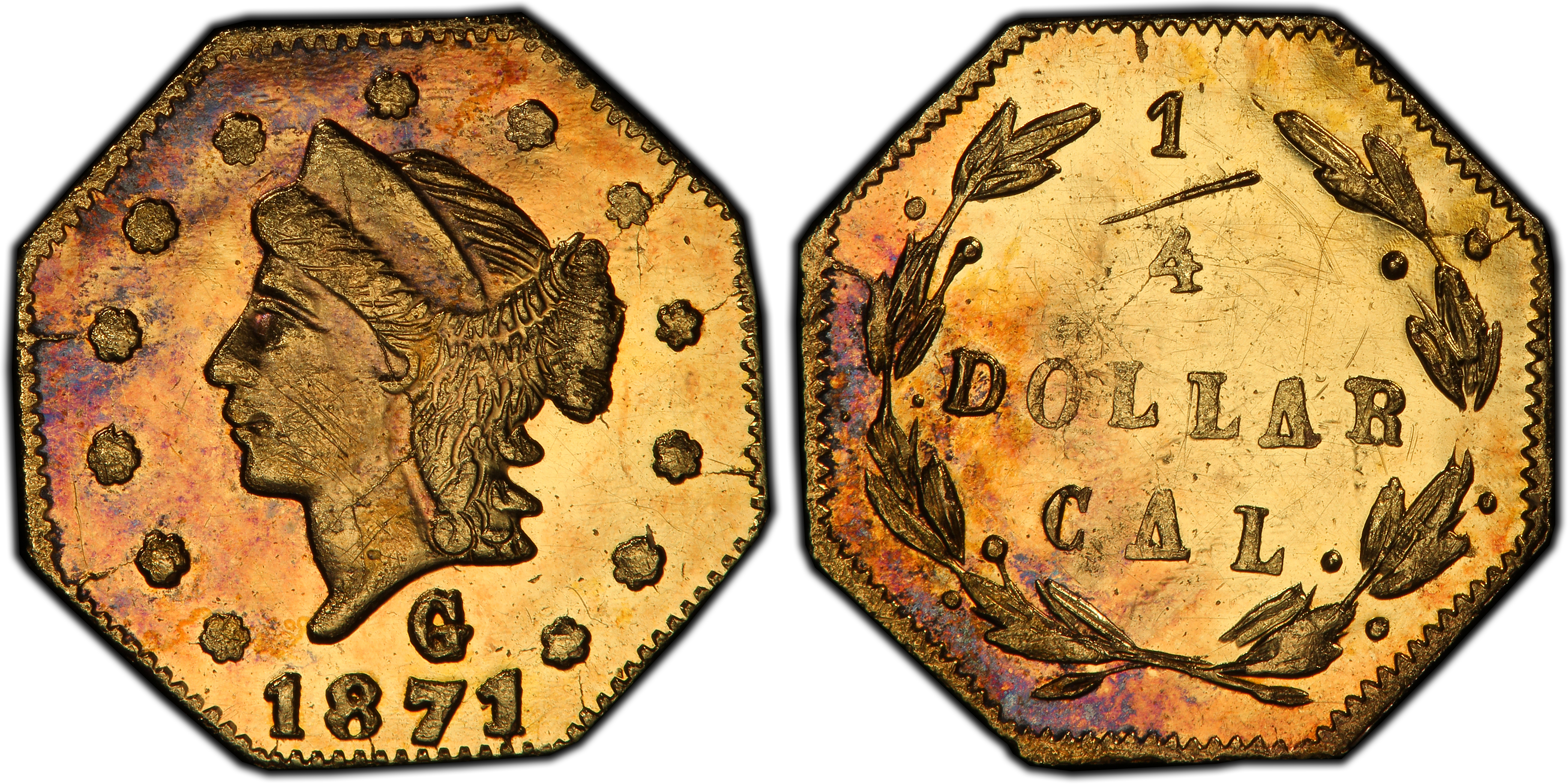
Obverse & Reverse
The 1871 G25C BG-767 is a quintessential example of 'Period Two' California Fractional Gold, a fascinating and complex series born from the economic realities of the American West. The initial California Gold Rush created an immense influx of population and gold dust, but a severe shortage of small denomination coinage for daily transactions. This led to the 'Period One' (1852-1857) issues, which were privately minted with the genuine intent of serving as circulating currency. However, by the late 1850s, the landscape had changed. The U.S. Mint in San Francisco was in full operation, and the novelty of the tiny gold pieces had captured the public's imagination. Enterprising jewelers, like Robert B. Gray, recognized a new market: souvenirs. The 'Period Two' issues (1858-1882), to which the BG-767 belongs, were struck primarily for sale as keepsakes, jewelry, and mementos of the romanticized Gold Rush era. These pieces were often deliberately underweight, containing less than their face value in gold, a fact that was of little concern to buyers who did not intend to spend them. Robert B. Gray & Co. was a prolific producer, having purchased the business of another jeweler, Antoine Louis Nouzillet, in the late 1850s. Gray's issues are identifiable by the small 'G' monogram on the obverse. The year 1871 was significant as it marked the end of Gray's involvement; he sold his interests to the California Jewelry Co. during that year, making the 1871-G issues among his last. The Coinage Act of 1864 had made private coinage illegal, but the law was weakly enforced in the West, allowing jewelers to continue production, often using earlier dates to feign legitimacy. The BG-767, with its explicit 1871 date, demonstrates the boldness of these minters in a period when their craft was legally dubious but commercially successful. These tiny octagonal gold pieces are not just coins; they are artifacts of a transitioning economy, embodying the shift from necessity-driven currency to commercial nostalgia.
Associated EventPost-Gold Rush Economic Expansion
Reason For MintingPrimarily created to satisfy the growing demand for souvenirs and keepsakes related to the California Gold Rush.
Minter HistoryRobert B. Gray & Co. was a prominent San Francisco jewelry firm active in the production of California Fractional Gold during the 'Period Two' era. Around 1859, Gray purchased the dies, hubs, and punches of fellow jeweler Antoine Louis Nouzillet, another key figure in the series. Gray began producing his own distinctive issues, marked with a characteristic 'G' monogram on the obverse below the Liberty portrait. His pieces are noted for being of generally higher weight and quality compared to many other 'jeweler's issues' of the period. The firm operated until 1871, the year this coin was struck, when Gray sold his interests to the California Jewelry Co. His 'G' marked coins are a distinct and collectible subset of the fractional gold series.
Historical SignificanceThe BG-767 represents the mature phase of the California Fractional Gold phenomenon, where the pieces evolved from quasi-currency into popular souvenirs. Its existence highlights the lax federal enforcement of the 1864 Coinage Act in California and the entrepreneurial spirit of jewelers who capitalized on the romantic image of the Gold Rush. It is a tangible link to the commerce and culture of post-Gold Rush San Francisco.
BG-767
Denomination25 Cents
Minting Period1871
Assayer/MinterRobert B. Gray & Co.
Geographic OriginSan Francisco, California
Obverse DescriptionA beaded border encloses a Liberty Head portrait facing left, modeled after the contemporary federal gold coinage. Thirteen stars encircle the head. The date '1871' is below the bust truncation, and the minter's hallmark, a small letter 'G', is prominent in the field between the date and the portrait's chin.
Obverse Inscription1871 G
Reverse DescriptionA wreath of leaves and berries, tied with a bow at the bottom, encircles the denomination. The legend 'CALIFORNIA GOLD' is inscribed at the top periphery, broken by the wreath. Within the wreath, the fraction '1/4' is displayed.
Reverse InscriptionCALIFORNIA GOLD 1/4
CompositionGold
Stated Fineness Actual FinenessVariable, typical for Period Two issues, generally lower than monetary standards.
Weight0.24 grams
Diameter9.60 mm
EdgePlain
Unknown
Survival Estimate201-500 (per R-3 rarity rating)
Rarity ScaleR-3
This variety is popular due to its clear date and minter's mark, octagonal shape, and direct connection to the well-documented jeweler Robert B. Gray. As a 'Period Two' issue, it is more affordable than the earlier, circulating types, making it an accessible entry point into the fascinating world of California Fractional Gold.
Key VarietiesThe primary variety is the regular business strike. No proof or special collector issues are known from the period of minting. The Breen-Gillio reference catalogs numerous minor die varieties within the broader series, but BG-767 itself is a specific die marriage. Collectors focus on die states, such as the presence of cracks or clashes, which can indicate the age of the dies.
Authentication TipsAuthentic examples have a sharp, albeit sometimes uneven, strike from hammered dies. The 'G' monogram should match known exemplars in shape and position. The lettering and stars, while small, should be well-defined and not mushy or cast-looking. Counterfeits are common and often have incorrect weight, a soapy appearance, or tool marks around the design elements. Comparison with high-resolution images of certified specimens is essential.
Shopping ConsiderationsA premium quality example for this issue is defined by a sharp, well-centered strike, particularly on the Liberty portrait and the numerals of the date. Seek out coins with minimal contact marks and original, undisturbed surfaces that exhibit a gentle, satiny luster. Some pieces show attractive prooflike or reflective fields, which command a significant premium. Avoid coins that have been harshly cleaned, polished, or previously mounted in jewelry, as evidenced by rim damage, solder, or tooling marks. The overall eye appeal, combining strike, luster, and surface preservation, is paramount.
A coin's grade is its condition, rated on a 1-70 scale. For rare coins, this is the most critical factor in determining value, as a tiny difference in preservation can mean a huge difference in price.
Relevant Grade TypesOriginal period issues were business strikes, technically intended as novelties rather than for circulation, but are found in all grades. They are categorized as Circulated (1-58) and Mint State (MS, 60-70). No Proof (PR/PF) examples were struck by Robert B. Gray & Co. during the original minting period. While some high-quality Mint State examples have reflective, 'prooflike' (PL) surfaces from polished dies, they are not true Proofs and are designated as such on the grading label.
Mint State CharacteristicsUncirculated examples often exhibit a soft, satiny luster characteristic of hammered gold. The strike can be inconsistent; a fully struck piece will show sharp details on Liberty's hair curls and the individual leaves of the wreath. Due to the manufacturing process, planchets are often slightly irregular, which is normal. Small planchet flaws or adjustment marks are not uncommon and should be assessed for their impact on eye appeal. The highest quality pieces are well-centered and free of distracting contact marks.
Circulated Wear PatternsWear first appears on the highest points of the design: Liberty's cheek, the hair above her eye, and the bow on the reverse wreath. On lower-grade circulated examples, the stars and letters will begin to merge with the fields, and the date can become faint. Significant wear will render the 'G' monogram indistinct.
Key Factors For ValueBeyond the numerical grade, value is driven by strike sharpness, surface quality, and eye appeal. A sharply struck coin with minimal marks and original, lustrous surfaces will command a strong premium over a weakly struck or heavily marked coin of the same grade. Coins with attractive, original toning are highly sought after. Certification by a top-tier grading service (PCGS or NGC) is standard for this series, and a CAC sticker indicates premium quality for the grade, often resulting in a higher market value.
PCGS Price Guide
| Grade | Price | Population |
|---|---|---|
| 40 | $210.00 | 1 |
| 45 | $220.00 | 1 |
| 45+ | $225.00 | N/A |
| 50 | $230.00 | 1 |
| 50+ | $240.00 | N/A |
| 53 | $250.00 | 5 |
| 53+ | $265.00 | N/A |
| 55 | $275.00 | 26 |
| 55+ | $285.00 | N/A |
| 58 | $300.00 | 40 |
| 58+ | $315.00 | N/A |
| 60 | $330.00 | 9 |
| 61 | $350.00 | 27 |
| 62 | $375.00 | 80 |
| 62+ | $400.00 | N/A |
| 63 | $450.00 | 26 |
| 63+ | $500.00 | N/A |
| 64 | $600.00 | 16 |
| 64+ | $700.00 | N/A |
| 65 | $1,100.00 | 1 |
| 65+ | $1,500.00 | N/A |
| 66 | $2,000.00 | 1 |