1875 G25C BG-784 (Regular Strike)
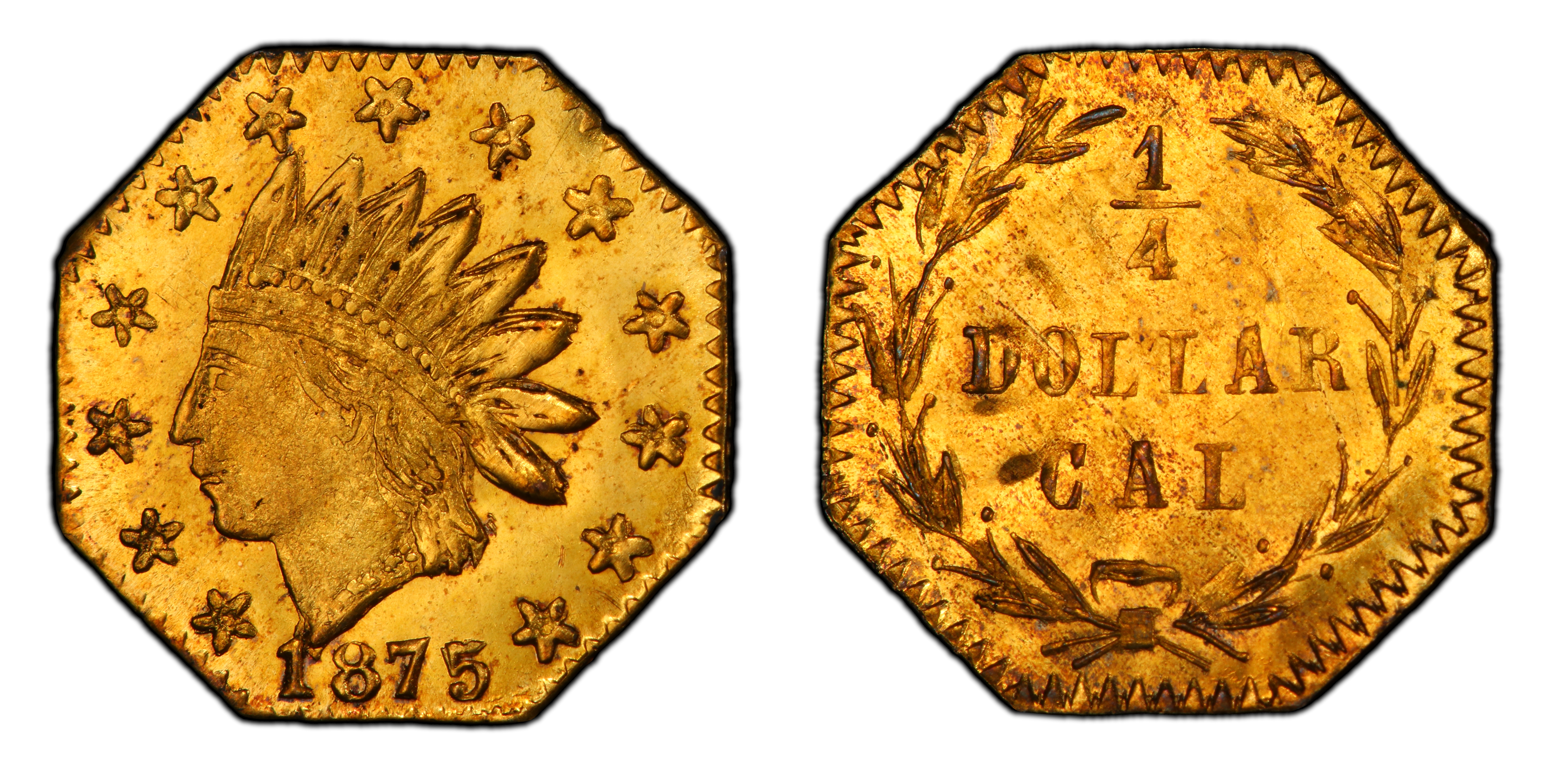
Obverse & Reverse
The 1875 G25C BG-784 is a product of the second period (1859-1882) of California Fractional Gold production, an era often dominated by pieces colloquially known as 'jeweler's issues.' Following the initial frenzy of the Gold Rush, the acute shortage of small change persisted in California's booming economy. Federal coinage was still scarce on the West Coast, making daily transactions for low-value goods and services incredibly difficult. While the initial wave of fractional gold from 1852-1856 was a direct and necessary response to this coin shortage, the pieces struck later, like this 1875 example, served a dual purpose. They continued to facilitate commerce but also catered to a growing tourist and souvenir market in San Francisco. By the 1870s, the city was a major commercial hub, and these tiny gold coins were popular keepsakes. Unlike the earlier, often anonymous issues, many pieces from this second period can be attributed to specific jewelers who possessed the requisite skills for die sinking and striking. Robert B. Gray & Co. is the likely producer of the BG-784, a firm known for its jewelry and engraving work in San Francisco. These pieces were typically struck by hand, using a hammer to strike the top die, which resulted in significant variations in strike quality. The gold content was often less than the face value would imply, a common characteristic of jeweler's issues. The passage of the Coinage Act of 1864 made private coinage illegal, but enforcement was lax on the West Coast, allowing these small-denomination tokens to be produced until the early 1880s when federal authorities finally cracked down on their manufacture, bringing an end to this fascinating chapter of American numismatic history.
Associated EventPost-Gold Rush Economic Expansion
Reason For MintingTo alleviate a persistent shortage of small denomination coinage for daily commerce and to serve the growing souvenir trade in California.
Minter HistoryRobert B. Gray & Co. was a San Francisco-based jeweler and engraver active during the latter half of the 19th century. Like many jewelers of the period, the firm leveraged its expertise in working with precious metals and creating intricate designs to produce California Fractional Gold pieces. Attribution of specific Breen-Gillio varieties to these makers is often based on stylistic analysis of the dies and punches used, which often match those seen in their marked jewelry or other metalwork. These jewelers were not official assayers or minters in the traditional sense but private entrepreneurs filling a specific market niche.
Historical SignificanceThe BG-784 represents the evolution of California Fractional Gold from a purely utilitarian currency of necessity to a commercial product reflecting the maturity and tourist appeal of San Francisco. It stands as a tangible artifact of a time when private citizens took it upon themselves to create the coinage that the federal government could not adequately supply to the burgeoning West. Its existence highlights the unique economic conditions and independent spirit of 19th-century California.
N/A
DenominationG25C
Minting Period1875
Assayer/MinterRobert B. Gray & Co. (Attributed)
Geographic OriginSan Francisco, California
Obverse DescriptionA head of a Native American, often referred to as an Indian Head, facing left. The portrait is adorned with a feathered headdress. The design is encircled by thirteen stars, representing the original colonies.
Obverse Inscription[No Inscription]
Reverse DescriptionThe denomination '1/4' is prominently featured within a wreath of leaves and berries. Below the wreath, the word 'DOL.' is present. The planchet is octagonal.
Reverse Inscription1/4 DOL.
CompositionGold
Stated Fineness Actual Fineness Weight0.25 grams
Diameter9.50 mm
EdgePlain
Unknown
Survival Estimate31-75 Known
Rarity ScaleR-5+
The BG-784 is highly sought after for its classic Indian Head design, octagonal shape, and status as a high-rarity (R-5+) piece within the popular California Fractional Gold series. Its appeal lies in its connection to the post-Gold Rush era and the charm of its miniature, privately-minted nature. Being a dated issue adds to its desirability compared to undated varieties.
Key VarietiesThe primary variety is the regular business strike. No known proof strikings or period restrikes are recorded for this specific Breen-Gillio number. The term 'Regular Strike' distinguishes it from modern copies or souvenir tokens made after the original period of issue ended. Collectors should be aware of the numerous brass, gilded, or base metal contemporary counterfeits and later souvenir pieces that mimic this design but are not genuine period issues.
Authentication TipsGenuine BG-784 examples have a specific die state and characteristic strike. Look for sharp details on the high points of the feathers and the numerals on the reverse, though weakness is common. The style of the engraving, particularly the shape of the numbers and letters, should match known genuine examples. Weight and diameter can vary slightly but should be close to the standard. Counterfeits are often soapy in appearance, have incorrect weights, or may show casting bubbles under magnification. Third-party certification by PCGS or NGC is highly recommended for this issue.
Shopping ConsiderationsA premium quality BG-784 will exhibit a bold strike, especially on the Indian's headdress and the reverse wreath. Look for original, undisturbed surfaces with a pleasing orange-gold or reddish-gold luster. Weakness in the strike is common, so a fully struck piece commands a significant premium. Check for common problems such as cleaning (which manifests as fine, parallel hairlines), tooling on the fields or devices, or evidence of having been previously mounted in jewelry. Eye appeal is paramount; a coin with attractive, original color and minimal distracting marks will always be more desirable than a technically similar but less attractive specimen.
A coin's grade is its condition, rated on a 1-70 scale. For rare coins, this is the most critical factor in determining value, as a tiny difference in preservation can mean a huge difference in price.
Relevant Grade TypesOriginal period issues of BG-784 were business strikes intended for circulation or sale as souvenirs, and they are found in Circulated (1-58) and Mint State (MS, 60-70) grades. Due to their small size and novelty status, many were preserved in high grades. There are no known Proofs (PR/PF) struck during the original 1875 minting period. Any piece described as a 'Proof' is almost certainly a later-date fantasy piece or restrike and should not be confused with the original issue.
Mint State CharacteristicsUncirculated examples of BG-784 are characterized by their luster, which is typically frosty or satiny. Strike quality varies; a sharp strike will show clear definition in all 13 stars and the details of the headdress feathers. It is common to see 'ghosting' of the obverse feathers on the reverse fields due to the high pressure of the strike on such a small, thin planchet. Contact marks, even small ones, can be distracting on a coin of this size and will significantly impact the grade. The highest quality pieces have clean fields and a crisp, full strike.
Circulated Wear PatternsWear first appears on the highest points of the design: the cheek and the feathers of the Indian's headdress on the obverse. On the reverse, the highest points of the wreath and the fraction '1/4' will show the first signs of friction. In lower circulated grades (VF and below), the stars will begin to merge with the field, and the finer details of the wreath will become indistinct.
Key Factors For ValueFor the BG-784, the most important value factors are grade, strike, and surface quality. A high-grade Mint State coin (e.g., MS-64 or better) will command a substantial premium over a circulated example. The sharpness of the strike is critical; a fully struck piece with clear details is far more valuable than a weakly struck coin of the same grade. Finally, original, uncleaned surfaces with attractive natural toning are highly prized. A CAC sticker for this issue indicates superior quality for the grade and will add a significant premium to the coin's value.
PCGS Price Guide
| Grade | Price | Population |
|---|---|---|
| 55 | $275.00 | 1 |
| 55+ | $295.00 | N/A |
| 58 | $325.00 | N/A |
| 58+ | $350.00 | N/A |
| 60 | $420.00 | N/A |
| 61 | $475.00 | N/A |
| 62 | $500.00 | 4 |
| 62+ | $600.00 | N/A |
| 63 | $850.00 | 8 |
| 63+ | $975.00 | N/A |
| 64 | $1,100.00 | 6 |
| 64+ | $1,350.00 | 1 |
| 65 | $1,900.00 | 4 |
| 65+ | $2,750.00 | N/A |
| 66 | $4,250.00 | 1 |