1871 G25C BG-770 (Regular Strike)
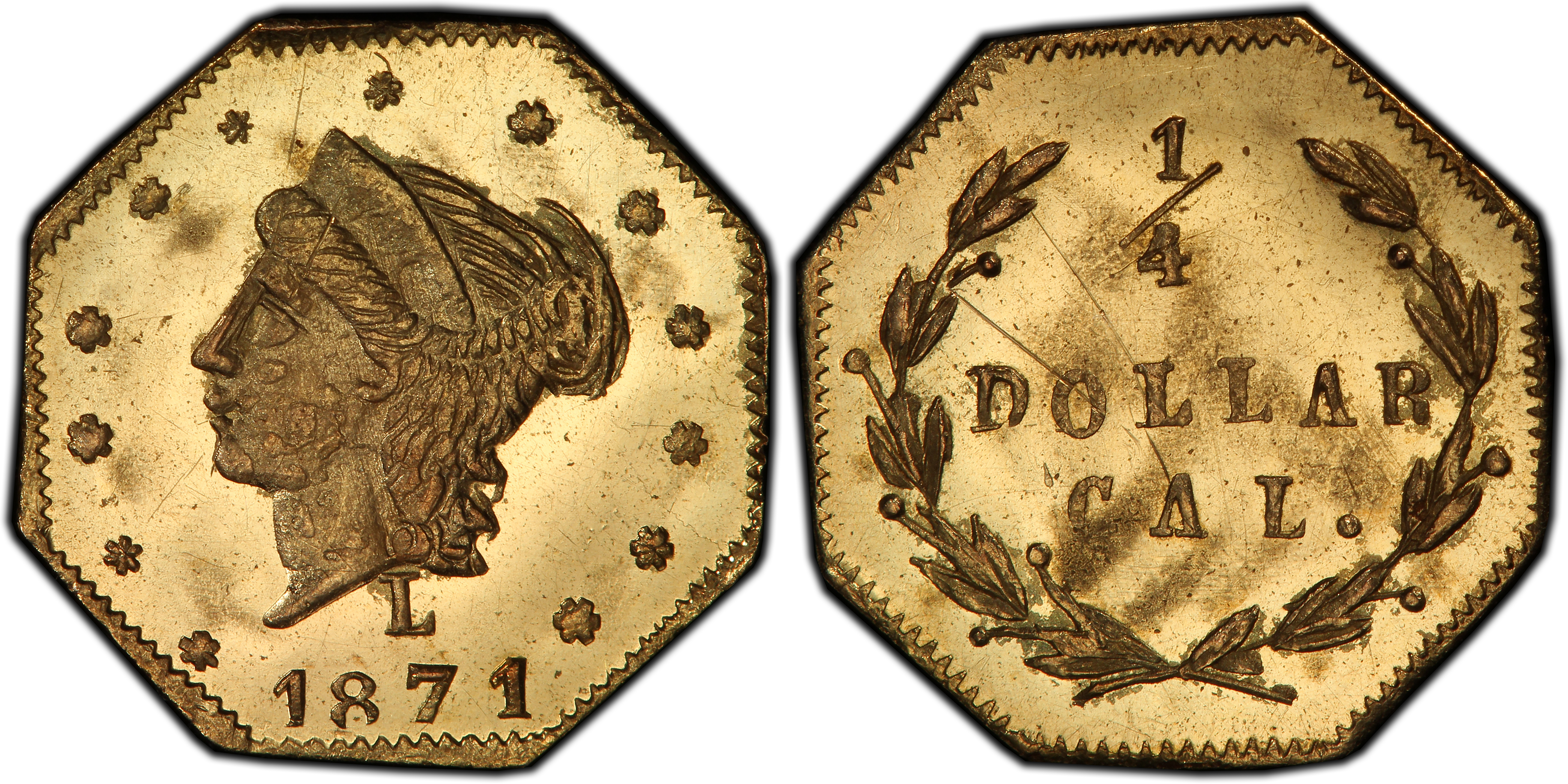
Obverse & Reverse
The 1871 Octagonal 25 Cents, cataloged as Breen-Gillio 770, is a quintessential example of a 'Period Two' California Fractional Gold piece. By 1871, the initial, desperate need for small denomination coinage that characterized the California Gold Rush had largely subsided. The San Francisco Mint, established in 1854, was in full operation, and federal silver coinage had become more plentiful. The purpose of these tiny gold pieces had thus shifted dramatically. No longer essential instruments of commerce, they were now primarily produced as souvenirs, keepsakes, and jewelry items for a burgeoning tourist trade and for residents still captivated by the romance of the Gold Rush. These 'jeweler's issues,' as they are often called, were manufactured by various private firms, with this specific piece attributed to the prominent San Francisco firm of Levison Brothers, who also operated as the California Jewelry Co. Their hallmark, a distinctive 'L', is located on the obverse below the bust of Liberty. The Private Coinage Act of 1864 had made such private minting illegal, but enforcement by the Secret Service was lax and not fully pursued until 1883. This legal gray area allowed jewelers like the Levison Brothers to continue production throughout the 1870s. These pieces were often intentionally underweight and of a lower fineness compared to their 'Period One' predecessors, as their value was derived from their novelty rather than their intrinsic worth. BG-770 was struck in a year when Levison Brothers was a major force in the city's luxury goods market, operating from a large, well-equipped building at 134 Sutter Street. Their production of these miniature gold pieces was a small but fascinating sideline to their main business of importing and manufacturing fine jewelry and watches. Today, the BG-770 serves as a tangible link to post-Gold Rush San Francisco, an era of growing civic pride and commercial maturity, where the raw memories of the '49ers were being transformed into collectible curiosities.
Associated EventPost-California Gold Rush Souvenir Trade
Reason For MintingPrimarily struck for sale as souvenirs and jewelry items, capitalizing on the romanticism of the Gold Rush, rather than for circulation.
Minter HistoryLevison Brothers, also known as the California Jewelry Co., was a major San Francisco firm founded by German immigrant brothers Herman and Louis Levison. Active from 1859 to 1935, they were importers and manufacturers of fine jewelry, watches, diamonds, and silverware. By 1871, they operated from a multi-story building on Sutter Street, a testament to their success. In 1871, they acquired the interests of another fractional gold producer, Robert B. Gray & Co. The production of fractional gold pieces, identified by the 'L' hallmark, was a small part of their extensive business, likely intended to appeal to tourists and locals seeking mementos of California's gold heritage.
Historical SignificanceThe BG-770 is significant not as a circulating coin, but as a cultural artifact representing the commercialization of the Gold Rush legend. It marks the transition of fractional gold from a necessary medium of exchange ('Period One') to a popular souvenir item ('Period Two'), reflecting the changing economic and social landscape of California in the decades following the initial rush.
N/A
Denomination25 Cents
Minting Period1871
Assayer/MinterLevison Brothers (California Jewelry Co.)
Geographic OriginSan Francisco, California
Obverse DescriptionA classic Liberty Head design facing left, similar in style to contemporary federal gold coinage. The hair is tied in a bun with a coronet inscribed LIBERTY (often weakly struck). Thirteen stars encircle the portrait. The date '1871' is below the bust, and the minter's hallmark, a small capital 'L' for Levison, is positioned in the field below the chin.
Obverse InscriptionLIBERTY
Reverse DescriptionAn ornamental wreath of two branches tied with a ribbon at the bottom. The denomination '25 CENTS' is displayed on two lines within the wreath. The design is simple and typical for Period Two fractional gold.
Reverse Inscription25 CENTS
CompositionGold
Stated Fineness Actual Fineness EdgePlain
Unknown
Survival Estimate75-125
Rarity ScaleR-4+
This coin is highly appealing to collectors of California Fractional Gold due to its clear attribution to a major San Francisco jeweler, Levison Brothers, via the 'L' mintmark. Its octagonal shape is a classic feature of the series, and the existence of a significant die variety adds to its collectability. As a 'Period Two' issue, it is more accessible than many 'Period One' coins but remains a scarce and historically rich piece.
Key VarietiesBG-770 is known for a significant die state variety. The initial obverse die featured small, triangular dentils. At some point, the die was re-engraved, sharpening the dentils between the 4 o'clock and 7 o'clock positions into prominent 'spikes'. Both the triangular and spiked dentil varieties are considered to be of roughly equal scarcity. No later-date restrikes or special collector issues are known.
Authentication TipsAuthentic examples are struck in gold, though often of a lower fineness. Check for the small 'L' below the bust; its style and position should match known genuine examples. The strike is often weak, particularly on the word LIBERTY on the coronet and on the central reverse details. Replicas are common and are often brassy in color, feel greasy, and may feature incorrect design details or a soapy, indistinct appearance. A key diagnostic is the weight and specific gravity, as fakes are typically incorrect. Comparing the piece to high-resolution images of certified examples is essential. Be aware of the two dentil varieties (triangular and spiked).
Shopping ConsiderationsA premium quality example for its grade will exhibit a sharp strike for the issue, with as much detail as possible on Liberty's hair and the wreath. Many examples are weakly struck, so a bold strike commands a significant premium. Look for original, undisturbed surfaces with some remaining mint luster; a pleasing, slightly reddish or greenish-gold color is desirable. Avoid coins that have been harshly cleaned, polished, or show evidence of being mounted in jewelry (solder marks, tooling around the rim). Planchet flaws, such as small laminations or fissures, are common and should be evaluated for their impact on eye appeal. The 'spiked dentils' variety is a key feature to look for and adds to the coin's interest.
A coin's grade is its condition, rated on a 1-70 scale. For rare coins, this is the most critical factor in determining value, as a tiny difference in preservation can mean a huge difference in price.
Relevant Grade TypesAll original 1871 BG-770 pieces were struck as business strikes, though they were intended for souvenir sales rather than active circulation. They are found in Circulated (1-58) and, more commonly, Mint State (MS, 60-70) grades due to their souvenir nature. No proofs were struck during the original period of issue, and no later-date Proof restrikes are known to exist.
Mint State CharacteristicsUncirculated examples often exhibit a soft, satiny luster, though some can be prooflike. Strike quality varies significantly; many show weakness on the highest points, such as the letters in LIBERTY, the hair above the ear, and the center of the wreath. Planchet quality can be inconsistent, with minor striations or flaws sometimes visible 'as struck.' Contact marks are common due to the softness of the gold and the way these small pieces were handled in bulk. A truly choice Mint State coin will have minimal marks, strong luster, and an unusually sharp strike for the variety.
Circulated Wear PatternsWear first appears on the high points of Liberty's cheek, the hair above the ear, and the coronet. On the reverse, the highest points of the wreath's leaves and the bow will show friction first. As wear progresses, the legend LIBERTY becomes illegible, and the individual leaves of the wreath begin to merge. In lower grades (VF and below), the date and legends will show significant flattening.
Key Factors For ValueThe primary value drivers for this coin are grade and surface quality. An example with original, uncleaned surfaces and strong mint luster will always be worth more than a cleaned or polished coin of the same grade. Strike sharpness is a major factor; a well-struck piece with full details on the portrait and wreath is highly prized. Eye appeal, including attractive original toning (often a subtle reddish or greenish-gold hue), adds a premium. Finally, certification by a top-tier grading service (PCGS or NGC) is essential for market acceptance and value, with a CAC sticker indicating premium quality for the grade.
PCGS Price Guide
| Grade | Price | Population |
|---|---|---|
| 45 | $190.00 | 1 |
| 45+ | $195.00 | N/A |
| 50 | $200.00 | N/A |
| 50+ | $205.00 | N/A |
| 53 | $210.00 | 2 |
| 53+ | $215.00 | N/A |
| 55 | $220.00 | 3 |
| 55+ | $225.00 | N/A |
| 58 | $230.00 | 8 |
| 58+ | $235.00 | N/A |
| 60 | $245.00 | 5 |
| 61 | $275.00 | 9 |
| 62 | $350.00 | 17 |
| 62+ | $400.00 | N/A |
| 63 | $500.00 | 12 |
| 63+ | $625.00 | N/A |
| 64 | $1,150.00 | 10 |
| 64+ | $1,250.00 | N/A |
| 65 | $2,000.00 | 1 |