1870 G25C BG-752 (Regular Strike)
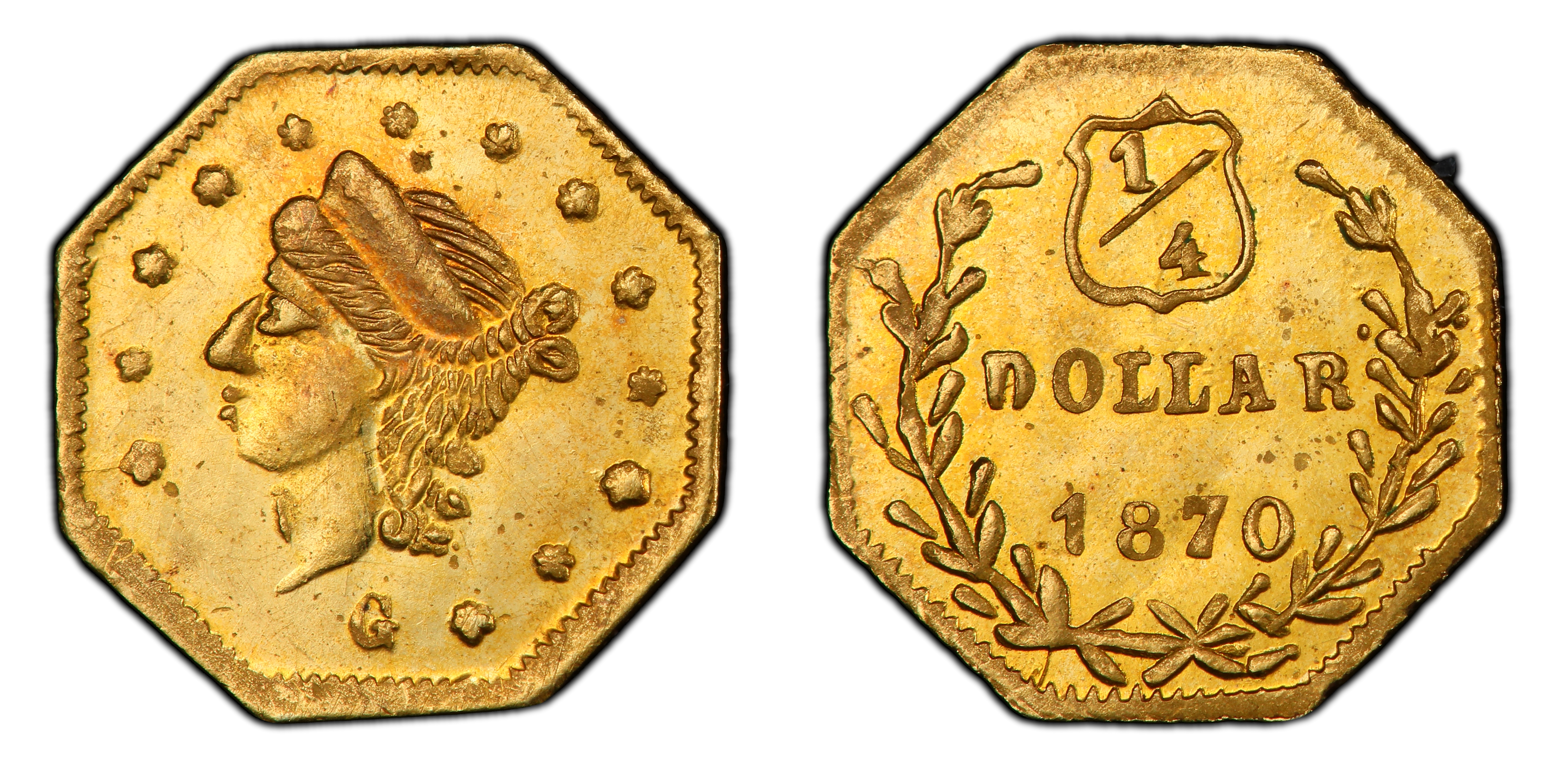
Obverse & Reverse
The 1870 BG-752 25 Cents is a quintessential example of a 'Period Two' California Fractional Gold piece. The initial wave of fractional gold, struck from 1852 to roughly 1857, arose from a genuine and severe shortage of small-denomination coinage in the rapidly expanding economy of Gold Rush California. Gold dust was an impractical and often imprecise medium for minor daily transactions. Private minters, often jewelers with metallurgical skills, stepped in to fill this void, creating quarter, half-dollar, and dollar coins that, while not legal tender, were widely accepted in local commerce. By 1870, the socio-economic landscape had shifted. The United States Mint in San Francisco, operational since 1854, had largely resolved the coinage crisis. The impetus for producing fractional gold transitioned from necessity to novelty. These 'Period Two' issues, struck from 1859 to 1882, were primarily created as souvenirs and keepsakes for tourists and locals fascinated by the Gold Rush legacy. Jewelers in San Francisco continued to be the primary manufacturers, leveraging their craft to create a wide variety of designs. The BG-752, with its distinctive and somewhat crude Liberty portrait, was not intended to circulate widely but rather to be sold as a memento. Its production was a response to a commercial demand for nostalgia, not a monetary need. Unlike the earlier 'Period One' pieces, these later issues were often deliberately underweight, their value derived more from their novelty and connection to California's golden identity than their intrinsic metallic content. The Coinage Act of 1864 had made private coinage illegal, but enforcement was lax, allowing this souvenir trade to flourish until a federal crackdown in the early 1880s finally brought the era of California Fractional Gold to a close.
Associated EventCalifornia Gold Rush (Later Souvenir Period)
Reason For MintingPrimarily struck as a souvenir or keepsake for the tourist trade, capitalizing on the romanticism of the Gold Rush.
Minter HistoryThe specific minter or jeweler who created the dies for BG-752 is unrecorded, a common trait for many 'Period Two' California Fractional Gold varieties. These pieces were often the work of small, independent jewelers in San Francisco who did not consistently apply identifiable mintmarks. Their primary business was jewelry and watchmaking, with fractional gold production being a profitable sideline.
Historical SignificanceThe BG-752 represents the evolution of California Fractional Gold from a necessary circulating medium to a commercial souvenir. Its existence demonstrates the sustained romantic allure of the Gold Rush well into the 1870s and the entrepreneurial spirit of San Francisco's craftsmen who catered to this market. Numismatically, it is part of a complex and highly specialized collecting field that captures a unique chapter in American monetary history.
BG-752
Denomination25 Cents
Minting Period1870
Assayer/MinterUnknown
Geographic OriginSan Francisco, California
Obverse DescriptionA crudely engraved bust of Liberty facing left, characterized by a bulbous throat and a prominent 'Adam's apple' feature, which is a key diagnostic. The portrait has a large nose and puckered lips. Thirteen stars, alternating between small and large in a somewhat irregular pattern, encircle the bust. The letter 'G' (for gold) is sometimes noted as being present, though often weakly struck and far from the truncation of the neck.
Obverse Inscription Reverse DescriptionA simple shield is the central device, containing the denomination '25 CENTS'. The date '1870' appears above the shield. This is noted as the only shield reverse design used in 1870 for this denomination.
Reverse Inscription1870 25 CENTS
CompositionGold
Stated Fineness Actual FinenessVariable, but typically made from native California gold alloy, which contained a significant percentage of silver, resulting in a lighter color than federal gold coinage. Period Two issues were often intentionally underweight and of lower fineness than their stated value.
EdgePlain
Unknown
Survival Estimate31-75 (based on R-5 to R-6 rating)
Rarity ScaleR-5 to R-6
The BG-752 is sought after for its distinctive and somewhat primitive 'Adam's apple' Liberty portrait, which makes it easily identifiable. As a 'Period Two' issue, it is more attainable in high grades than circulating 'Period One' coins, appealing to collectors who want a Mint State example of fractional gold. Its specific design and one-year-only shield reverse type add to its desirability for variety collectors.
Key VarietiesThere are no major varieties of the BG-752 itself, as it is a specific die marriage. No special collector issues, patterns, or restrikes are known to exist for this variety.
Authentication TipsAuthentication requires comparison to known genuine examples. Key diagnostics are the unique 'bulbous throat' or 'Adam's apple' on Liberty's neck, the specific arrangement of the crude stars, and the shield reverse. The strike is often crude and may appear soft in areas. Counterfeits may have incorrect details, a soapy or cast-like texture, or be made of gold-plated base metal. Weight and specific gravity tests can be helpful, but consulting an expert or relying on third-party grading is highly recommended.
Shopping ConsiderationsA premium quality example for its grade will exhibit a sharp strike, particularly on the date and the details of Liberty's face. Look for coins with bright, original mint luster and minimal distracting contact marks. The very small size of these coins makes them prone to being lost or damaged; avoid examples that have been holed, bent, or used in jewelry. Surface quality is paramount; coins with original, uncleaned surfaces command significant premiums. Some examples show attractive, subtle toning, which is prized by discerning collectors.
A coin's grade is its condition, rated on a 1-70 scale. For rare coins, this is the most critical factor in determining value, as a tiny difference in preservation can mean a huge difference in price.
Relevant Grade TypesOriginal period issues were business strikes. While created as souvenirs, they could have seen minor handling, so they are found in both Circulated (1-58) and Mint State (MS, 60-70) grades. Due to their nature as collectibles from the time of issue, a higher proportion survive in uncirculated grades compared to 'Period One' pieces. No Proof (PR/PF) examples of this variety were struck during the original period of issue, and no later-date restrikes are known.
Mint State CharacteristicsUncirculated examples of BG-752 typically exhibit a satiny to sometimes semi-prooflike luster. The quality of the strike is a key determinant of grade; many were struck with uneven pressure, resulting in weakness on the high points of Liberty's hair or the stars. A well-struck piece with full details is rare and desirable. Small, planchet-related flaws or die crudeness are common and should not be confused with post-strike damage. Contact marks, even small ones, can be prominent due to the tiny size and soft nature of the gold.
Circulated Wear PatternsWear first appears on the highest points of the design. On the obverse, this includes Liberty's cheek, the hair above her eye, and her 'Adam's apple'. On the reverse, the high points of the shield and the digits of the date will show the first signs of friction. In lower grades (VF and below), the stars will begin to lose their definition and merge with the fields.
Key Factors For ValueThe primary drivers of value are grade and surface quality. An uncirculated coin with brilliant, undisturbed luster will be worth many times more than a circulated or cleaned example. Strike sharpness is a major factor; a bold strike that clearly renders the crude but distinctive features of the portrait is highly sought after. Eye appeal, encompassing attractive original color and a lack of distracting marks, is critical. For this series, certification by a major grading service (PCGS or NGC) is almost essential for marketability, and a CAC sticker signifying premium quality for the grade will add a substantial premium.
PCGS Price Guide
| Grade | Price | Population |
|---|---|---|
| 50 | $200.00 | 1 |
| 50+ | $205.00 | N/A |
| 53 | $220.00 | 1 |
| 53+ | $225.00 | N/A |
| 55 | $240.00 | 7 |
| 55+ | $250.00 | N/A |
| 58 | $275.00 | 7 |
| 58+ | $300.00 | N/A |
| 60 | $350.00 | 5 |
| 61 | $425.00 | 6 |
| 62 | $500.00 | 17 |
| 62+ | $625.00 | N/A |
| 63 | $800.00 | 9 |