1881 25C BG-799M (Regular Strike)
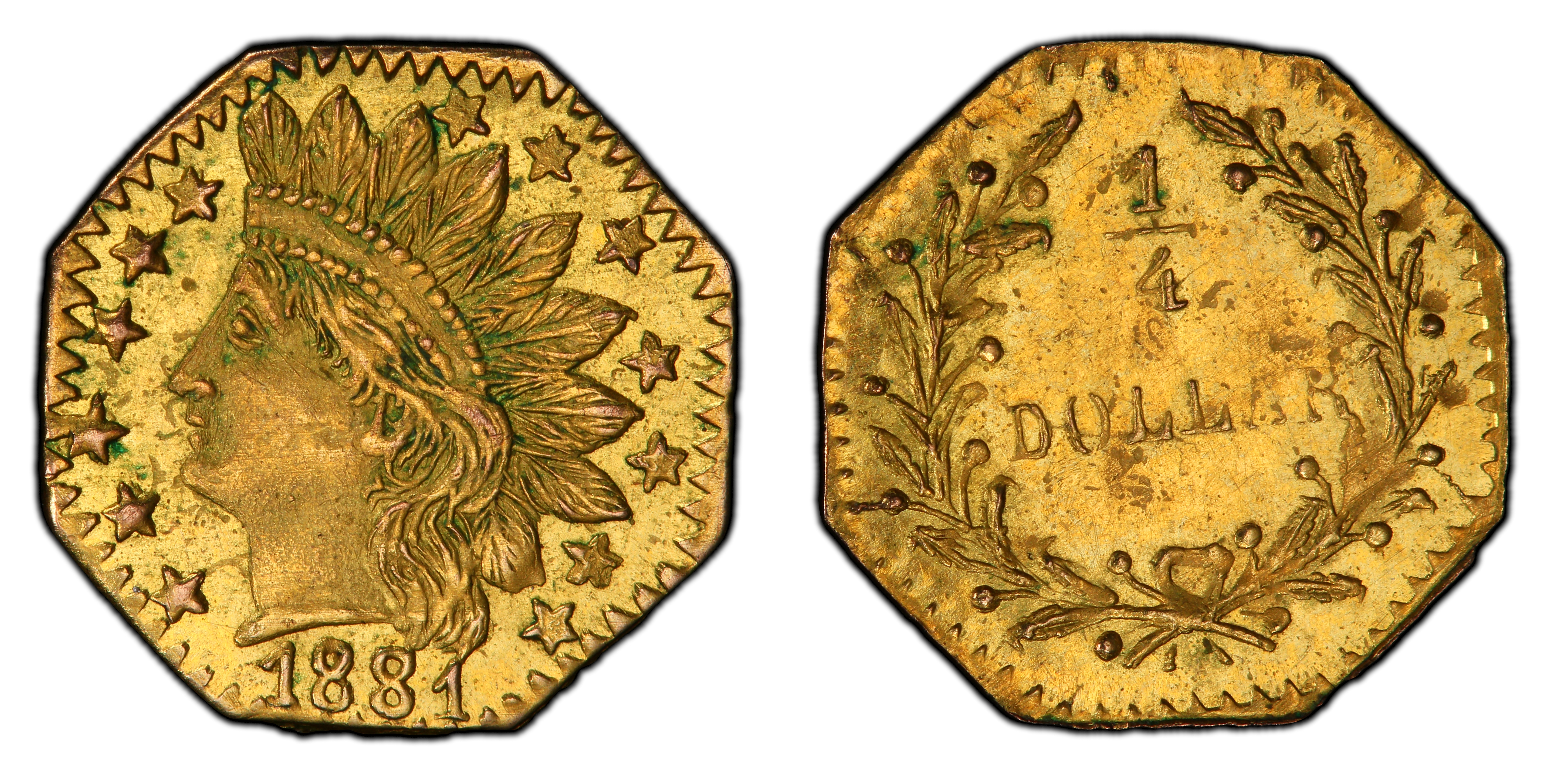
Obverse & Reverse
The 1881 25-cent BG-799M is a quintessential example of a 'Period Two' California Fractional Gold piece. These later issues (1858-1882) stand in contrast to the 'Period One' (1852-1857) coins, which were struck out of genuine commercial necessity to alleviate a severe shortage of small change during the initial frenzy of the Gold Rush. By the 1880s, the economic landscape of California had matured significantly. The San Francisco Mint was in full operation, supplying ample federal coinage for daily transactions. The acute need for privately-minted fractional gold had long since vanished. Instead, these miniature gold pieces had found a new and enduring market as souvenirs and keepsakes. San Francisco had become a major tourist destination, and visitors from the East Coast and Europe were fascinated by the romantic legacy of the '49ers. Jewelers and private minters, such as Christopher Ferdinand Mohrig, capitalized on this by producing beautifully crafted, albeit often debased, gold tokens that evoked the spirit of the Gold Rush. These pieces were not intended for circulation but were sold as charms, mementos, and additions to jewelry. The Coinage Act of 1864 had made private coinage illegal, but the law was not aggressively enforced against these small, denominated tokens until the U.S. Secret Service launched a crackdown in the early 1880s. This pressure effectively ended the era of denominated fractional gold production by 1883. Mohrig himself had been arrested in 1876 for his coining activities, leading to the confiscation and destruction of many of his dies and coins, which explains the rarity of several varieties within his prolific output (BG-790 through BG-799V). The 1881 BG-799M represents one of the final expressions of this uniquely Californian numismatic tradition, a tangible link to the fading memory of the Gold Rush, produced just before federal enforcement closed the chapter on private gold coinage in the United States.
Associated EventPost-Gold Rush California Tourism
Reason For MintingTo be sold as a souvenir or charm capitalizing on the romantic history of the California Gold Rush.
Minter HistoryChristopher Ferdinand Mohrig was a prominent San Francisco jeweler and one of the most prolific producers of 'Period Two' California Fractional Gold. He is credited with minting the extensive series of varieties cataloged as BG-790 through BG-799V. His operations faced legal challenges, culminating in his arrest on August 10, 1876, for violating the Private Coinage Act of 1864. Authorities confiscated and destroyed his dies and existing coin stock, which contributes to the scarcity of many of his issues. Despite this, he continued production into the early 1880s, creating some of the last denominated fractional gold pieces before federal enforcement ended the practice.
Historical SignificanceThe BG-799M is historically significant not as a circulating coin, but as a cultural artifact of late 19th-century California. It represents the commercialization of the Gold Rush legend and the transition of fractional gold from a practical monetary substitute to a nostalgic souvenir, marking the end of a 30-year tradition of private gold coining in the West.
N/A
Denomination25C
Minting Period1881
Assayer/MinterChristopher Ferdinand Mohrig
Geographic OriginSan Francisco, California
Obverse DescriptionAn Indian Head profile facing left, adorned with a feathered headdress. The portrait is encircled by 13 stars, representing the original colonies. The date '1881' is positioned below the bust.
Obverse Inscription1881
Reverse DescriptionA wreath of leaves and berries surrounds the denomination '1/4 DOLLAR'. The wreath is open at the top. This variety is known as a 'No Cal' type as the word 'CALIFORNIA' is absent.
Reverse Inscription1/4 DOLLAR
CompositionGold
Stated Fineness Actual FinenessOften debased, with fineness ranging from 14 to 22 karats for Period Two issues.
Weight0.25 grams
Diameter9.50 mm
EdgePlain
Unknown
Survival Estimate76-150 (Low R-5)
Rarity ScaleLow R-5
This variety appeals to collectors for its distinctive octagonal shape, attractive Indian Head design, and its status as a late-date, historically significant souvenir issue. Its known rarity and connection to the minter C.F. Mohrig add to its desirability.
Key VarietiesThe primary variety is the regular business strike. No original proofs were struck, but high-quality surviving examples often exhibit prooflike surfaces from being struck on polished planchets. There are no known major die varieties for BG-799M itself, but the broader BG-799 series contains numerous minor die variations (designated by letters A through V). No later-date restrikes are known.
Authentication TipsGenuine Period Two fractionals like BG-799M are characteristically very thin, often compared to the thickness of a business card. Replicas and fakes are almost always significantly thicker and heavier. A key diagnostic is the presence of a denomination (e.g., '1/4 DOLLAR'); most fakes and later charms are undenominated or use phrases like 'CAL GOLD CHARM'. Genuine pieces can exhibit weak or uneven strikes, sometimes with unstruck areas, a feature rarely seen on modern copies. The style of the engraving, particularly the portrait and lettering, should be compared to known genuine examples.
Shopping ConsiderationsA premium quality example for its grade will possess sharply struck details, especially on the feathers of the headdress and the lettering on the reverse. Many examples come with prooflike or deeply mirrored fields, which command a significant premium. Look for original, undisturbed luster and a pleasing 'butter-gold' color. Common issues to avoid include cleaning, which imparts hairlines and dulls the luster, and jewelry use, such as solder marks, holes, or excessive rim damage. Some genuine pieces were struck on slightly wavy planchets, which is an acceptable characteristic of their manufacture. An example with 'attenuated' letters (e.g., the AR in DOLLAR) due to die polishing is a known characteristic and not necessarily a flaw.
A coin's grade is its condition, rated on a 1-70 scale. For rare coins, this is the most critical factor in determining value, as a tiny difference in preservation can mean a huge difference in price.
Relevant Grade TypesOriginal period issues were business strikes produced for sale as souvenirs and are found in Circulated (1-58) and, more commonly, Mint State (MS, 60-70) grades. Due to their nature as keepsakes, many were well-preserved. No official Proof (PR/PF) examples were struck during the original minting period. However, many Mint State examples were struck on highly polished planchets, resulting in reflective, mirror-like surfaces. These are designated as Prooflike (PL) or Deep Prooflike (DMPL) by grading services and are considered distinct numismatic items from the regular business strikes, commanding significant premiums.
Mint State CharacteristicsUncirculated examples of BG-799M are characterized by their often brilliant, prooflike luster. The strike can be variable; while some are sharp, many exhibit softness in the centers, particularly on the highest points of the Indian's hair and the reverse wreath. It is not uncommon to find minor strike-throughs (small debris struck into the coin's surface) or slight planchet waviness, both artifacts of the private minting process. The extremely soft gold is prone to contact marks, even on coins that never circulated, so finding a truly pristine example is a major challenge.
Circulated Wear PatternsAs these were primarily souvenirs, circulated examples are uncommon. When wear is present, it first appears on the highest points: the cheek and feathers of the Indian Head on the obverse, and the leaves of the wreath and the fraction '1/4' on the reverse. In lower grades, the fine details of the feathers would merge and the reverse legends would become soft.
Key Factors For ValueValue is driven by several key factors. Grade is paramount, with Gem (MS-65 and higher) examples being significant rarities. The quality of the surface is critical; specimens with deep, vibrant, original prooflike or deep prooflike surfaces are the most desirable and command the highest prices. Eye appeal, determined by the sharpness of the strike, lack of distracting marks, and attractive original color, is a major value driver. A sticker from CAC (Certified Acceptance Corporation) indicating a premium quality coin for its assigned grade will add a substantial premium.
PCGS Price Guide
| Grade | Price | Population |
|---|---|---|
| 60 | $300.00 | 2 |
| 61 | $325.00 | 1 |
| 62 | $350.00 | 4 |
| 62+ | $365.00 | N/A |
| 63 | $400.00 | 19 |
| 63+ | $440.00 | N/A |
| 64 | $550.00 | 19 |
| 64+ | $600.00 | N/A |
| 65 | $675.00 | 11 |
| 65+ | $850.00 | N/A |
| 66 | $1,300.00 | 1 |