1876 25C BG-799D (Regular Strike)
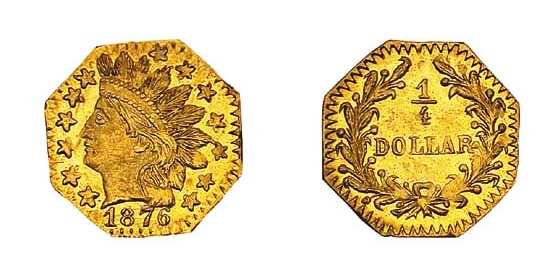
Obverse & Reverse
The 1876 BG-799D 25 Cent piece emerges from the second period of California Fractional Gold production (1859-1882), a fascinating and complex chapter in American numismatics. The initial impetus for these tiny gold coins stemmed from the acute shortage of small change during the early California Gold Rush. Gold dust was impractical for minor transactions, leading private minters to fill the void starting in 1852. By the 1870s, however, the role of these pieces had evolved significantly. The Coinage Act of 1864 had made private coinage illegal, yet the law was not strictly enforced in California until 1883. This legal gray area allowed for continued production, but the pieces became less like circulating currency and more like souvenirs or 'keepsakes' for tourists and locals. Termed 'jeweler's issues,' these Period Two coins were often underweight for their stated value and featured a wider variety of creative, non-federal designs, a stark contrast to the utilitarian Period One issues that more closely mimicked official U.S. coinage. The year 1876 was particularly significant as it marked the Centennial of the United States' independence, celebrated with the massive Centennial International Exposition in Philadelphia. This event sparked a nationwide interest in commemorative items and American history. While produced in San Francisco, coins like the BG-799D, with their 'Indian Head' motif—a popular and romanticized symbol of America—would have resonated with the patriotic and nostalgic sentiments of the era. These pieces were manufactured by various, often anonymous, jewelers in San Francisco, using techniques like the hammer method, which resulted in coins of varying strike quality. Their primary market was no longer grizzled miners making daily purchases, but rather citizens and visitors captivated by the allure of the Gold Rush and looking for an affordable, tangible piece of that legacy. The BG-799D and its contemporaries represent the commercial adaptation of a numismatic necessity into a popular collectible souvenir before the federal government finally shuttered all private minting operations.
Associated EventCalifornia Gold Rush (Later Period) / U.S. Centennial
Reason For MintingPrimarily created as popular souvenirs and curios for a public fascinated with the Gold Rush, rather than to alleviate a currency shortage which was the impetus for earlier issues.
Minter HistoryThe specific minters of most Period Two California Fractional Gold, including BG-799D, are unknown. They are collectively referred to as 'jeweler's issues' and are believed to have been produced by various French and other jewelers operating in San Francisco. These craftsmen were skilled in working with gold but were not official minters, hence the often creative designs and inconsistent weights. Their anonymity was also likely a strategic choice, given the legally ambiguous nature of their work after the Coinage Act of 1864.
Historical SignificanceThe BG-799D is historically significant not as a coin that facilitated commerce, but as a representation of the commercialization of the Gold Rush mythos. It marks a transition from utilitarian private coinage to souvenir tokens, reflecting both the maturation of California's economy and the enduring national fascination with the West. Its 1876 date ties it directly to the American Centennial, a period of intense national reflection and celebration.
Not Applicable
Denomination25C
Minting Period1876
Assayer/MinterUnknown, likely San Francisco-based jewelers
Geographic OriginSan Francisco, California
Obverse DescriptionA stylized head of a Native American figure, often referred to as 'Indian Head,' facing left. The figure wears a feathered headdress. The design is encircled by thirteen stars, representing the original colonies.
Obverse Inscription[None, design only]
Reverse DescriptionThe reverse features the denomination '1/4' and the word 'DOLLAR' within a wreath of leaves. The date '1876' is positioned below the wreath.
Reverse Inscription1/4 DOLLAR 1876
CompositionGold
Stated Fineness Actual FinenessVariable, often ranging from 14 to 22 carats; these Period Two issues were known for being underweight and containing less gold than their face value suggested.
Diameter9.70 mm
EdgePlain
Unknown
Survival EstimateScarce, likely a few hundred known
Rarity ScaleHigh R-6 (per some dealer descriptions, implying approximately 4 to 6 known, though this may refer to specific high grades rather than the total population).
The BG-799D appeals to collectors due to its connection to the romanticized California Gold Rush, its classic 'Indian Head' design, and its status as a tangible artifact from the U.S. Centennial year. Its tiny size and octagonal shape add to its charm and distinctiveness.
Key VarietiesThe Breen-Gillio (BG) catalog is the definitive reference for this series. The BG-799 variety is known for its Indian head obverse and wreath reverse. The 'D' in BG-799D refers to a specific die pair with unique characteristics. Other BG-799 varieties (like 799E, 799F, etc.) exist from different dies. No original proof strikings or official restrikes are known for this specific variety; all are considered business strikes, though some may exhibit prooflike surfaces from polished dies.
Authentication TipsGenuine pieces are typically very thin, often the thickness of a business card. Counterfeits are often thicker and have a 'soapy' or cast appearance. Weak or incomplete strikes are common on authentic pieces, especially around the peripheries, due to the hammer striking method. Fakes, conversely, may appear too perfectly struck. Verify the style of the Indian head and the wreath against known genuine examples. Be wary of any pieces with unusual surfaces, incorrect weight or diameter, or design details that do not match the BG-799D die characteristics. Authentication by a major third-party grading service (PCGS or NGC) is highly recommended.
Shopping ConsiderationsWhen acquiring a BG-799D, look for a sharp strike on the high points of the design, particularly the details in the headdress and the numerals of the date. Original, lustrous surfaces are highly desirable and command significant premiums. Many surviving examples have been cleaned or damaged due to their small size and use in jewelry; avoid pieces with harsh cleaning lines, excessive scratches, tooling, or evidence of being mounted. A premium quality example will have pleasing eye appeal, with minimal distracting marks and a well-centered strike. Given the variability of the manufacturing process, even Mint State examples can show some striking weakness, so understanding the typical characteristics of the issue is key.
A coin's grade is its condition, rated on a 1-70 scale. For rare coins, this is the most critical factor in determining value, as a tiny difference in preservation can mean a huge difference in price.
Relevant Grade TypesOriginal 1876 BG-799D pieces were business strikes intended for sale as souvenirs, not circulation in the traditional sense. They are found in Circulated (1-58) grades, though this wear may be from handling or jewelry use, and Mint State (MS, 60-70) grades. No original Proofs (PR/PF) were struck. However, some business strikes were made with highly polished dies, resulting in a mirrored or 'Prooflike' (PL) surface, which is a desirable characteristic noted on the grading label but is distinct from a true Proof striking.
Mint State CharacteristicsAn uncirculated BG-799D is defined by the presence of original mint luster. The quality of this luster can range from satiny to semi-prooflike. Strike is a key factor; many are softly struck, so a piece with sharp details on the headdress and wreath is a premium coin. Due to the softness of the gold and the manufacturing process, even high-grade uncirculated examples can have small planchet flaws or minor contact marks. A truly 'gem' (MS-65 or higher) example is very rare.
Circulated Wear PatternsWear first appears on the highest points of the design. On the obverse, this includes the cheek and the feathers of the headdress. On the reverse, the high points of the wreath and the numerals in the date will show the first signs of friction and loss of detail. On lower grade examples, the stars on the obverse will begin to merge with the field.
Key Factors For ValueThe primary value drivers for an 1876 BG-799D are grade and surface quality. An example with original, undisturbed luster will be worth multiples of a cleaned or polished coin. Sharpness of the strike is critical; well-struck specimens with full details are highly prized. Eye appeal, encompassing attractive original color and minimal distracting marks, is also paramount. Certification by a top-tier service like PCGS or NGC is essential for market acceptance and value realization. A CAC sticker for this issue would indicate superior quality for the grade and carry a significant premium.
PCGS Price Guide
| Grade | Price | Population |
|---|---|---|
| 63 | $425.00 | 5 |
| 63+ | $525.00 | N/A |
| 64 | $675.00 | 14 |
| 64+ | $1,150.00 | N/A |
| 65 | $2,750.00 | 3 |