1881 G25C BG-788 (Regular Strike)
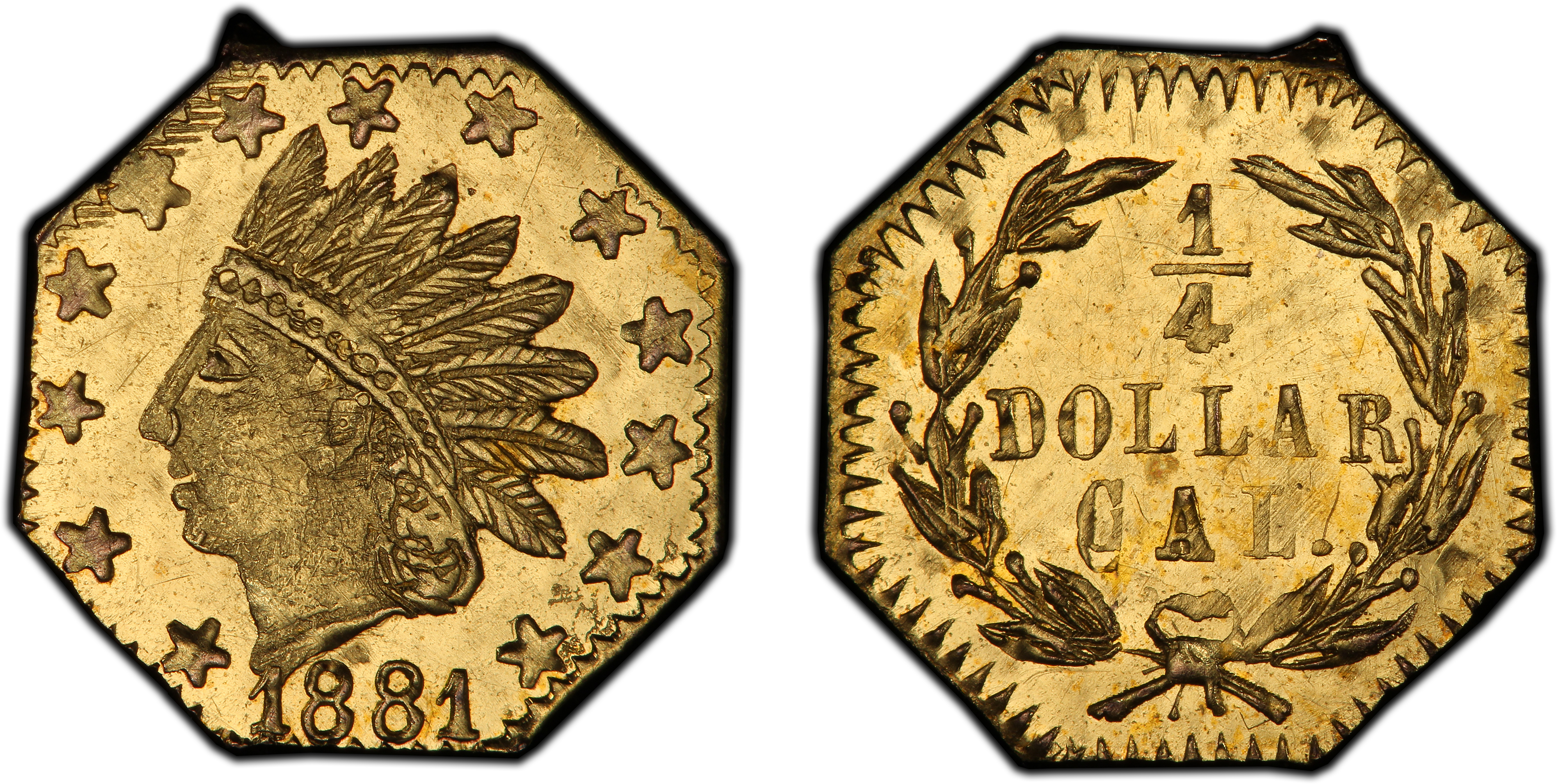
Obverse & Reverse
The 1881 G25C BG-788 is a quintessential example of a 'Period Two' California Fractional Gold piece. By the 1880s, the frantic necessity for small denomination coinage that characterized the initial California Gold Rush had long subsided. The United States Mint in San Francisco, operational since 1854, was producing ample federal coinage for commerce. The continued production of these tiny, privately-issued gold pieces had therefore shifted from a monetary necessity to a commercial enterprise catering to nostalgia, tourism, and the jewelry trade. These later issues, often termed 'jeweler's pieces,' were not intended for widespread circulation in the same manner as their 'Period One' (1852-1857) predecessors. Instead, they were created as charming keepsakes and souvenirs of the romanticized Gold Rush era. Many were sold to tourists visiting San Francisco or were incorporated into rings, stickpins, and other adornments. The minters were typically jewelers who possessed the requisite skills and equipment for die-sinking and striking. While the minter of BG-788 is not definitively known, stylistic analysis and business succession point strongly towards Robert B. Gray & Co. Gray had acquired the business of an earlier fractional gold producer, Antoine Nouizillet, around 1859-60, and was a prolific maker of these souvenir coins until selling his own interests in 1871. However, dies were often used, sold, and muled for years, making precise attribution for later dates challenging. The passage of the Comstock Act in 1873, and increasing pressure from the U.S. Secret Service which viewed private coinage as a violation of federal law, created a legally precarious environment for minters. This led many to backdate their creations to pre-1864 dates to avoid prosecution. The 1881 date on BG-788 is therefore notable as one of the last explicit dates used before production was effectively halted in 1883. Surviving examples are almost exclusively found in high grades, confirming their status as collectibles from the time of issue rather than workhorse coins of commerce. Their numismatic significance today lies in their connection to the enduring legacy of the Gold Rush and as representatives of the final chapter of this uniquely American private coinage tradition.
Associated EventPost-Gold Rush California Tourism
Reason For MintingPrimarily produced as souvenirs and for use in jewelry, catering to a nostalgic market long after the initial coin shortage had ended.
Minter HistoryRobert B. Gray was a San Francisco jeweler who became a significant producer of 'Period Two' California Fractional Gold. Around 1859-60, he purchased the business of Antoine Louis Nouizillet, another key minter from 'Period One.' Gray continued to use some of Nouizillet's dies while also creating his own, which are often identifiable by a 'G' hallmark. His issues are noted by researchers like Breen and Gillio for being of generally higher quality and weight compared to other contemporary jeweler's pieces. Gray sold his business to the California Jewelry Co. in 1871, but the dies he created likely remained in use or influenced subsequent designs, making attributions of later-date, unmarked pieces like BG-788 to his workshop plausible.
Historical SignificanceThis coin represents the twilight of the California Fractional Gold series, embodying the transition from emergency-use currency to commercial souvenir. It is a tangible artifact of how the Gold Rush was memorialized and merchandised in the late 19th century, produced just before federal enforcement ended the practice of private gold coinage entirely.
BG-788
Denomination25 Cents
Minting Period1881
Assayer/MinterAttributed to Robert B. Gray & Co.
Geographic OriginSan Francisco, California
Obverse DescriptionA right-facing portrait of a Native American (Indian Head) wearing a feathered headdress. The portrait is surrounded by thirteen six-pointed stars. The date '1881' is positioned below the bust truncation.
Obverse Inscription1881
Reverse DescriptionThe denomination '1/4 DOLLAR' is inscribed within a wreath composed of two olive branches tied with a bow at the bottom. A small dot or pellet is often visible in the center, a relic of the manufacturing process.
Reverse Inscription1/4 DOLLAR
CompositionGold
Stated Fineness Actual FinenessVariable, typically between .500 and .800 fine, and generally underweight relative to their face value.
EdgePlain
Unknown
Survival EstimateFewer than 15 known (NGC Census shows only 7 graded as of late 2025)
Rarity ScaleR-7 (4 to 12 known)
The BG-788 is highly sought after due to its extreme rarity as a late-date issue. Its octagonal shape and classic Indian Head design make it visually appealing. As one of the final dated issues of this historic series, it holds significant numismatic importance for specialists.
Key VarietiesA very rare muling exists (sometimes called the 'Burnie variety') where the BG-788 obverse die is paired with a different reverse. This mule is considered even rarer than the regular BG-788 striking and is cataloged as R-7+.
Authentication TipsAuthentic pieces must have the denomination clearly stated as '1/4 DOLLAR'; modern replicas often omit this or use phrases like 'CAL GOLD' with a bear motif, which is never found on genuine 19th-century issues. The strike on genuine pieces is often uneven, with some softness in the stars or wreath details due to the crude minting process. Replicas are frequently sharply and evenly struck. The gold color should appear natural; overly bright, brassy tones suggest a modern copy. The planchets are typically very thin. Any suspicious piece should be compared to high-resolution images of certified examples.
Shopping ConsiderationsA premium quality example for this issue is defined by a sharp strike on the central devices, particularly the details of the headdress and the lettering on the reverse. Given their purpose as souvenirs, most survivors are in Mint State, so circulation wear is not a major factor. Look for coins with bright, original luster and minimal distracting contact marks. Prooflike (PL) or Deep Prooflike (DPL) surfaces command a significant premium. Avoid examples that have been holed or mounted for jewelry, as this severely impacts value, although it is not uncommon for the type. Check for evidence of cleaning (hairlines) or tooling in the fields.
A coin's grade is its condition, rated on a 1-70 scale. For rare coins, this is the most critical factor in determining value, as a tiny difference in preservation can mean a huge difference in price.
Relevant Grade TypesOriginal issues were business strikes, although not intended for circulation, and are found in Mint State (MS, 60-70) grades. Circulated examples (1-58) are almost never encountered, as these pieces were saved as keepsakes. No true Proofs (PR/PF) were struck during the original period of issue. The highly reflective fields seen on some examples are a result of polished dies and are designated as Prooflike (PL) or Deep Prooflike (DPL), which are attributes of a business strike, not a separate striking method.
Mint State CharacteristicsUncirculated examples of BG-788 typically exhibit a soft, satiny luster, though some possess highly reflective, prooflike fields from polished dies. The strike can be inconsistent; weakness is common on the stars nearest the rim and on the finer details of the wreath. The small, thin planchet is prone to minor handling marks, even on high-grade specimens. The color of the gold can vary depending on the alloy but is often a rich yellow-gold.
Circulated Wear PatternsOn the rare occasion a circulated example is found, wear first appears on the high points of the design. For the obverse, this would be the Indian's cheekbone, the eyebrow, and the details of the feathers in the headdress. On the reverse, the highest points of the wreath's leaves and the bow would show the first signs of friction and flattening.
Key Factors For ValueRarity is the primary driver of value for this variety. Beyond that, surface quality is paramount. An example with clean, undisturbed fields and original luster will be worth multiples of one with hairline scratches from cleaning or numerous contact marks. Strike quality is also key; a coin with a full, sharp strike on both the Indian Head and the wreath is highly desirable. Eye appeal, including attractive original toning or deep prooflike contrast, adds a significant premium. A CAC sticker for this issue confirms premium quality for the grade and results in a substantial increase in value.
PCGS Price Guide
| Grade | Price | Population |
|---|---|---|
| 60 | $700.00 | N/A |
| 61 | $800.00 | N/A |
| 62 | $950.00 | 5 |
| 62+ | $1,250.00 | N/A |
| 63 | $2,000.00 | 2 |
| 63+ | $2,750.00 | N/A |
| 64 | $4,250.00 | 6 |
| 64+ | $5,000.00 | N/A |
| 65 | $6,000.00 | 1 |
| 65+ | $6,750.00 | N/A |
| 66 | $8,000.00 | N/A |
| 66+ | $9,250.00 | N/A |