1875 25C BG-796, PL (Regular Strike)
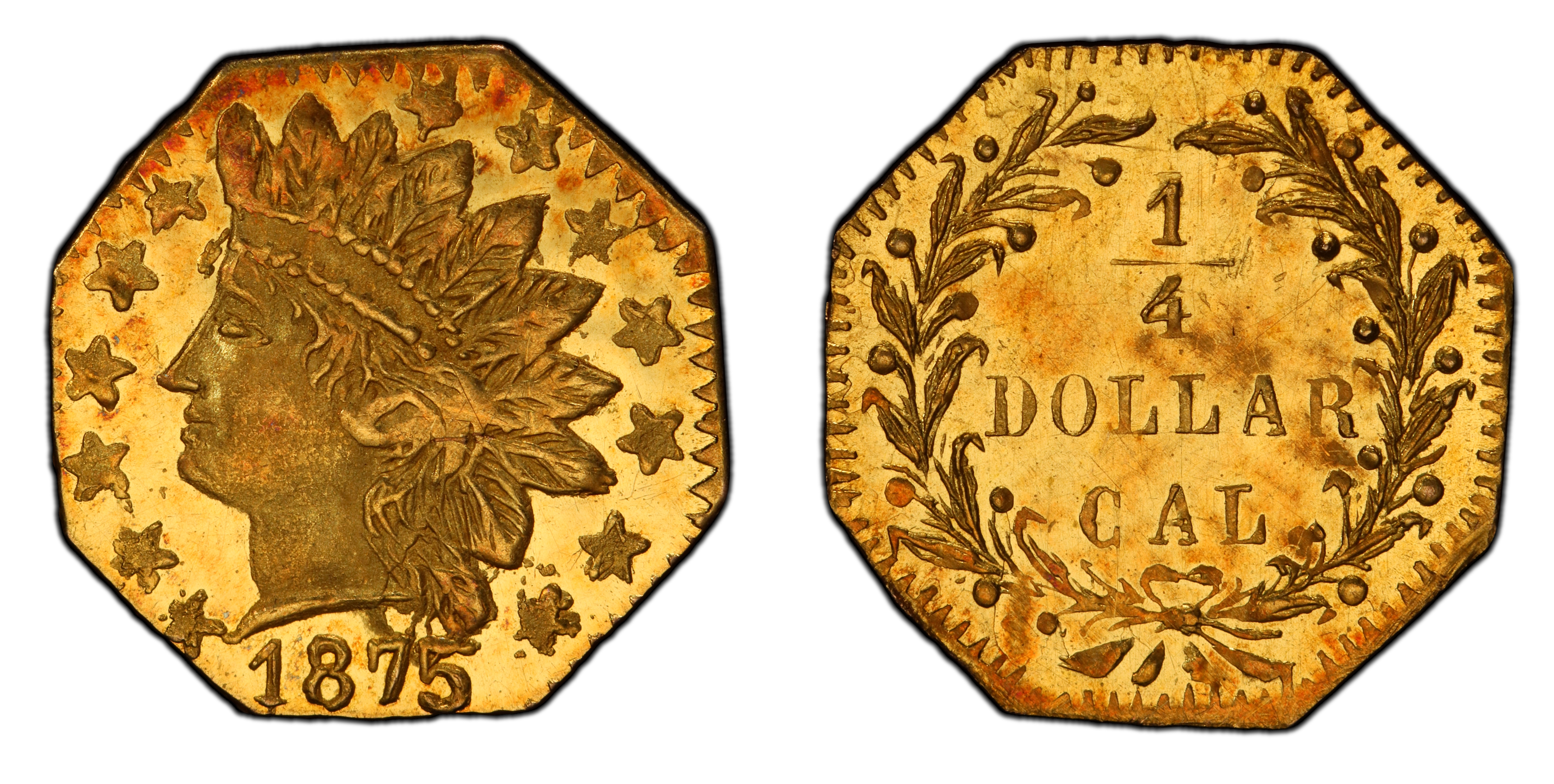
Obverse & Reverse
The 1875 Octagonal Indian Head Quarter Dollar, cataloged as BG-796, is a quintessential example of a 'Period Two' California Fractional Gold piece. These later issues (1858-1882) stand in contrast to the earlier 'Period One' coins (1852-1857), which were struck out of genuine commercial necessity to alleviate a severe shortage of small change during the initial frenzy of the Gold Rush. By the mid-1870s, the San Francisco Mint was in full operation and the acute need for private fractional coinage had long since passed. Instead, these miniature gold pieces were produced and sold primarily as souvenirs, jewelry, and curiosities for tourists and locals nostalgic for the Gold Rush era. The minter of the BG-790 through BG-799 series, Christopher Ferdinand Mohrig, was a San Francisco jeweler who actively produced these popular tokens. His enterprise, however, operated in a legally gray area. The Coinage Act of 1864 had explicitly prohibited private coinage, but enforcement was lax on the West Coast for over a decade. This tolerance ended in the mid-1870s when the U.S. Secret Service, under the direction of Chief James J. Brooks, began a concerted crackdown on private minters, viewing their products as a potential source of fraud. Mohrig himself was arrested on August 10, 1876, and his dies and remaining inventory were confiscated and destroyed. This law enforcement action abruptly ended his production and contributes to the relative scarcity of his later issues. The BG-796, therefore, is not a coin that ever served as money in the conventional sense but is a tangible link to the romantic aftermath of the Gold Rush and the federal government's efforts to centralize and control the nation's currency.
Associated EventPost-Gold Rush Era Souvenir Coinage
Reason For MintingPrimarily created for sale as a souvenir or keepsake of the California Gold Rush, rather than for circulation.
Minter HistoryChristopher Ferdinand Mohrig was a San Francisco-based jeweler and one of the most prolific producers of 'Period Two' California Fractional Gold. He is credited with striking numerous varieties from 1872 until his arrest in August 1876. His work is characterized by the Indian Head motif common to this period. His operation was shut down by the U.S. Secret Service, which confiscated his equipment, making his extant pieces a finite and historically significant collection.
Historical SignificanceThe BG-796 is significant not as a circulating coin, but as a historical artifact representing the commercialization of the Gold Rush legacy and the final chapter of private gold minting in the United States before federal law was strictly enforced.
BG-796
Denomination25C
Minting Period1875
Assayer/MinterChristopher Ferdinand Mohrig
Geographic OriginSan Francisco, California
Obverse DescriptionThe obverse features a large, stylized bust of a Native American princess facing left, often referred to as an Indian Head. She wears a feathered headdress. The date '1875' is positioned below the bust. Thirteen stars encircle the central motif along the octagonal border.
Obverse Inscription1875
Reverse DescriptionThe central design element on the reverse is a wreath of leaves and berries, open at the top. Inside the wreath, the denomination '1/4 DOLLAR' is inscribed on two lines. The abbreviation 'CAL.' for California is located at the top of the wreath.
Reverse Inscription1/4 DOLLAR CAL.
CompositionGold
Stated Fineness Actual FinenessTypically underweight and of varying fineness, often ranging from 14 to 22 karats, but no specific analysis for BG-796 is widely published.
Weight0.24 grams
Diameter9.60 mm
EdgePlain
Unknown
Survival EstimateFewer than 200, possibly as low as 75-125.
Rarity ScaleR-5 (Very Scarce) to R-6 (Extremely Scarce)
The BG-796 appeals to collectors due to its direct connection to a named and historically documented Gold Rush-era minter, its classic Indian Head design, octagonal shape, and its status as a 'Period Two' issue, which are often collected as a distinct series. The scarcity, resulting from the short minting period before Mohrig's arrest, adds to its desirability.
Key VarietiesThe primary variety distinction for collectors is the surface characteristic. The 'PL' (Prooflike) designation, noted in the original request, refers to a regular business strike that exhibits deeply mirrored fields and sometimes frosted devices, resembling a proof coin. These are highly sought after and command a significant premium over non-PL examples. No major die varieties or later-date restrikes are cataloged for BG-796.
Authentication TipsGenuine BG-796 pieces have a sharp, albeit sometimes uneven, strike from die-cut punches. Look for the correct die markers and compare them to high-resolution images from major grading services. Counterfeits are common and often have a cast or mushy appearance, incorrect weight, or incorrect design details. Replicas made after 1883 often omit the denomination ('DOLLAR') to circumvent the law, instead saying 'CHARM' or simply '1/4'. A key diagnostic is that authentic pieces were denominated and intended to appear as coinage.
Shopping ConsiderationsA premium quality example for its grade will exhibit strong prooflike or semi-prooflike fields. While the overall strike is often uneven, with softness on the high points of the Indian's hair being common, look for examples with the sharpest possible details on the face, date, and reverse wreath. Original, reddish-gold toning is highly prized and indicates undisturbed surfaces. Avoid coins that have been harshly cleaned, which strips the original skin and luster, or those that show evidence of being used as jewelry (solder marks, excessive rim damage, or obvious polishing).
A coin's grade is its condition, rated on a 1-70 scale. For rare coins, this is the most critical factor in determining value, as a tiny difference in preservation can mean a huge difference in price.
Relevant Grade TypesOriginal BG-796 issues were all business strikes, often produced with polished dies to enhance their appeal as souvenirs. They are found in Circulated (1-58) and, more commonly, Mint State (MS, 60-70) grades due to their non-circulating purpose. Many high-grade examples are designated 'PL' (Prooflike) by grading services due to their mirrored surfaces. No true Proofs were struck during the original period of issue, and no later-date Proof restrikes are known to exist.
Mint State CharacteristicsUncirculated examples are defined by their luster and strike. A typical MS example will show soft, satiny luster, though exceptional pieces designated 'PL' have flashy, mirror-like fields. The strike is characteristically uneven; softness on the high points of the Indian's hair and feathers is very common and should be expected. A coin can be a high-grade gem even with this feature. Small planchet flaws or adjustment marks are not unusual given the private nature of the minting process.
Circulated Wear PatternsFor circulated examples, wear first appears on the highest points of the design. On the obverse, this includes the cheek, the upper feathers of the headdress, and the brow of the Indian princess. On the reverse, the high points of the wreath's leaves and the numerals of the fraction will show initial friction and smoothing.
Key Factors For ValueThe most significant value driver is the surface quality, specifically the presence of a 'PL' designation. Deeply mirrored, flashy surfaces command the highest premiums. Beyond that, sharpness of the strike, even accounting for the typical weakness, is key; a well-defined portrait is very desirable. Eye appeal, enhanced by original, uncleaned surfaces and attractive reddish-gold patina, is paramount. Given the prevalence of forgeries and replicas, certification by a top-tier grading service (PCGS or NGC) is nearly essential for market acceptance. A CAC sticker on a certified coin would indicate premium quality for the grade.
PCGS Price Guide
| Grade | Price | Population |
|---|---|---|
| 65 | $1,550.00 | 1 |
| 65+ | $2,000.00 | N/A |
| 66 | $3,000.00 | N/A |
| 66+ | $3,250.00 | N/A |
| 67 | $4,000.00 | N/A |