1869 G25C BG-751 (Regular Strike)
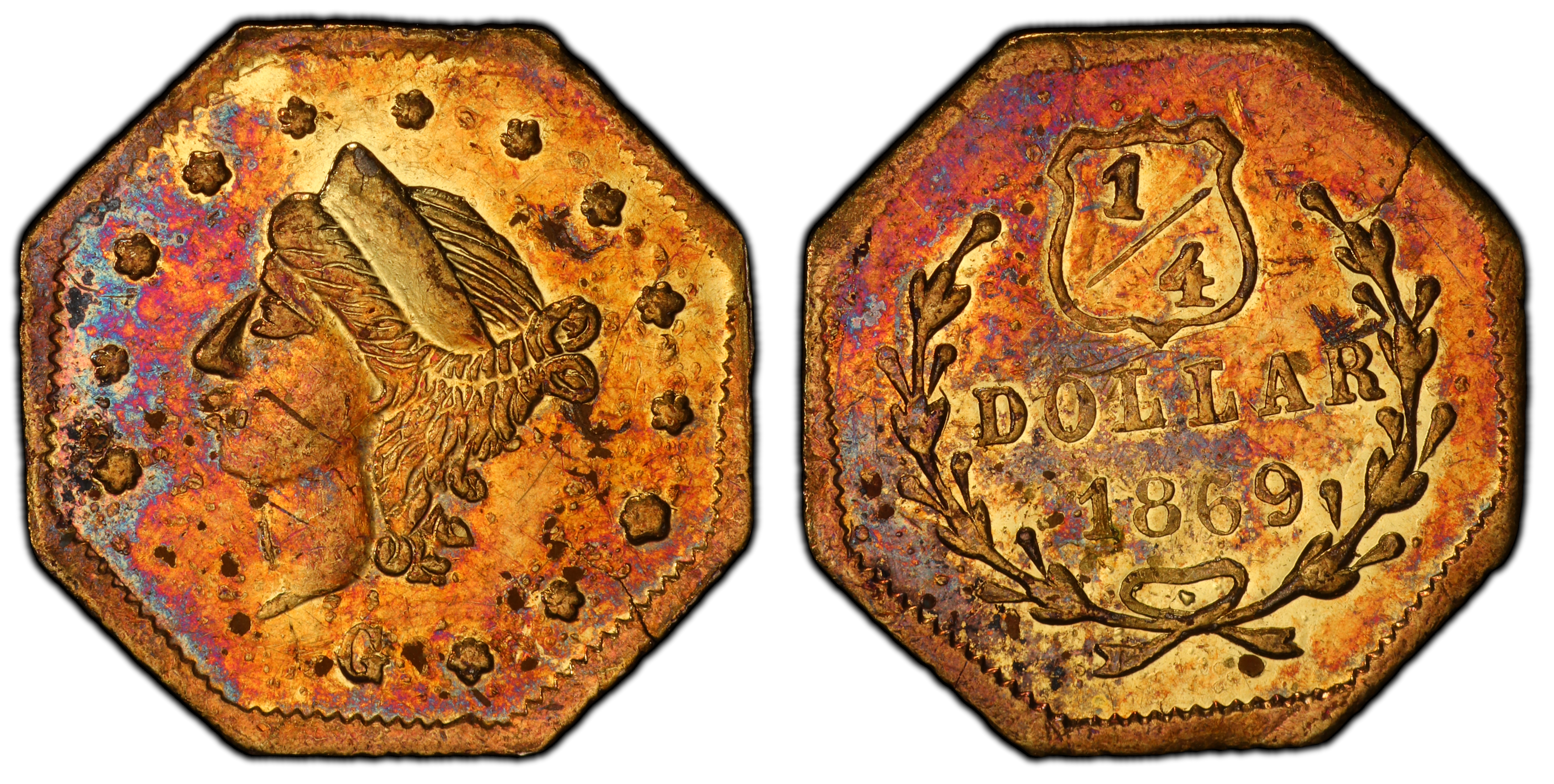
Obverse & Reverse
The 1869 G25C BG-751 is a quintessential example of 'Period Two' California Fractional Gold. The initial wave of fractional gold, struck from 1852-1857 ('Period One'), arose from a genuine and severe shortage of small-denomination coinage for daily commerce in the wake of the California Gold Rush. Miners paid in gold dust or large-denomination private coins struggled with simple transactions. By the late 1850s, however, the newly established San Francisco Mint was producing sufficient quantities of federal silver and gold coins, alleviating the commercial need for private issues. The nature of fractional gold subsequently transformed. The 'Period Two' pieces, including this 1869 issue, were not primarily intended to circulate as money but were instead manufactured by jewelers as souvenirs, keepsakes, and novelty items. These miniature gold coins captured the romance of the Gold Rush for tourists and locals alike and were often incorporated into jewelry. This shift in purpose is reflected in their physical characteristics; unlike their Period One predecessors which often attempted to conform to federal weight standards, Period Two issues are notoriously underweight and of varying fineness, their value being in their form and story rather than their intrinsic content. Struck by San Francisco jeweler Robert B. Gray & Co., the BG-751 variety is part of a larger series of similar octagonal and round pieces produced throughout the 1860s and 1870s. Production of these pieces operated in a legally gray area, especially after the Private Coinage Act of 1864, but the law was not strictly enforced against these popular souvenir items until a Secret Service crackdown in 1883, which effectively ended the era of fractional gold production.
Associated EventPost-California Gold Rush Economic Expansion
Reason For MintingPrimarily struck to be sold as souvenirs and jewelry items, not to alleviate a coin shortage which had been resolved by the late 1850s.
Minter HistoryRobert B. Gray & Co. was a prominent San Francisco manufacturing jeweler active during the 'Period Two' era of fractional gold. Around 1859, Gray purchased the business of another established jeweler and fractional gold producer, Antoine Louis Nouzillet. This acquisition likely included dies, hubs, and punches, giving Gray a significant foundation in the trade. Gray's own issues are distinguished by his hallmark, a small letter 'G,' which is prominently featured on the obverse of the BG-751 variety below Liberty's bust. Breen and Gillio note that Gray's pieces are often of higher weight and intrinsic value than many other Period Two issues. The firm produced a wide variety of octagonal and round quarter dollar, half dollar, and dollar pieces through 1871, when Gray reportedly sold his interests to the California Jewelry Co.
Historical SignificanceThis coin is significant not as a circulating medium of exchange, but as a tangible artifact of the commercialization of the Gold Rush mythos. It represents a pivot from necessity-driven private coinage to souvenir and novelty production, reflecting California's burgeoning tourism and its romanticized perception by the rest of the nation.
N/A
Denomination25 Cents
Minting Period1869
Assayer/MinterRobert B. Gray & Co.
Geographic OriginSan Francisco, California
Obverse DescriptionA bust of Liberty facing left, her hair tied in a bun. She wears a coronet inscribed LIBERTY. Thirteen stars encircle the portrait within the octagonal border. The minter's initial 'G' is located below the bust, above the date.
Obverse InscriptionLIBERTY / 1869
Reverse DescriptionThe denomination '1/4' and the word 'DOLLAR' are contained within a simple shield, which is itself centered within a wreath of leaves and berries. The word 'CALIFORNIA' is inscribed at the top, following the upper octagonal border.
Reverse InscriptionCALIFORNIA / 1/4 DOLLAR
CompositionGold
Stated Fineness Actual Fineness EdgePlain
Unknown
Survival EstimateFewer than 200, likely in the 30-75 range.
Rarity ScaleHigh R-4 to R-6 (Sources vary)
The BG-751 is popular among specialists for its clear attribution to a known maker (Robert B. Gray), its classic octagonal shape reminiscent of larger pioneer slugs, and its status as a representative 'Period Two' jeweler's issue. The defined diagnostics make it an excellent piece for variety collectors.
Key VarietiesThe BG-751 is itself a key variety of 1869 octagonal 25-cent gold. There are no known major variations, patterns, or official restrikes of this specific Breen-Gillio number from the period of issue. All known examples are considered business strikes intended for commercial sale as souvenirs.
Authentication TipsGenuine examples of BG-751 have specific die markers: a small 'G' is present below the bust, the point of the shield on the reverse is located directly above the 'LL' in DOLLAR, and a diagnostic berry appears just to the right of the digit '9' in the date. Fakes are common in the fractional gold series; they often have a soapy, cast-like appearance, incorrect weight, or mushy details. Genuine pieces, even when weakly struck, will show sharp die characteristics. Weakness in the center of the reverse is a common characteristic of genuine strikes, not a sign of a fake.
Shopping ConsiderationsA premium quality example for its grade will exhibit a sharp strike on the peripheral details like the stars, date, and legends, even if the central reverse is soft as is typical for the issue. Look for undisturbed, original surfaces with some remaining mint luster; many have been cleaned or used as jewelry, so problem-free examples command significant premiums. Deeply toned pieces with attractive 'old gold' reddish or honey-gold patinas are highly desirable. Avoid examples that are holed, bent, or show evidence of being mounted in jewelry, as these issues dramatically reduce value unless the coin is of extreme rarity.
A coin's grade is its condition, rated on a 1-70 scale. For rare coins, this is the most critical factor in determining value, as a tiny difference in preservation can mean a huge difference in price.
Relevant Grade TypesAll original 1869 BG-751 pieces are business strikes, originally created for commercial sale as souvenirs. They are found in Circulated grades (AU-58 and below, though extensive circulation was uncommon) and, more frequently, in Mint State grades (MS-60 to 70). No proofs were struck during the original period of issue, and there are no known later-date collector restrikes.
Mint State CharacteristicsUncirculated examples are defined by their luster, which is typically semi-prooflike or satiny. The strike is a key determinant of quality; many are weakly struck in the centers, particularly on the '1/4 DOLLAR' on the reverse. A coin that shows unusual sharpness in the central reverse is rare and desirable. As these were made by jewelers from relatively soft gold and handled as novelties, even high-grade Mint State examples will often show minor handling marks or planchet imperfections. Flashy, undisturbed fields are a hallmark of a premium MS example.
Circulated Wear PatternsWear first appears on the highest points: Liberty's cheek, the hair above her eye, and the coronet. On the reverse, the fine details of the wreath and the edges of the shield will show the first signs of friction. On lower grade examples, the stars on the obverse and the lettering on both sides will begin to lose their sharpness and merge towards the fields.
Key Factors For ValueFor the BG-751, the primary value drivers are grade and surface quality. An example with original, uncleaned surfaces and attractive honey-gold toning is worth substantially more than a cleaned or harshly polished piece of the same grade. Strike quality is a major factor; a well-struck reverse is a significant bonus. Problem-free surfaces are paramount, as many were damaged from use in jewelry. A CAC sticker will add a strong premium, confirming both the grade and the superior eye appeal for that grade.
PCGS Price Guide
| Grade | Price | Population |
|---|---|---|
| 40 | $200.00 | N/A |
| 45 | $210.00 | N/A |
| 45+ | $215.00 | N/A |
| 50 | $225.00 | 1 |
| 50+ | $235.00 | N/A |
| 53 | $250.00 | N/A |
| 53+ | $265.00 | N/A |
| 55 | $280.00 | 7 |
| 55+ | $300.00 | N/A |
| 58 | $325.00 | 14 |
| 58+ | $350.00 | N/A |
| 60 | $375.00 | 5 |
| 61 | $400.00 | 7 |
| 62 | $425.00 | 13 |
| 62+ | $450.00 | N/A |
| 63 | $525.00 | 13 |
| 63+ | $575.00 | N/A |
| 64 | $675.00 | 3 |
| 64+ | $800.00 | N/A |
| 65 | $1,100.00 | 3 |