1870 G25C BG-753 (Regular Strike)
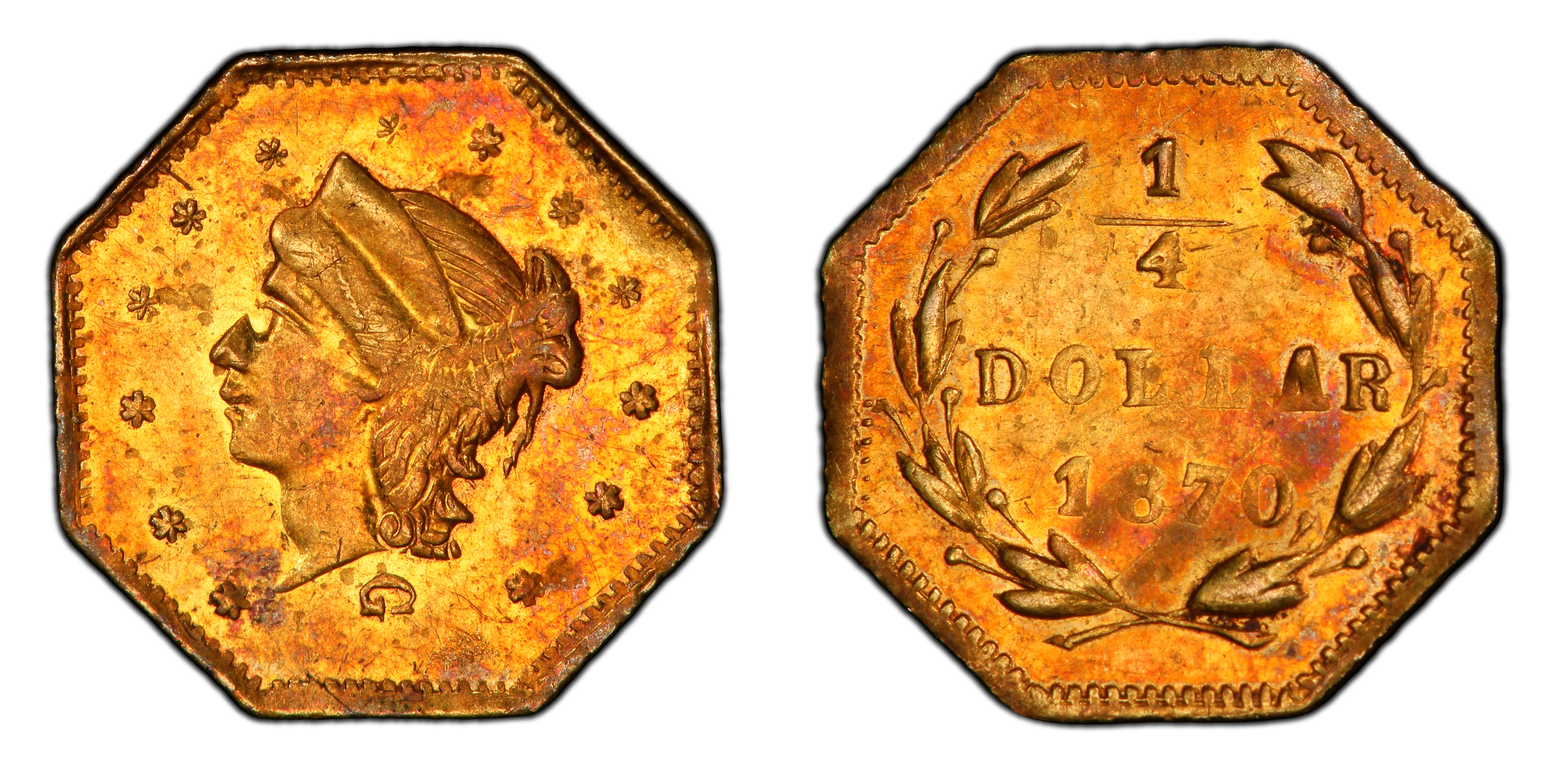
Obverse & Reverse
The 1870 G25C BG-753 is a quintessential example of a 'Period Two' California Fractional Gold piece, a fascinating and complex series born from the economic realities of the American West. Following the initial 1848 gold discovery at Sutter's Mill, California was inundated with prospectors and entrepreneurs, creating a vibrant but chaotic economy. A severe shortage of circulating small change plagued daily commerce; transactions were often conducted with pinches of gold dust, an imprecise and contentious method. To fill this void, private jewelers and metallurgists began striking their own small-denomination gold coins in 1852. These 'Period One' (1852-1856) issues were generally intended for circulation and were struck with a gold content approaching their face value. However, the BG-753 belongs to the second major era of production (1859-1882). By 1870, the San Francisco Mint had been in full operation for years, alleviating the initial coin shortage. The purpose of fractional gold had shifted; they were now primarily produced as souvenirs and curiosities for tourists and for use in the jewelry trade. These 'jeweler's issues' were often significantly underweight and valued more for their novelty than their intrinsic worth. The Coinage Act of 1864 had officially prohibited private coinage, but enforcement was lax in the West until the early 1880s, allowing firms like Robert B. Gray & Co. to continue production. Gray, a San Francisco die-sinker and engraver, was a prolific producer of these pieces, identified by the characteristic 'G' initial on many of his dies. These tiny, octagonal coins, crudely struck by hand-operated presses, served as tangible mementos of the Gold Rush's enduring legacy, long after its initial frenzy had passed. Their existence speaks to a transitional period in California's economy, where the lines between currency, commodity, and collectible were beautifully blurred.
Associated EventCalifornia Gold Rush Aftermath
Reason For MintingPrimarily created to serve the growing demand for souvenirs and jewelry trade items in post-Gold Rush California, rather than to alleviate a coin shortage.
Minter HistoryRobert B. Gray & Co. was a prominent San Francisco-based die-sinking and engraving firm active in the latter half of the 19th century. Gray was a key figure in the production of 'Period Two' California Fractional Gold. He produced a wide variety of dies for these small denomination pieces, often marked with his initial, 'G', as seen below the bust on the BG-753. His work is characteristic of the 'jeweler's issues' of the era, which were often lighter and more varied in design than the earlier circulation-focused pieces.
Historical SignificanceThe BG-753 represents the evolution of California Fractional Gold from a necessary medium of exchange to a popular souvenir. It highlights the continued private production of coin-like objects even after the establishment of the San Francisco Mint and the passing of prohibitive federal laws. As a product of Robert Gray, it is an important artifact from one of the key engravers in this specialized numismatic field.
N/A
Denomination25 Cents
Minting Period1870
Assayer/MinterRobert B. Gray & Co.
Geographic OriginSan Francisco, California
Obverse DescriptionA Liberty Head, facing left, with hair tied in a bun. The portrait is encircled by 13 five-pointed stars. Below the truncation of the neck is a small, horizontal initial 'G' for the minter, Robert Gray.
Obverse InscriptionG
Reverse DescriptionThe denomination '25 CENTS' and the date '1870' are inscribed within a wreath of leaves and berries. The wreath is open at the top.
Reverse Inscription25 CENTS 1870
CompositionGold
Stated Fineness Actual FinenessVaries, typical for Period Two issues to be of lower fineness than official U.S. coinage.
Diameter10.00 mm
EdgePlain
Unknown
Survival Estimate31-75
Rarity ScaleR-6+
This variety is highly sought after due to its specific attribution to minter Robert Gray, its high rarity (R-6+), and its octagonal shape, which is emblematic of the series. It appeals to collectors of territorial gold, die varieties, and California history.
Key VarietiesThe BG-753 is itself a specific die variety within the broader 1870 G25C octagonal series. No major sub-varieties, patterns, or restrikes are commonly associated with this specific Breen-Gillio number. Collecting focuses on acquiring the single known 'Regular Strike' of this variety.
Authentication TipsGenuine BG-753 pieces have a distinctive, somewhat crude but sharp strike from hand-cut dies. The horizontal 'G' below the bust is a key diagnostic. Look for die cracks, such as a diagonal crack through the '7' in the date, which have been noted on authenticated examples. Counterfeits are rampant in this series; many are brass or gold-plated tokens, often with incorrect details, a soapy or cast-like appearance, or incorrect weight. Authentication by a major third-party grading service (PCGS or NGC) is highly recommended.
Shopping ConsiderationsA premium quality example for its grade will exhibit a bold strike, particularly on the stars, Liberty's hair details, and the wreath on the reverse. Original, undisturbed surfaces with some remaining mint luster are highly desirable. Many surviving examples are cleaned, hairlined, or have been used in jewelry, so careful inspection for rim damage, solder marks, or excessive surface abrasion is critical. Pieces with attractive, original reddish-gold toning command significant premiums. Avoid examples with significant planchet flaws or weak strikes, which are common but less desirable.
A coin's grade is its condition, rated on a 1-70 scale. For rare coins, this is the most critical factor in determining value, as a tiny difference in preservation can mean a huge difference in price.
Relevant Grade TypesOriginal period issues were business strikes, many of which saw some circulation or handling and are found in Circulated (1-58) and Mint State (MS, 60-70) grades. No original proofs were struck during this period. The term 'Proof-Like' (PL) or 'Deep Proof-Like' (DPL) may be applied by grading services to business strikes that have exceptionally reflective surfaces, but these are not true Proof coins.
Mint State CharacteristicsUncirculated examples of BG-753 typically display a soft, satiny luster rather than a hard, frosty one. The strike can be inconsistent due to the manual minting process; a well-struck piece will show clear separation in Liberty's hair strands and sharp details in the wreath's leaves. Small, planchet-made flaws or strike-throughs are not uncommon and are generally accepted by collectors if they are not distracting. Bag marks are less common than handling marks due to their small size, but tiny abrasions on the high points are frequent.
Circulated Wear PatternsWear first appears on the high points of Liberty's hair above her ear and on her cheek. On the reverse, the highest points of the wreath leaves and the numerals of the date will show the first signs of friction. In lower grades (VF and below), the stars on the obverse and the finer details of the wreath begin to merge with the fields.
Key Factors For ValueFor the BG-753, rarity is paramount, but within a given grade, value is driven by surface quality and strike. An example with original, uncleaned surfaces will always be worth more than a brighter, cleaned coin of the same grade. A sharp, well-centered strike that brings up all the design details is a major factor. Finally, superior eye appeal—a combination of luster, attractive color, and mark-free surfaces—can make a coin command a price well above typical levels for its assigned grade. A CAC sticker for this issue confirms premium quality and adds a significant premium.
PCGS Price Guide
| Grade | Price | Population |
|---|---|---|
| 50 | $325.00 | 1 |
| 50+ | $340.00 | N/A |
| 53 | $375.00 | 1 |
| 53+ | $400.00 | N/A |
| 55 | $440.00 | 3 |
| 55+ | $445.00 | N/A |
| 58 | $465.00 | 4 |
| 58+ | $475.00 | N/A |
| 60 | $550.00 | 1 |
| 61 | $550.00 | 3 |
| 62 | $900.00 | 6 |
| 62+ | $1,100.00 | N/A |
| 63 | $1,500.00 | 1 |