1872 G25C BG-791 (Regular Strike)
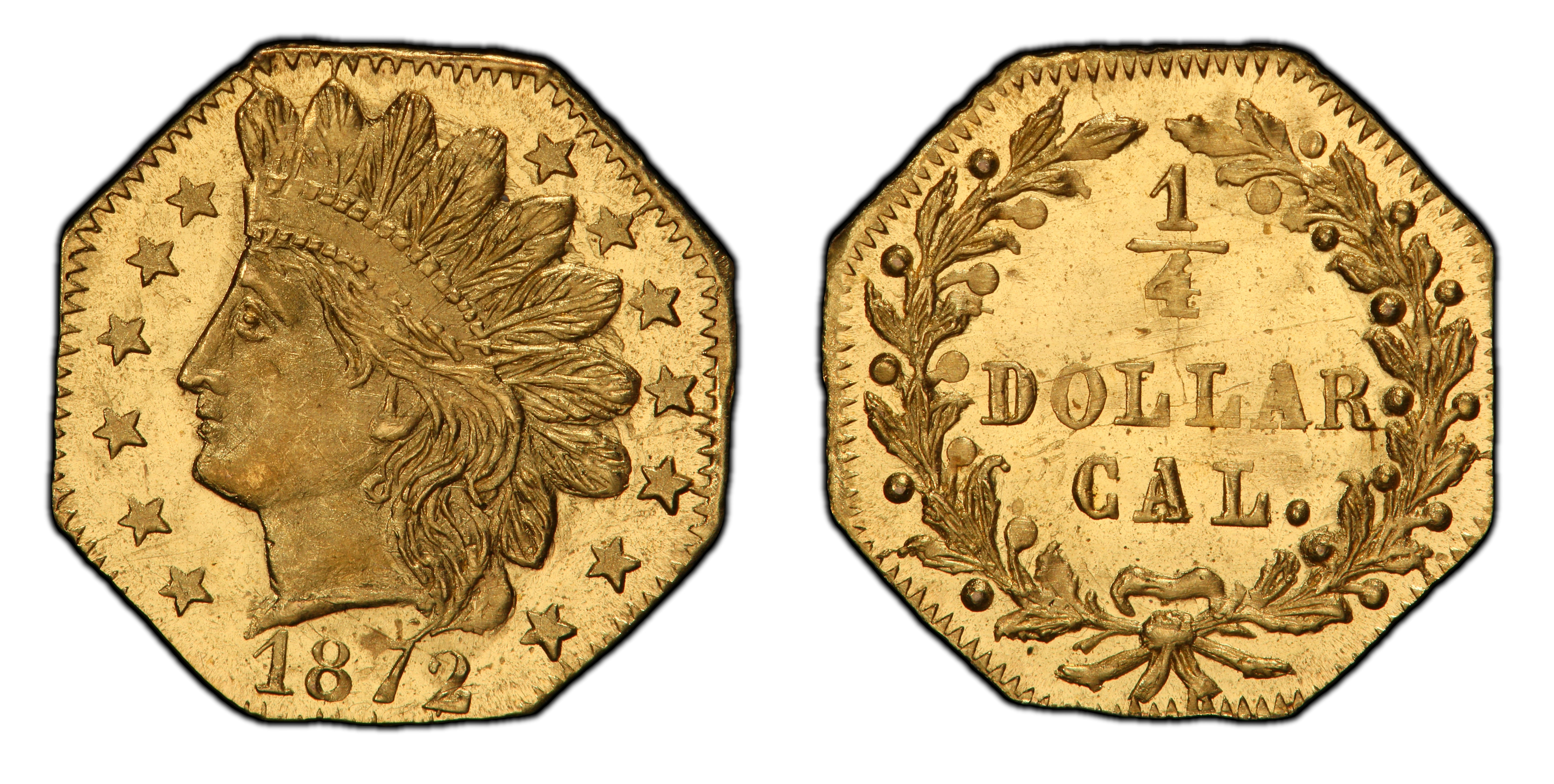
Obverse & Reverse
The 1872 G25C BG-791 is a fascinating product of the second period of California Fractional Gold production (1859-1882). Following the initial California Gold Rush, the United States Mint was established in San Francisco in 1854, which gradually alleviated the severe shortage of small change that had plagued the region. The earliest fractional gold pieces (1852-1857) were struck out of genuine commercial necessity, serving as a substitute for the scarce silver coins of the day. However, by the 1870s, the landscape had changed. The immediate, desperate need for circulating small-denomination gold had waned. Instead, these miniature coins transitioned into a popular form of souvenir and collectible, eagerly purchased by tourists and locals as mementos of the romanticized Gold Rush era. This second period is often referred to as the 'jeweler's issue' period, as the manufacturers were primarily jewelers and artisans, not pioneer assayers. The coins were lighter and often of lower fineness than their earlier counterparts, reflecting their new role as keepsakes rather than essential currency. The BG-791 was designed by Christopher Ferdinand Mohrig, a prominent San Francisco jeweler and die-sinker, whose work is well-regarded for its artistic merit within the series. Despite being intended as souvenirs, their production was still technically legal until federal laws against private coinage were more strictly enforced starting in 1883. These tiny gold pieces represent a tangible link to the enduring legacy of the Gold Rush and the entrepreneurial spirit that defined 19th-century California, capturing a moment when the memory of the '49ers was being actively commercialized.
Associated EventCalifornia Gold Rush Aftermath
Reason For MintingPrimarily created as a popular souvenir for the growing tourist trade in California, rather than to alleviate a coinage shortage as earlier issues had.
Minter HistoryChristopher Ferdinand Mohrig was a notable San Francisco-based jeweler and die-sinker active in the latter half of the 19th century. He was a prolific producer of California Fractional Gold pieces during the 'jeweler's issue' period. His designs, particularly the Indian Head motifs, are often praised by numismatists for their relatively high artistic quality and sharp details compared to other contemporary private issues. His mintmark is not explicitly stated on the coins, but his work is identified through die analysis and historical records.
Historical SignificanceThe BG-791 represents the evolution of California Fractional Gold from a necessary form of currency to a commercial souvenir. It is a prime example of the 'Period Two' issues, which catered to a nostalgic public fascination with the Gold Rush. Its existence highlights the unique economic and cultural environment of post-Gold Rush California and the legal gray area that allowed private minters to continue producing gold 'coins' for decades after the federal mint's establishment in San Francisco.
N/A
Denomination25 Cents
Minting Period1872
Assayer/MinterChristopher Ferdinand Mohrig
Geographic OriginSan Francisco, California
Obverse DescriptionAn Indian Head design, facing left, surrounded by thirteen stars representing the original colonies. The portrait is typically well-defined for the series, occupying a large portion of the octagonal planchet.
Obverse InscriptionNo inscription.
Reverse DescriptionThe denomination '1/4' and the word 'DOLLAR' are enclosed within a wreath of leaves and berries. The date '1872' is positioned below the wreath.
Reverse Inscription1/4 DOLLAR 1872
CompositionGold
Stated Fineness Actual FinenessVaries, but generally lower than federal issues of the era.
Weight0.24 grams
Diameter10.00 mm
EdgePlain
Unknown
Survival Estimate150-250
Rarity ScaleR-4 (61-125 Known)
This variety is highly sought after by specialists for its attractive Indian Head design by Christopher Mohrig, its distinctive octagonal shape, and its status as a representative 'Period Two' issue. The combination of historical interest and aesthetic quality makes it a popular type coin within the broader California Fractional Gold series.
Key VarietiesThe primary variety is the BG-791 regular strike. No major varieties, patterns, or official restrikes are known from the period. Modern copies and replicas are extremely common and should be carefully distinguished from genuine 19th-century issues.
Authentication TipsGenuine pieces will have a denomination (e.g., 'DOLLAR' or 'CENTS'). Be wary of pieces with a bear on the reverse, as these are modern fantasy tokens. The strike on genuine pieces can sometimes be weak in areas, a characteristic often absent on modern fakes. Consulting the Breen-Gillio reference work, 'California Pioneer Fractional Gold,' is the best defense, as it photographs and catalogs all known genuine varieties. Any piece not listed in this guide should be considered suspect. Due to their small size and the prevalence of forgeries, authentication by a reputable third-party grading service like PCGS or NGC is highly recommended.
Shopping ConsiderationsFor a premium quality example, look for a sharp strike, particularly on the details of the Indian's headdress and the lettering on the reverse. Many surviving examples are graded Mint State, but they can still vary widely in quality. Seek out coins with original, lustrous surfaces, often described as 'prooflike' or 'PL', which command significant premiums. Avoid examples that have been cleaned, which will appear unnaturally bright or have hairline scratches, or those that have been mounted in jewelry, which may show evidence of soldering or rim damage. A smooth, mark-free field and strong eye appeal are paramount for this issue.
A coin's grade is its condition, rated on a 1-70 scale. For rare coins, this is the most critical factor in determining value, as a tiny difference in preservation can mean a huge difference in price.
Relevant Grade TypesOriginal issues were business strikes intended for sale as souvenirs, not circulation, so they are most commonly found in Mint State (MS, 60-70) grades. Circulated (1-58) examples exist but are less common. No true Proofs were struck during the original minting period. Some high-quality Mint State coins exhibit reflective, prooflike surfaces (designated PL) due to polished dies, and these are highly prized, but they are not true Proof strikings.
Mint State CharacteristicsA typical Mint State BG-791 will exhibit satiny to semi-prooflike luster. The strike can be variable; a well-struck example will show full details in the feathers of the headdress and the leaves of the wreath. Due to the manufacturing process, it's not uncommon to see minor planchet flaws or a slightly uneven strike, even on high-grade specimens. Small, scattered contact marks are common and should be expected, but large or distracting marks will lower the grade.
Circulated Wear PatternsOn circulated examples, wear first appears on the high points of the design. For the obverse, this is the cheek and the upper feathers of the headdress. On the reverse, the highest points of the wreath and the fraction '1/4' will show the first signs of friction. In lower grades (VF and below), the stars on the obverse and the finer details of the wreath begin to merge with the fields.
Key Factors For ValueThe primary drivers of value for an 1872 BG-791 are grade and surface quality. An example with sharp, prooflike (PL) surfaces will sell for a significant premium over a typical Mint State coin of the same grade. Originality is key; coins with undisturbed, lustrous surfaces are far more desirable than those that have been cleaned or polished. Eye appeal, which is a subjective measure of the coin's overall attractiveness, plays a major role. A CAC sticker, indicating that a coin is of premium quality for its grade, adds a substantial premium for this series.
PCGS Price Guide
| Grade | Price | Population |
|---|---|---|
| 53 | $200.00 | 1 |
| 53+ | $205.00 | N/A |
| 55 | $210.00 | N/A |
| 55+ | $215.00 | N/A |
| 58 | $220.00 | 2 |
| 58+ | $230.00 | N/A |
| 60 | $240.00 | 1 |
| 61 | $275.00 | 4 |
| 62 | $325.00 | 46 |
| 62+ | $335.00 | N/A |
| 63 | $385.00 | 86 |
| 63+ | $405.00 | N/A |
| 64 | $475.00 | 99 |
| 64+ | $550.00 | 1 |
| 65 | $750.00 | 25 |
| 65+ | $925.00 | 2 |
| 66 | $1,250.00 | 6 |
| 66+ | $1,750.00 | N/A |
| 67 | $2,500.00 | N/A |