1870 G25C BG-762 (Regular Strike)
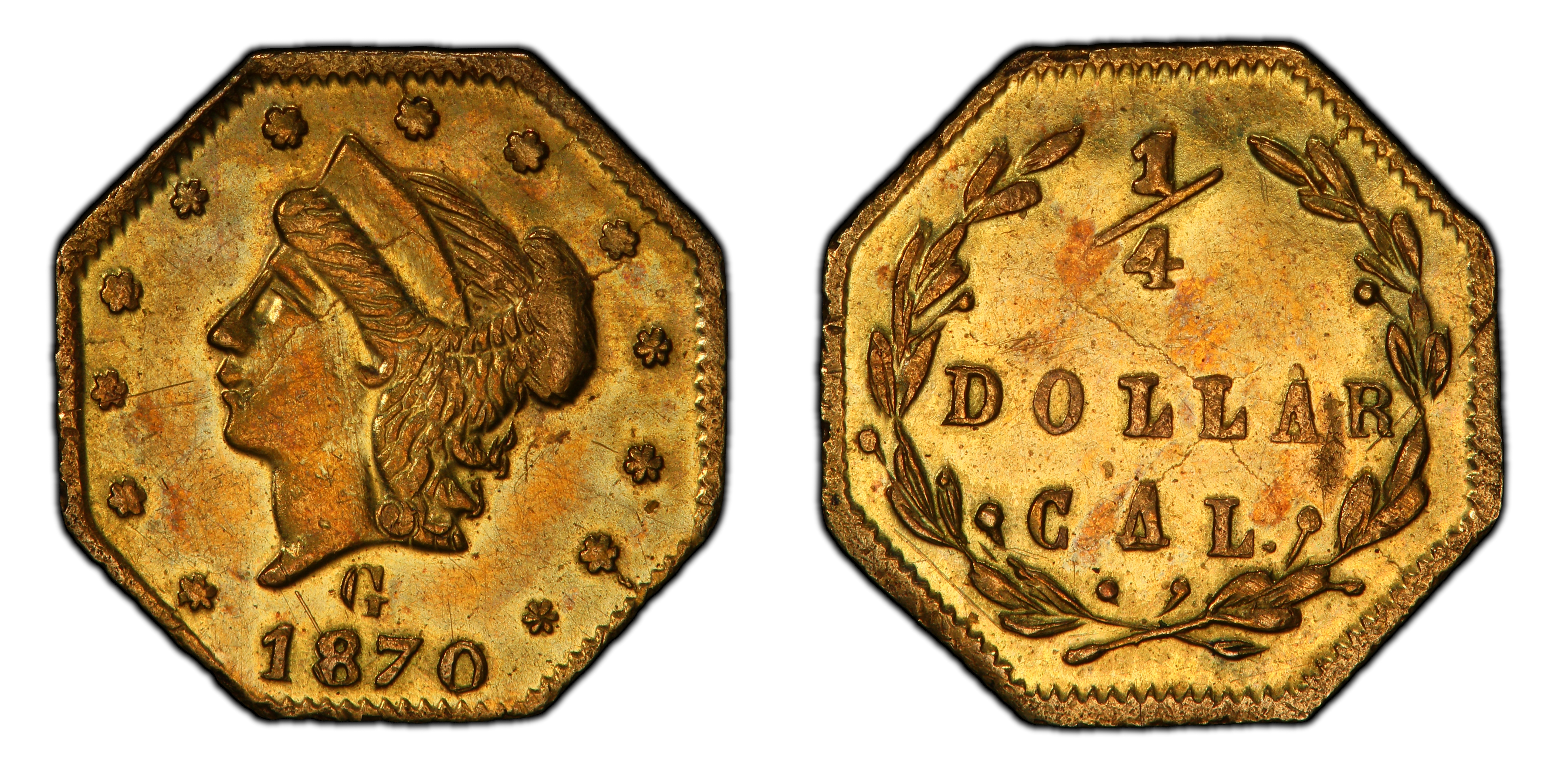
Obverse & Reverse
The 1870 G25C BG-762 is a product of the second period (1859-1882) of California Fractional Gold production, a fascinating and complex era of private coinage in American history. Following the initial gold rush boom, California's economy stabilized, but a chronic shortage of small-denomination federal coinage persisted, making everyday transactions difficult. The U.S. Mint in San Francisco, established in 1854, primarily struck larger gold and silver coins, leaving a vacuum for coins valued under a dollar. This void was filled by private minters, often jewelers by trade, who began producing fractional gold pieces in quarter-dollar, half-dollar, and dollar denominations starting in 1852. By 1870, the nature of this coinage had evolved. While still serving a marginal commercial need, the pieces were increasingly popular as souvenirs, keepsakes, and jewelry items, purchased by tourists and locals fascinated by the romance of the Gold Rush. The Private Coinage Act of 1864 had officially outlawed such private issues, but the law was weakly enforced on the West Coast until the early 1880s. This legal gray area allowed dozens of manufacturers to continue production throughout the 1870s. The BG-762 variety is attributed to Robert B. Gray & Co., a prominent San Francisco jeweler and die-sinker. These 'jeweler's issues' were typically struck from gold of varying fineness, often below their implied bullion value, but their utility and novelty ensured acceptance. They were usually produced by the 'hammer method,' a crude process where dies were struck by hand with a sledgehammer, leading to significant variations in strike quality even within the same variety. The BG-762, with its classic Liberty Head design reminiscent of federal coinage, was designed to inspire confidence and facilitate its use in commerce, even as its primary market shifted towards numismatic and souvenir purposes. The eventual crackdown by the U.S. Secret Service in 1883 brought an end to this unique chapter of American monetary history, cementing the status of these tiny gold pieces as cherished collectibles.
Associated EventCalifornia Gold Rush Aftermath
Reason For MintingTo alleviate a persistent shortage of small-denomination coinage for commerce and to satisfy a growing demand for Gold Rush souvenirs.
Minter HistoryRobert B. Gray & Co. was a well-known San Francisco-based jeweler, die-sinker, and engraver active in the latter half of the 19th century. Like many of his contemporaries, Gray capitalized on the unique economic conditions in California by producing fractional gold tokens. His work is identified by specific design elements and die characteristics cataloged by researchers like Walter Breen and Ronald J. Gillio. Gray's issues are part of the 'Period Two' or 'Jeweler's Issues' of California Fractional Gold, which are noted for their popularity as keepsakes as much as for their limited role in circulation.
Historical SignificanceThe BG-762 is a tangible link to the post-Gold Rush era in California, representing a period of transition where private minting straddled the line between necessity and novelty. It showcases the resourcefulness of local merchants in the face of inadequate federal coin supply and marks the beginning of a numismatic market for souvenirs of the romanticized West. These pieces are a testament to a time when private enterprise directly addressed gaps in the nation's monetary system, albeit in a legally ambiguous and ultimately suppressed chapter of coinage history.
N/A
Denomination25 Cents
Minting Period1870
Assayer/MinterRobert B. Gray & Co.
Geographic OriginSan Francisco, California
Obverse DescriptionA Liberty Head, facing left, with 'LIBERTY' inscribed on her coronet. The head is surrounded by thirteen stars, representing the original colonies. The date '1870' appears below the bust.
Obverse InscriptionLIBERTY 1870
Reverse DescriptionThe denomination '1/4 DOLLAR' is enclosed within a wreath of leaves and berries, which is open at the top. The 'G' initial for the minter, Robert B. Gray, is located below the wreath, a key diagnostic for this series.
Reverse Inscription1/4 DOLLAR G
CompositionGold
Stated Fineness Actual FinenessVaries, often between .500 and .750 (12k to 18k gold).
Weight0.25 grams
Diameter9.80 mm
EdgePlain
Unknown
Survival Estimate76-150 (per Breen-Gillio)
Rarity ScaleR-5
This coin is highly sought after as a representative of the popular and historically rich California Fractional Gold series. Its octagonal shape, clear denomination, date, and minter's mark make it a classic example of a 'Period Two' jeweler's issue. The BG-762 is relatively available compared to rarer varieties, making it an accessible yet challenging piece for collectors.
Key VarietiesThe primary variety is the regular strike BG-762. No contemporary proof restrikes or patterns are known to exist for this specific variety. Collectors should be aware that the broader California Fractional Gold series includes many different die pairings, die states (showing cracks or cuds), and planchet variations. However, BG-762 itself is a distinct variety defined by its specific obverse and reverse dies. Later souvenir pieces from the 20th century exist but are not considered part of the original series; they lack a denomination and are typically gilt brass.
Authentication TipsAuthentic BG-762 pieces have a specific 'small G' minter's mark below the wreath. The strike is often uneven due to the hammer-striking process; an unusually sharp, perfectly centered strike can be a red flag. Genuine pieces often show die file marks or other minor planchet imperfections. Counterfeits are common; many are brassy in color, have a soapy or cast-like appearance, and often feature incorrect design details. A prominent red flag for many replica Cal Gold pieces is the image of a bear on the reverse, which is not found on any genuine 19th-century issues. All authentic pieces from this period must carry a denomination (e.g., 'DOLLAR' or 'CENTS').
Shopping ConsiderationsA premium quality example for its grade will exhibit a bold strike, especially on Liberty's coronet and the reverse wreath. Look for original, uncleaned surfaces with some remaining luster; many specimens are found cleaned or have been used as jewelry, showing solder marks or excessive polishing. The color should be a natural, rich gold, not a brassy yellow. Pay close attention to the stars and date for sharpness. Avoid examples that are bent, holed, or have significant rim damage, as these are common problems for these small, delicate pieces.
A coin's grade is its condition, rated on a 1-70 scale. For rare coins, this is the most critical factor in determining value, as a tiny difference in preservation can mean a huge difference in price.
Relevant Grade TypesOriginal period issues were business strikes intended for circulation and as souvenirs. They are found in Circulated grades (AG-3 to AU-58) and Mint State grades (MS-60 to MS-70). No proofs were struck during the original period of issue for this variety. While many high-grade examples exhibit prooflike surfaces due to the nature of their striking, they are not true Proofs. Any items described as 'Proof restrikes' would be from a much later period and are not considered part of the original series.
Mint State CharacteristicsIn uncirculated (MS) condition, the BG-762 typically displays a soft, satiny luster. The strike is a key factor; many are weakly struck in the center, particularly on the highest points of Liberty's hair and the wreath. A well-struck MS example with full details is highly desirable. Due to the softness of the gold and the crude production methods, even Mint State coins will often display minor planchet flaws or light contact marks that do not impair the grade but are characteristic of the issue.
Circulated Wear PatternsWear first appears on the highest points of the design: Liberty's cheek, the hair above the ear, and the coronet. On the reverse, the highest points of the wreath's leaves and the bow will show the first signs of friction. In lower grades (VF and below), the word 'LIBERTY' on the coronet becomes indistinct, and the individual stars begin to merge with the fields.
Key Factors For ValueThe primary drivers of value are grade and surface quality. An example with original, uncleaned surfaces commands a significant premium over a harshly cleaned or polished coin of the same grade. Strike sharpness is critical; a fully struck piece is worth considerably more than a weakly struck one. Eye appeal, including attractive original toning (often a reddish-gold hue), also plays a major role. For this series, third-party certification by PCGS or NGC is nearly essential for establishing authenticity and grade, and a CAC sticker indicating premium quality for the grade adds a further premium.
PCGS Price Guide
| Grade | Price | Population |
|---|---|---|
| 40 | $200.00 | 1 |
| 45 | $210.00 | 1 |
| 45+ | $212.00 | N/A |
| 50 | $215.00 | 4 |
| 50+ | $217.00 | N/A |
| 53 | $220.00 | 3 |
| 53+ | $225.00 | N/A |
| 55 | $230.00 | 12 |
| 55+ | $235.00 | N/A |
| 58 | $240.00 | 26 |
| 58+ | $250.00 | N/A |
| 60 | $275.00 | 4 |
| 61 | $300.00 | 13 |
| 62 | $325.00 | 41 |
| 62+ | $350.00 | N/A |
| 63 | $400.00 | 14 |
| 63+ | $450.00 | N/A |
| 64 | $575.00 | 3 |
| 64+ | $750.00 | N/A |
| 65 | $1,350.00 | 2 |
| 65+ | $1,500.00 | N/A |
| 66 | $1,850.00 | 1 |