1868 G25C BG-745 (Regular Strike)
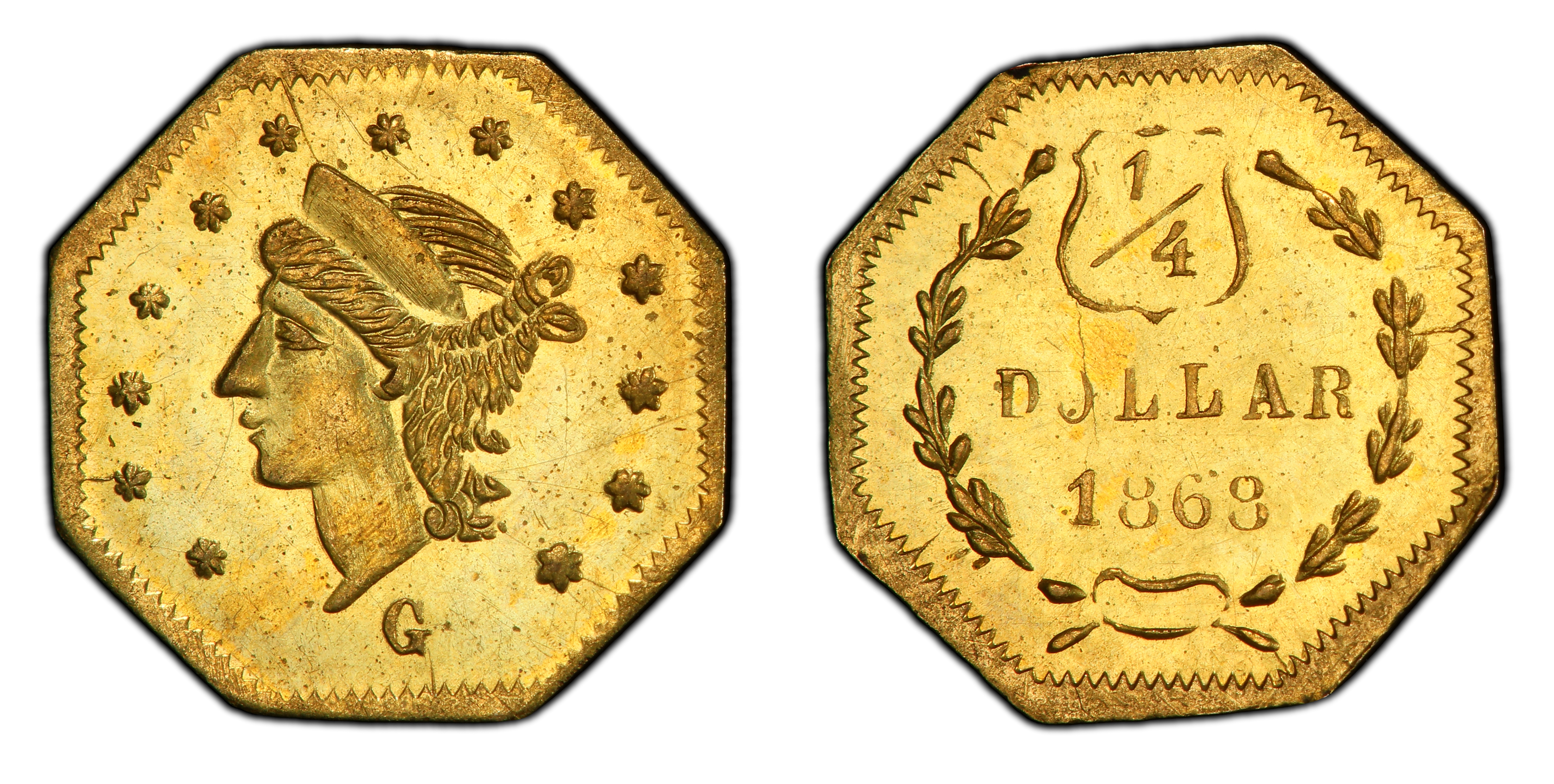
Obverse & Reverse
The 1868 BG-745 octagonal 25-cent gold piece emerges from the second major period of California Fractional Gold production (1859-1882). Unlike the 'Period One' (1852-1856) issues, which were struck out of a genuine commercial necessity to alleviate a severe shortage of small-denomination coinage during the initial Gold Rush boom, the pieces from this later era are often termed 'jeweler's issues.' By 1868, the San Francisco Mint was in full operation, supplying federal silver coinage that largely satisfied the region's needs for small change. Consequently, the impetus for private gold fractional issues shifted from circulation to novelty. These small gold pieces were primarily manufactured by San Francisco jewelers and sold as souvenirs, keepsakes for tourists, and curiosities that harkened back to the more chaotic early days of the Gold Rush. The Coinage Act of 1864 had officially prohibited the private issuance of coinage, placing these manufacturers on precarious legal ground. Despite this, production continued quietly for nearly two more decades. The BG-745 is a product of this environment, likely struck using the traditional hammer method, where dies were struck by hand. This process often resulted in coins with inconsistent strike quality, a characteristic feature of the series. While they did not circulate in the traditional sense, they represent a continuation of California's unique numismatic identity and the enduring allure of gold in the American West. Their creation speaks to a burgeoning tourist trade in San Francisco and a nostalgic public eager to own a tangible, golden piece of the Gold Rush story.
Associated EventCalifornia Gold Rush Aftermath
Reason For MintingPrimarily created as souvenirs and keepsakes for a growing tourist trade in San Francisco, not for general circulation.
Minter HistoryThe specific minter for BG-745 is unknown, which is typical for many 'Period Two' California Fractional Gold pieces. These were often produced by various jewelers in San Francisco, such as Frontier, Deviercy & Co., or Deriberpe & Nouizillet, who did not always place their initials on the coins. Their operations were small-scale, focusing on creating novelty items rather than circulating currency.
Historical SignificanceThe BG-745 represents the transition of California Fractional Gold from essential circulating coinage to souvenir and collector items. It is a tangible artifact from the post-Gold Rush era, reflecting California's evolving economy and the romanticism that had already begun to surround its gold mining history. As a 'jeweler's issue,' its existence demonstrates the persistence of private minting despite federal prohibitions and the high demand for gold novelties.
BG-745
Denomination25 Cents
Minting Period1868
Assayer/MinterUnknown Private Minter
Geographic OriginSan Francisco, California
Obverse DescriptionA Liberty Head facing left, her hair tied in a bun. She is surrounded by 13 six-pointed stars.
Obverse Inscription1868
Reverse DescriptionThe denomination '1/4' is in the center, enclosed within a wreath of leaves and berries. The inscription 'CALIFORNIA GOLD' is outside the wreath, but this variety is defined by having the denomination within the wreath without surrounding text.
Reverse Inscription1/4
CompositionGold
Stated Fineness Actual FinenessVariable; 'Period Two' issues were often debased and of lower fineness than official U.S. coinage.
EdgePlain
Unknown; mintage records were not kept by these private jewelers.
Survival Estimate16-30 coins known
Rarity ScaleR-6 (Very Rare)
This coin is highly sought after due to its connection to the California Gold Rush era, its octagonal shape, and its high rarity. As a specific, attributed Breen-Gillio variety, it appeals to advanced specialists who collect the entire series by die marriage.
Key VarietiesBG-745 is itself a key die pairing. It is noted as being similar to the BG-744 variety but is distinguished by having larger stars on the obverse, particularly star 10. No proof strikings or official restrikes are known from the period; all known examples are business strikes.
Authentication TipsGenuine examples exhibit sharp, albeit sometimes uneven, die work characteristic of hand-engraved dies. The stars should be distinct and well-formed. Look for a 'hammered' appearance rather than the smooth, uniform fields of a modern reproduction. Counterfeits are often cast, showing pitting or a soft, soapy appearance, or are brass tokens with incorrect weight and luster. Compare the specific die markers, such as the position of the date and stars, to high-resolution images of certified examples.
Shopping ConsiderationsA premium quality example for this issue is defined by a bold, well-centered strike. As noted in auction records, this variety is often found with weakness in the central reverse, opposite the high points of Liberty's portrait; coins with a stronger reverse strike command a premium. Look for smooth, lustrous surfaces with minimal contact marks. The original coloration, often described as 'honey-gold' or 'ruby-red,' is highly desirable and indicates the coin has not been harshly cleaned or dipped. Avoid examples that are described as 'cleaned,' 'scratched,' or have any form of damage, as these significantly impair value.
A coin's grade is its condition, rated on a 1-70 scale. For rare coins, this is the most critical factor in determining value, as a tiny difference in preservation can mean a huge difference in price.
Relevant Grade TypesAll original examples of BG-745 are business strikes intended for sale as souvenirs. They are found in Circulated grades (AU-50 to AU-58 are most common for survivors) and, more rarely, in Mint State (MS, 60-70). No original Proof (PR/PF) strikings are known to exist for this variety. Any piece described as a 'Proof' would be a modern creation or a misattribution.
Mint State CharacteristicsAn uncirculated BG-745 will exhibit bright, flashy luster, often with attractive reddish or honey-gold toning. The strike can be variable due to the hammer-striking process. It is common for the high points of Liberty's hair to be fully struck while the center of the reverse wreath is weak. Small planchet flaws or die polishing lines are not uncommon and are characteristic of the manufacturing process. Contact marks, even on MS coins, are to be expected due to the softness of the gold and their handling as souvenirs.
Circulated Wear PatternsWear first appears on the highest points: Liberty's hair above the eye and ear, and the leaves and bow of the wreath on the reverse. On moderately circulated examples (VF-XF), the finer details of the hair and leaves will be flattened, and the stars will begin to lose their sharpness. In lower grades, the date and legends can become soft and difficult to read.
Key Factors For ValueFor the BG-745, the primary value drivers are grade and surface quality. An example with original, undisturbed luster and attractive coloration will command a significant premium. Strike sharpness is critical; a coin that is well-struck on both the obverse and the typically weak reverse is highly desirable. Eye appeal is paramount; a clean, vibrant coin will always be valued more than a dull or marked specimen in the same technical grade. Certification by a top-tier service like PCGS or NGC is essential for market acceptance, and a CAC sticker would denote premium quality for the assigned grade.
PCGS Price Guide
| Grade | Price | Population |
|---|---|---|
| 53 | $325.00 | 1 |
| 53+ | $350.00 | N/A |
| 55 | $375.00 | 2 |
| 55+ | $400.00 | N/A |
| 58 | $425.00 | 11 |
| 58+ | $450.00 | N/A |
| 60 | $525.00 | N/A |
| 61 | $675.00 | 3 |
| 62 | $1,100.00 | 13 |
| 62+ | $1,750.00 | N/A |
| 63 | $3,750.00 | 2 |
| 63+ | N/A | N/A |
| 64+ | N/A | N/A |