1874 25C BG-799P (Regular Strike)
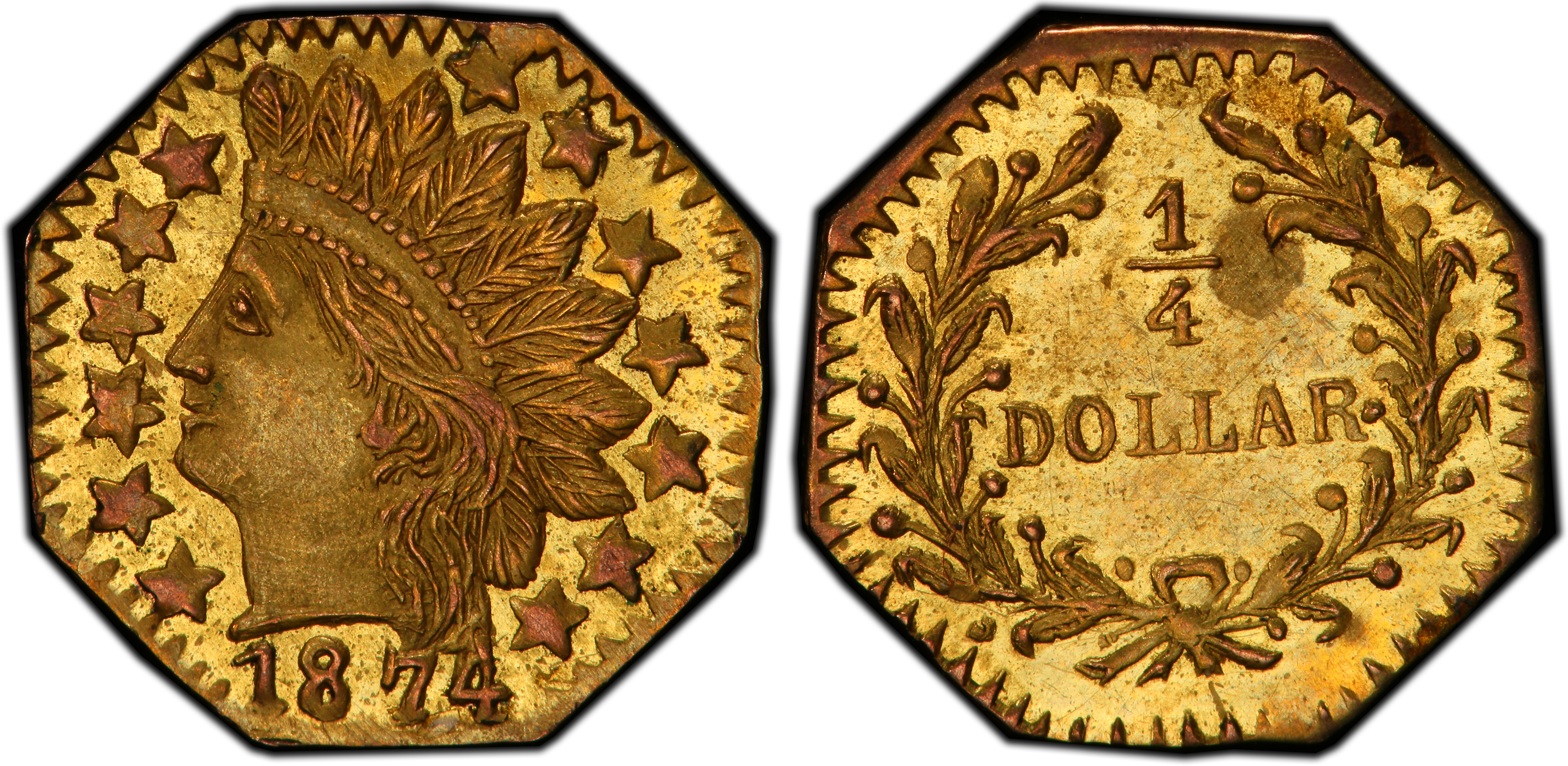
Obverse & Reverse
The 1874 25C BG-799P is a product of the second period (1859-1882) of California Fractional Gold production, a fascinating and complex chapter in American numismatics. Unlike the 'Period One' issues, which were struck out of a genuine necessity to alleviate a shortage of small change during the initial Gold Rush, the Period Two pieces were created in a different economic climate. By the 1870s, the San Francisco Mint was in full operation, producing ample federal coinage for commerce. The rationale for these tiny gold pieces had shifted from utility to novelty. San Francisco had become a major tourist destination, and a class of jewelers recognized the demand for unique souvenirs of the 'Golden State.' These 'jeweler's issues' were not intended to circulate as legal tender, a fact reflected in their physical characteristics; they were often underweight for their face value and sometimes made of debased gold, functioning more as tokens or charms. The Coinage Act of 1864 had officially prohibited private coinage, but enforcement was lax, particularly for items not meant to directly compete with federal money. Jewelers continued to strike these pieces, often backdating them to pre-1864 years to maintain a veneer of legality. The BG-799P, dated 1874, falls squarely into this era. It was produced by a skilled but as-yet unidentified private minter using hand-operated presses, resulting in variable strike quality. Its existence speaks to a mature post-Gold Rush economy where the romanticism of the '49ers had been commercialized. These tiny, intricate gold pieces captured the imagination of visitors and locals alike, serving as tangible, yet affordable, mementos of California's unique identity. Today, their numismatic significance lies in their direct connection to this transitional period of Californian history and the entrepreneurial spirit of the jewelers who created them. The sheer number of die varieties, meticulously cataloged by Walter Breen and Ronald J. Gillio, attests to a competitive and vibrant market for these miniature treasures.
Associated EventPost-Gold Rush California Tourism
Reason For MintingPrimarily created as souvenirs and novelty items for tourists and collectors, not for general circulation.
Minter HistoryThe specific minter for the BG-799P die marriage is unknown, which is common for many Period Two California Fractional Gold varieties. The pieces from this era were produced by a number of competing San Francisco jewelers, such as Robert B. Gray & Co. While Gray is a known producer of similar items, a definitive attribution for this specific variety is not established. These minters operated small-scale, often using hand-engraved dies and manual screw presses, leading to the vast number of die marriages and subtle variations that characterize the series.
Historical SignificanceThe BG-799P represents the evolution of private gold from a necessity of commerce to a commercial souvenir. It is a tangible artifact of California's burgeoning tourism industry in the 1870s and the romantic allure of the Gold Rush era, which persisted long after the placer mines were exhausted. As an example of a 'jeweler's issue' made after the 1864 Private Coinage Act, it also highlights a period of limited federal oversight regarding private token production.
BG-799P
Denomination25 Cents
Minting Period1874
Assayer/MinterUnknown San Francisco Jeweler
Geographic OriginSan Francisco, California
Obverse DescriptionFeatures a stylized Indian Head portrait facing left, wearing a feathered headdress. The portrait is surrounded by 13 six-pointed stars, representing the original colonies. The date '1874' appears below the bust.
Obverse Inscription1874
Reverse DescriptionThe reverse is dominated by a central wreath composed of two branches tied by a ribbon at the bottom. Within the wreath is the denomination '1/4' and the word 'DOLLAR'.
Reverse Inscription1/4 DOLLAR
CompositionGold
Stated Fineness Actual FinenessVaries, but typically lower than the .900 fineness of federal gold coinage for Period Two issues.
EdgePlain
Unknown, but extremely small.
Survival EstimateFewer than 5 known examples.
Rarity ScaleR-7 (3-4 known)
This coin's appeal lies in its extreme rarity and its connection to the popular California Fractional Gold series. As a Breen-Gillio number, it is sought by specialists attempting to complete variety sets. Its miniature size and intricate design make it a fascinating piece of exonumia that captures the essence of the post-Gold Rush era.
Key VarietiesThe BG-799 series consists of several die marriages (mules) of similar 1874-dated octagonal Indian Head obverses and 1/4 DOLLAR reverses. The BG-799P is a specific and extremely rare die pairing. No restrikes or special collector issues are known for this specific variety.
Authentication TipsAuthentic Period Two fractionals are die-struck, not cast, and should exhibit sharp details on a high-grade example. Look for characteristic weakness in the strike, a common feature of manually operated presses. The gold should have a natural, aged patina. Modern replicas are common; they often have a brassy color, mushy details, tool marks, or a suspicious 'soapy' luster. Genuine pieces will always have a stated denomination (e.g., 'DOLLAR' or 'CENTS'); most souvenir tokens without a denomination are modern creations. Comparing the piece to high-resolution images of certified examples is the best authentication method.
Shopping ConsiderationsFor a 'premium quality' BG-799P, a buyer should prioritize a sharp strike on the highest-relief areas, particularly the feathers of the headdress and the numerals of the fraction. Original, undisturbed surfaces with some remaining luster are highly desirable. Given the handmade nature of these coins, minor planchet flaws or striking imperfections are to be expected and do not necessarily detract if the overall eye appeal is strong. Avoid examples that have been harshly cleaned, polished, or used as jewelry, as this severely impacts their value. Due to its extreme rarity, any certified example appearing on the market is a significant event.
A coin's grade is its condition, rated on a 1-70 scale. For rare coins, this is the most critical factor in determining value, as a tiny difference in preservation can mean a huge difference in price.
Relevant Grade TypesOriginal issues were business strikes, although their primary purpose was for sale to collectors and tourists rather than circulation. They are found in both Circulated (1-58) and, more commonly for this period, Mint State (MS, 60-70) grades. No proofs were struck during the original minting period, and no later-date proof restrikes of this specific variety are known to exist. Many Mint State examples from this era exhibit prooflike (PL) or deep mirror prooflike (DMPL) surfaces due to the polished dies used by the jewelers.
Mint State CharacteristicsUncirculated examples of BG-799P are defined by their luster, which can range from satiny to deeply prooflike. Strike quality varies; a sharp strike across the entire design is rare and commands a significant premium. It is common to see some weakness on the high points of the Indian's cheek or the center of the wreath. Because they were made of soft gold and often handled as novelties, even high-grade specimens may show minor contact marks or hairlines.
Circulated Wear PatternsAlthough not intended for heavy circulation, wear on these pieces first appears on the highest points of the design. On the obverse, look for flattening on the feathers of the headdress and on the cheek and brow of the Indian Head. On the reverse, the leaves and bow of the wreath, along with the edges of the fractional numbers, will show the first signs of friction. In lower circulated grades, the stars and legends will begin to wear down and merge with the fields.
Key Factors For ValueExtreme rarity is the primary value driver for the BG-799P. After that, surface quality is paramount. An example with original, uncleaned surfaces and strong luster will be worth multiples of a cleaned or damaged coin of the same technical grade. Strike sharpness is the next consideration, with well-defined central devices being highly prized. Finally, superior eye appeal—often characterized by attractive, subtle toning and prooflike fields—can add a significant premium. Third-party certification by PCGS or NGC is essential for market acceptance and value.
PCGS Price Guide
| Grade | Price | Population |
|---|---|---|
| 63 | $2,000.00 | N/A |
| 63+ | $2,500.00 | N/A |
| 64 | $3,000.00 | 3 |
| 64+ | $3,750.00 | N/A |
| 65 | $4,750.00 | 1 |