1876 25C BG-799A (Regular Strike)
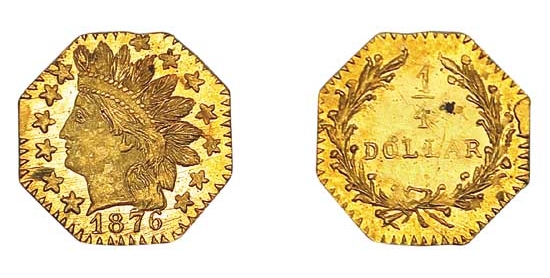
Obverse & Reverse
The 1876 BG-799A 25 Cent piece emerges from the second major phase of California Fractional Gold production, often termed 'Period Two' (1859-1882) by numismatists. Unlike the 'Period One' issues, which were struck out of genuine commercial necessity to alleviate a severe shortage of small change during the initial Gold Rush boom, the pieces from this later era served a different purpose. By the mid-1870s, the San Francisco Mint was in full operation, and the acute need for privately minted fractional currency had subsided. Instead, these small gold pieces were primarily manufactured by jewelers and artisans for the burgeoning souvenir and gift trade. San Francisco had become a major tourist destination, and visitors from the East Coast and Europe were eager for keepsakes of their California adventure. These miniature gold 'coins' were perfect for this role: small, affordable, easily transportable, and intrinsically tied to the romanticism of the Gold Rush. The legal environment for these pieces was ambiguous. The Private Coinage Act of 1864 had explicitly outlawed the creation of private currency intended to circulate as money. However, enforcement was inconsistent, and producers of fractional gold argued their creations were tokens or charms, not coins, thus skirting the law. This legal gray area allowed production to flourish throughout the 1870s. The makers, often anonymous jewelers rather than the named assayers of the 1850s, focused on attractive designs, such as the popular Indian Head motif, rather than adherence to federal weight standards. Consequently, Period Two fractionals are characteristically underweight for their stated denomination, containing far less than 25 cents worth of gold. Their primary value was sentimental and aesthetic. The BG-799A variety, dated to America's centennial year, would have held particular appeal. Production of these charming tokens was finally halted in the early 1880s after increased pressure from the U.S. Secret Service, which grew concerned about their potential for fraudulent use, bringing an end to a fascinating chapter of private minting.
Associated EventPost-Gold Rush California Tourism Boom
Reason For MintingPrimarily created to satisfy the demand for souvenirs and novelty items for tourists, rather than for monetary circulation.
Minter HistoryThe specific minter of BG-799A is unknown, which is characteristic of most 'Period Two' or 'Jeweler's Issues' of California Fractional Gold. These pieces were not the product of large, identifiable assaying firms like their 'Period One' predecessors. Instead, they were created by various jewelers and artisans in San Francisco and possibly other cities. These makers focused on producing attractive, gold-rush themed keepsakes for a thriving tourist market. Their work is often identified by die characteristics and style rather than a specific maker's mark.
Historical SignificanceThe BG-799A is significant not as a coin for commerce, but as a numismatic artifact representing the evolution of California's economy from a frontier gold-mining society to a center of tourism and trade. It marks a period when the romantic legend of the Gold Rush was commodified for a national audience, and it stands as a testament to the legal and entrepreneurial ambiguities of 19th-century private minting.
BG-799A
Denomination25C
Minting Period1876
Assayer/MinterUnknown Private Minter (Jeweler)
Geographic OriginSan Francisco, California (presumed)
Obverse DescriptionAn Indian Head profile facing left, adorned with a feathered headdress. The portrait is surrounded by 13 six-pointed stars arranged in an arc above the head. The date '1876' is positioned below the bust.
Obverse Inscription1876
Reverse DescriptionA wreath of two branches, open at the top and tied with a bow at the bottom, encircles the denomination. The denomination is expressed with the numeral '1/4' and the word 'DOLLAR' below it. The legend 'CALIFORNIA GOLD' is inscribed within the wreath, above the denomination.
Reverse InscriptionCALIFORNIA GOLD 1/4 DOLLAR
CompositionGold
Stated Fineness Actual FinenessVariable, but typically lower than Period One issues and significantly below U.S. Mint standards.
Diameter9.80 mm
EdgePlain
Unknown
Survival Estimate4-6 pieces known
Rarity ScaleHigh R-6
This variety is highly sought after due to its extreme rarity (High R-6), attractive octagonal shape, and classic Indian Head design. As a 'Period Two' issue, it tells the story of the souvenir trade that followed the Gold Rush. High-grade examples with prooflike surfaces are especially prized.
Key VarietiesBG-799A is a specific die marriage. Other BG-799 varieties (B, C, D, etc.) exist with the same date and general design but were struck from different dies, identifiable by minor variations in the placement of the date, stars, or lettering. No special collector issues like Proof restrikes are known for this specific variety; all known examples are considered business strikes, though often with prooflike surfaces from being struck on polished planchets.
Authentication TipsGenuine BG-799A pieces will exhibit a sharp, albeit sometimes uneven, strike from a hand-operated press. The details of the feathers and wreath should be fine, not mushy or cast-looking. Be wary of modern replicas, which are common in the Cal Gold series; fakes often have a soapy luster, incorrect weight, and may feature design elements not found on originals, such as a bear on the reverse. Any piece with a bear is a 20th-century token, not a genuine 19th-century fractional. The surfaces of authentic pieces often show die polishing lines and may have a prooflike or mirrored appearance.
Shopping ConsiderationsFor a premium quality BG-799A, look for a sharp strike, particularly on the highest points of the Indian's cheek and the feathers of the headdress. Luster is critical; a piece with original, vibrant, prooflike or satiny luster commands a significant premium. Given their purpose as souvenirs, many were mounted as jewelry; carefully check the edges and surfaces for signs of mounting, removal, or tooling. Cleaning is also common, so favor examples with original, undisturbed 'skin.' A specimen with a sharp strike, clean surfaces, and beautiful eye appeal is a true prize, given its rarity.
A coin's grade is its condition, rated on a 1-70 scale. For rare coins, this is the most critical factor in determining value, as a tiny difference in preservation can mean a huge difference in price.
Relevant Grade TypesOriginal examples of BG-799A were produced as business strikes, although many were struck on polished planchets to enhance their appeal as souvenirs, resulting in prooflike (PL) or deep mirror prooflike (DMPL) surfaces. They are found in both Circulated (1-58) and, more commonly, Mint State (MS, 60-70) grades. Due to their non-monetary purpose, circulated examples are scarce. No true Proofs were struck during the original period of issue, and no later-date collector restrikes are known to exist.
Mint State CharacteristicsUncirculated examples of BG-799A are defined by their luster and strike. A typical piece often displays highly reflective, prooflike fields due to the use of polished dies and planchets. The strike can be inconsistent; some are sharply detailed, while others may show weakness on the central devices, particularly the Indian's hair and the leaves of the wreath. Contact marks, though small, can be distracting on the mirrored surfaces, making clean-fielded examples exceptionally desirable.
Circulated Wear PatternsOn circulated examples, wear first appears on the highest points of the design. Look for friction and loss of detail on the Indian's cheekbone, the eyebrow, and the topmost feathers of the headdress. On the reverse, the high points of the bow and the central leaves of the wreath will show wear first. In lower grades (VF and below), the smaller letters in 'CALIFORNIA GOLD' and the numbers in the date will begin to soften and merge with the fields.
Key Factors For ValueThe primary value drivers for this variety are its rarity and grade. Given that most survivors are in high Mint State grades, surface quality is paramount. A BG-799A with deep, flashy, prooflike surfaces and minimal contact marks will command a substantial premium over a hazy or heavily marked piece of the same grade. Strike sharpness is also a key factor; a fully struck specimen is rare and highly valued. Finally, any example certified by a top-tier grading service (PCGS or NGC), especially with a CAC sticker, provides sought-after validation of authenticity and quality for this challenging series.
PCGS Price Guide
| Grade | Price | Population |
|---|---|---|
| 60 | $275.00 | 1 |
| 61 | $290.00 | 1 |
| 62 | $325.00 | 1 |
| 62+ | $375.00 | N/A |
| 63 | $500.00 | 3 |
| 63+ | $550.00 | N/A |
| 64 | $675.00 | 8 |
| 64+ | $800.00 | N/A |
| 65 | $1,500.00 | 1 |