1870 G25C BG-756 (Regular Strike)
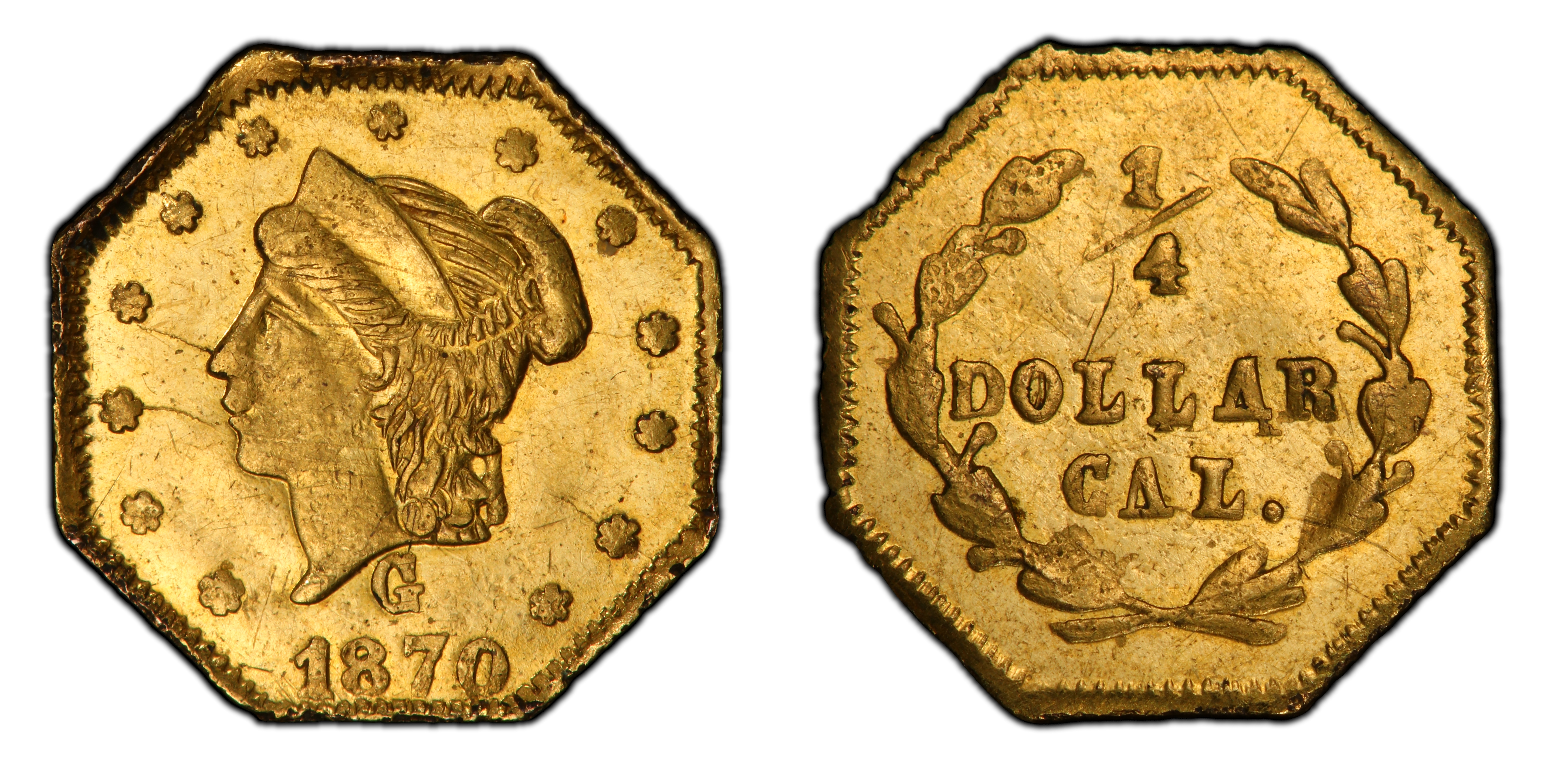
Obverse & Reverse
The 1870 G25C BG-756 is a fascinating artifact from the second phase of California's private gold coining era, a period numismatists designate as 'Period Two' (1858-1882). Unlike the 'Period One' issues, which were struck out of genuine commercial necessity to alleviate a severe shortage of small change during the initial Gold Rush frenzy, these later pieces were created primarily as souvenirs and keepsakes. By 1870, the San Francisco Mint was in full operation, supplying the region with ample federal coinage. However, the romance of the Gold Rush had captivated the nation, creating a robust market for miniature gold tokens that evoked the era's adventurous spirit. San Francisco jewelers, many of whom had produced the earlier necessity coinage, astutely pivoted to meet this demand. They struck hundreds of varieties of 25-cent, 50-cent, and one-dollar gold pieces, often backdating them or using generic designs to circumvent the Private Coinage Act of April 22, 1864, which technically made such activities illegal. These 'jeweler's issues' were not intended to and did not circulate as money; their intrinsic gold value was significantly less than their face value, rendering them tokens rather than true coins. Production of these pieces flourished throughout the 1870s, as they were popular gifts and mementos for tourists and locals alike. The 1870 BG-756, an octagonal Liberty Head piece, is a quintessential example of this phenomenon. Its creation is often attributed to the prolific jeweler Robert B. Gray & Co., who marked many of his firm's pieces with a distinctive 'G'. The eventual demise of this lively industry came not from a lack of demand, but from increased federal pressure. In 1883, the U.S. Secret Service, under Chief James J. Brooks, finally cracked down, determining that the denominated pieces could be used to defraud the public, however small their scale. Production ceased, marking the end of a unique and colorful chapter in American numismatic history. Today, the BG-756 is recognized as a significant rarity, a tangible link to the post-Gold Rush souvenir trade of San Francisco.
Associated EventCalifornia Gold Rush Aftermath & Souvenir Trade
Reason For MintingPrimarily created as a souvenir or keepsake of the California Gold Rush era for sale to tourists and the public, rather than for circulation.
Minter HistoryWhile not definitively signed, the BG-756 is stylistically attributed by many specialists to Robert B. Gray & Co., a prominent San Francisco jewelry firm. Active in producing fractional gold from the late 1850s until at least 1871, Gray's operation was notable. In late 1858 or 1859, Gray acquired the dies and equipment of another pioneer minter, Antoine Louis Nouizillet. Gray's pieces are generally regarded as being of higher weight and quality than many of their 'Period Two' contemporaries. His firm produced a wide variety of dated and undated types, often marking them with a 'G' hallmark, solidifying his legacy as one of the key figures in the fractional gold souvenir market.
Historical SignificanceThe BG-756 represents the commercialization of the Gold Rush legacy. It is not a coin of necessity but a token of nostalgia, illustrating how jewelers adapted to changing economic conditions by creating a popular collectible that capitalized on the romantic image of the '49ers. Its extreme rarity today underscores the limited production of individual die pairings and the ephemeral nature of these historic souvenirs.
N/A
Denomination25 Cents
Minting Period1870
Assayer/MinterProbably Robert B. Gray & Co.
Geographic OriginSan Francisco, California
Obverse DescriptionA head of Liberty facing left, her hair tied in a bun. She is surrounded by 13 six-pointed stars arranged in a circle near the octagonal border. The date, 1870, appears below the bust.
Obverse Inscription1870
Reverse DescriptionThe denomination '25 CENTS' is enclosed within a wreath of two olive branches tied with a bow at the bottom. The legend 'CALIFORNIA GOLD' appears along the upper periphery, outside the wreath.
Reverse InscriptionCALIFORNIA GOLD 25 CENTS
CompositionGold
Stated Fineness Actual FinenessTypically varied from 14 to 22 karats for Period Two issues.
Weight0.24 grams
Diameter9.60 mm
EdgePlain
Unknown, but extremely small.
Survival EstimateFewer than 10; possibly as few as 4-6 pieces.
Rarity ScaleR-7 (Low R-7)
The 1870 BG-756 is a highly coveted numismatic rarity. Its appeal stems from its octagonal shape, the immense popularity of the California Fractional Gold series, and its status as a high R-7 variety. Acquiring any example, regardless of grade, is a significant achievement for a specialist.
Key VarietiesThis is a single, specific die marriage (BG-756). No major varieties from the original minting period are known. As a 'Period Two' issue, it is itself a type of special collector issue, not intended for circulation. No known restrikes or patterns exist for this specific variety.
Authentication TipsGenuine pieces must have a denomination; fakes and modern replicas often say 'CALIFORNIA GOLD' without 'CENTS' or 'DOLLAR'. Look for a characteristically soft strike, as these were often produced with less care than federal coinage. The surfaces should not be mirror-like or prooflike, which is common on modern copies. The gold color should be consistent with 19th-century alloys, not the brassy look of gold-plated fakes. Any piece featuring a bear on the reverse is a fantasy item. The Breen-Gillio reference is the ultimate arbiter; if a piece is not listed, it is almost certainly not a genuine Period Two issue.
Shopping ConsiderationsFor a premium quality BG-756, look for a well-centered and reasonably sharp strike, as many were weakly struck, especially at the borders. Original, uncleaned surfaces are paramount; many of these tiny coins have been harshly cleaned, polished, or used in jewelry, resulting in impaired surfaces, solder marks, or holes. Look for attractive, slightly reddish-gold toning that indicates originality. Avoid examples with significant scratches, rim bumps, or planchet flaws, which are common but still detract from the value. Given the rarity, even a problem-free, circulated example (e.g., AU grade) is a major prize. Any Mint State example is a condition census rarity.
A coin's grade is its condition, rated on a 1-70 scale. For rare coins, this is the most critical factor in determining value, as a tiny difference in preservation can mean a huge difference in price.
Relevant Grade TypesOriginal 1870 issues were business strikes, although intended as souvenirs rather than for commerce. They are found in Circulated (1-58) and Mint State (MS, 60-70) grades. Due to their purpose as collectibles from day one, a higher proportion may exist in uncirculated grades than circulation-issue coinage. No true Proofs were struck during the original period of issue, and there are no known later-date restrikes.
Mint State CharacteristicsAn uncirculated BG-756 typically exhibits a soft, satiny luster rather than a hard, frosty one. The strike is often weak on the highest points of Liberty's hair and the leaves in the wreath. Small planchet imperfections or adjustment marks made prior to striking are common and should be distinguished from post-striking damage. Due to the softness of the gold, even high-grade uncirculated examples will likely show minor contact marks from handling over the last 150+ years.
Circulated Wear PatternsWear first appears on the high points of Liberty's hair above her ear and on her cheekbone. On the reverse, the highest points of the wreath's leaves and the bow will show initial friction and flattening. In lower grades (VF and below), the stars on the obverse will begin to lose their definition, and the finer details of the wreath will merge.
Key Factors For ValueRarity is the primary driver. Beyond that, surface preservation is critical; an example with original, undisturbed luster and skin will command a massive premium over one that has been cleaned, even if the technical grade is similar. Strike quality is also key; a coin with a sharp central strike on the Liberty head and wreath is highly desirable. Finally, eye appeal—a combination of toning, luster, and strike—plays a huge role. A CAC sticker on a coin of this rarity would signify premium quality for the grade and add a substantial premium to its value.
PCGS Price Guide
| Grade | Price | Population |
|---|---|---|
| 55 | $700.00 | 1 |
| 55+ | $720.00 | N/A |
| 58 | $750.00 | N/A |
| 58+ | $775.00 | N/A |
| 60 | $800.00 | N/A |
| 61 | $850.00 | 1 |
| 62 | $1,000.00 | 3 |
| 62+ | $1,250.00 | N/A |
| 63 | $1,850.00 | 4 |