1869 G25C BG-748 (Regular Strike)
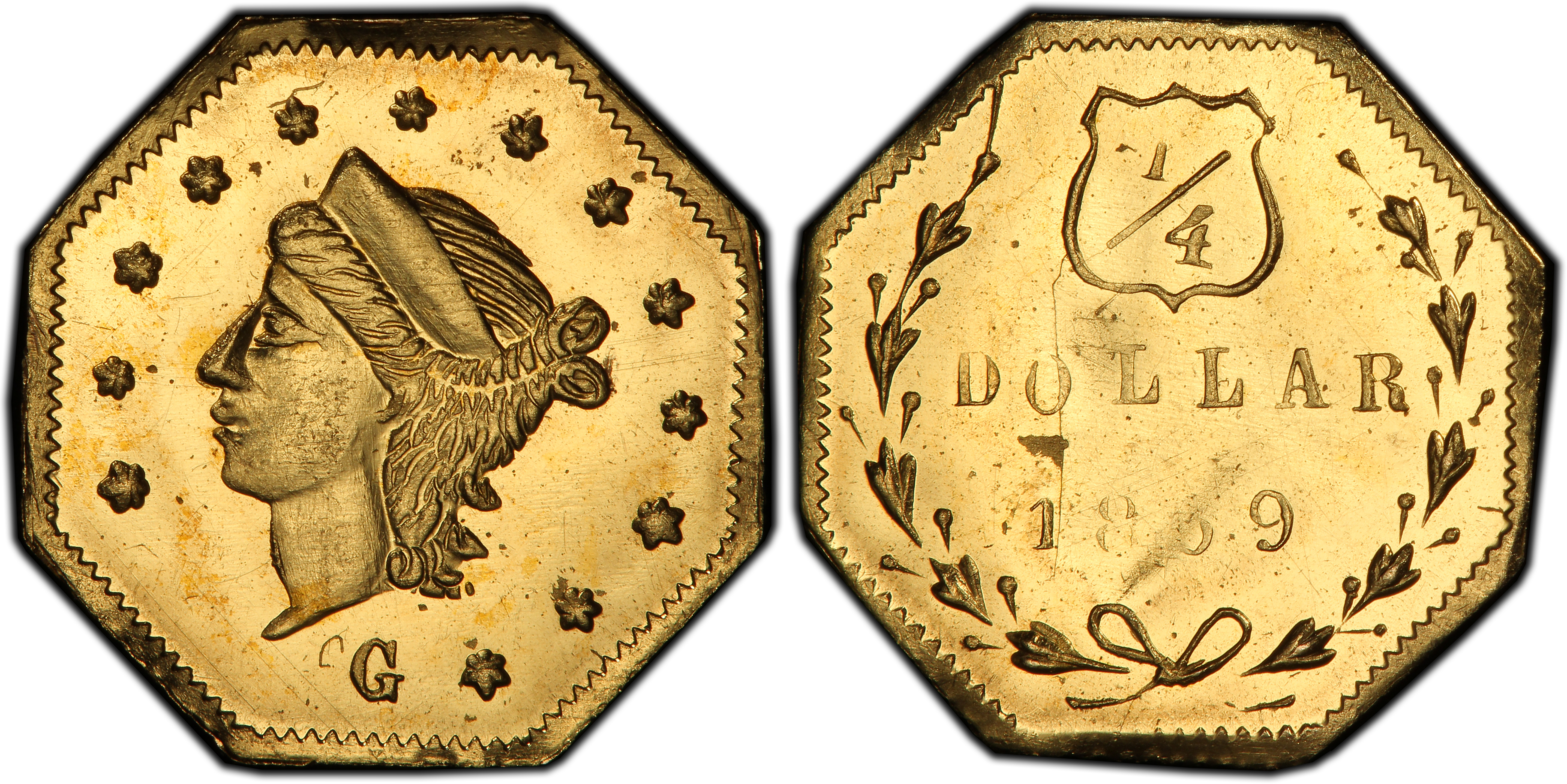
Obverse & Reverse
The 1869 G25C BG-748 is a quintessential example of a 'Period Two' California Fractional Gold piece, a fascinating series born from the economic realities of the American West. Following the initial California Gold Rush, the region was flooded with gold dust but severely lacked official small-denomination coinage for everyday transactions. To fill this void, private jewelers and metallurgists began striking their own fractional gold coins in 25-cent, 50-cent, and dollar denominations starting in 1852. These 'Period One' (1852-1857) issues were genuinely intended for commerce. However, by the late 1850s, the San Francisco Mint was producing sufficient federal silver and gold coinage, diminishing the commercial need for these private issues. The nature of fractional gold production shifted. Enterprising jewelers like Robert B. Gray & Co. recognized a new market: souvenirs and novelty items for tourists, merchants, and those back East captivated by the romance of the Gold Rush. The BG-748, struck in 1869, falls squarely into this 'Jeweler's Issue' era (1858-1882). These pieces were not intended to circulate widely but were sold as keepsakes. The prominent 'G' on the obverse is the identifying mark of Robert B. Gray, who had purchased the coining business of Antoine Louis Nouzillet around 1859. Gray continued to produce a wide variety of these small gold pieces until selling his interests in 1871. Despite the Coinage Act of 1864, which made private minting illegal, enforcement was lax, and production of these popular tokens actually increased in the 1870s. It wasn't until a Secret Service crackdown in 1883 that the industry was finally shuttered. The BG-748 is a tangible link to this later, more commercialized phase of the Gold Rush story, representing a memento of an era rather than a tool of daily commerce.
Associated EventPost-Rush California Commerce and Tourism
Reason For MintingPrimarily created as a souvenir or novelty item for a commercial market, rather than to alleviate a coin shortage.
Minter HistoryRobert B. Gray & Co. was a prominent San Francisco jewelry firm and a prolific producer of 'Period Two' California Fractional Gold. Around 1859-1860, Gray purchased the coining equipment and dies of Antoine Louis Nouzillet, one of the key 'Period One' minters. Gray began producing his own distinctive issues, marking many of his dies with a 'G' below the bust of Liberty. His firm was located at 616 Merchant Street in San Francisco. Gray's issues are noted for being of generally higher weight and quality than many other contemporary jeweler's pieces. He sold his business to the California Jewelry Co. in 1871.
Historical SignificanceThis coin represents the transition of fractional gold from a circulating medium of necessity to a popular collectible and souvenir. It highlights the continued romantic allure of the Gold Rush and the entrepreneurial spirit of San Francisco's jewelers who adapted their products to a changing market, even in the face of prohibitive federal laws.
N/A
Denomination25 Cents
Minting Period1869
Assayer/MinterRobert B. Gray & Co.
Geographic OriginSan Francisco, California
Obverse DescriptionA head of Liberty facing left, her hair tied in a bun with some loose curls. She wears a coronet or tiara, and is surrounded by thirteen stars. The date '1869' is below the bust, and the minter's initial 'G' is visible in the field to the left, between the date and the rearmost star.
Obverse Inscription1869
Reverse DescriptionThe denomination '25 CENTS' is enclosed within a wreath of two olive branches. The wreath is tied with a bow at the bottom.
Reverse Inscription25 CENTS
CompositionGold
Stated Fineness Actual FinenessVariable, typically 14 to 22 karats. Known to be intrinsically worth less than face value.
Weight0.24 grams
Diameter9.60 mm
EdgePlain
Unknown
Survival Estimate46-60 (R-5)
Rarity ScaleR-5
Sought for its direct connection to a famous Gold Rush-era minter, its octagonal shape, clear date, and status as a representative of the 'Jeweler's Issue' period. The BG-748 is a relatively attainable variety within a highly popular and historically rich collecting field.
Key VarietiesThe primary collecting method for this series is by Breen-Gillio (BG) number, which identifies a specific die pair. BG-748 is itself a distinct variety. No major sub-varieties or special collector restrikes are noted for this specific die marriage. The broader category includes numerous other die pairings by Robert B. Gray & Co. with minor variations in design and placement of elements.
Authentication TipsGenuine pieces are very thin and light. Fakes are often thicker, heavier, and have a soapy or cast-like appearance. The strike on genuine pieces is often somewhat crude and uneven, a result of the 'hammered' minting process. A perfectly struck, uniform piece should be viewed with suspicion. The details, while potentially soft, should be sharp in areas, not blurry. The 'G' mintmark and the style of the numerals and letters should be compared to known genuine examples.
Shopping ConsiderationsA premium quality example for its grade will exhibit a bold, well-centered strike, especially on the high points of Liberty's hair and the leaves of the wreath. Many genuine pieces have prooflike or reflective surfaces, which are highly desirable. Look for original, uncleaned surfaces with attractive reddish-gold or yellow-gold toning. Avoid examples that have been used as jewelry, showing solder marks, harsh cleanings, scratches, or tooling in the fields. Given the crude striking method, a weakly struck date or periphery is common, but the central devices should be as sharp as possible.
A coin's grade is its condition, rated on a 1-70 scale. For rare coins, this is the most critical factor in determining value, as a tiny difference in preservation can mean a huge difference in price.
Relevant Grade TypesOriginal period issues were business strikes, though they were primarily sold as novelties and not intended for heavy circulation. They are found in Circulated (1-58) and Mint State (MS, 60-70) grades. No true Proofs were struck during the original period of issue. The term 'Prooflike' (PL) is often applied to high-grade Mint State examples that exhibit deeply mirrored fields from polished dies, a characteristic common to this series.
Mint State CharacteristicsUncirculated examples often display a sharp contrast between frosty devices and deeply prooflike, reflective fields. Luster is typically bright and glassy. Due to the manufacturing process, it is common to see minor planchet irregularities or a slightly uneven strike, even on high-grade pieces. Small, scattered contact marks are typical, but large, distracting abrasions on Liberty's cheek or in the central fields will detract significantly from the grade and eye appeal.
Circulated Wear PatternsWear first appears on the highest points of the design. On the obverse, this includes Liberty's cheek, the hair above her ear, and the highest points of the coronet. On the reverse, the leaves at the top of the wreath and the bow will show the first signs of friction. On lower-grade circulated examples, the stars and legends will begin to weaken and merge with the fields.
Key Factors For ValueThe primary value drivers for a BG-748 are grade and surface quality. A sharp, well-executed strike commands a significant premium, as many are softly struck. Original, uncleaned 'skin' with prooflike surfaces is highly prized by collectors. Eye appeal is critical; a coin with rich, original color will be worth more than a dipped or washed-out specimen of the same grade. A CAC sticker, indicating premium quality for the grade, adds a substantial premium for this series.
PCGS Price Guide
| Grade | Price | Population |
|---|---|---|
| 55 | $250.00 | 3 |
| 55+ | $255.00 | N/A |
| 58 | $265.00 | 8 |
| 58+ | $275.00 | N/A |
| 60 | $300.00 | 5 |
| 61 | $325.00 | 6 |
| 62 | $375.00 | 19 |
| 62+ | $450.00 | N/A |
| 63 | $750.00 | 9 |
| 63+ | $825.00 | N/A |
| 64 | $1,050.00 | 4 |
| 64+ | $1,250.00 | N/A |
| 65 | $2,500.00 | 1 |