1868 25C BG-799T (Regular Strike)
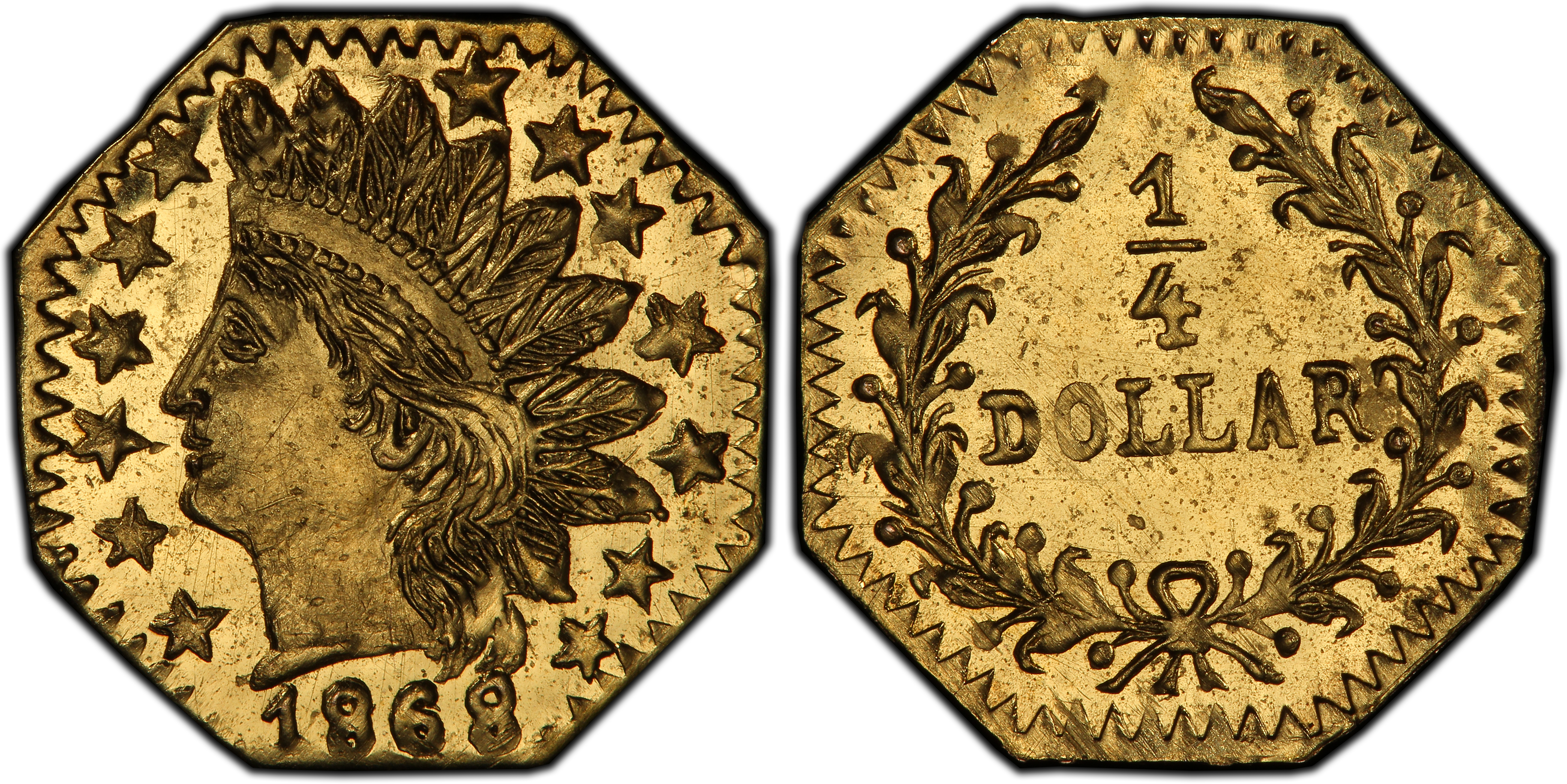
Obverse & Reverse
The 1868 25 Cents, cataloged as BG-799T, is a quintessential example of a 'Period Two' California Fractional Gold piece. These fascinating and diminutive coins emerged from a complex evolution in California's post-Gold Rush economy. The initial period of fractional gold (1852-1856) was born of true necessity; the deluge of gold dust and large-denomination federal and private coins left a severe void of small change for daily commerce. Private minters and jewelers filled this gap with tiny 25-cent, 50-cent, and one-dollar gold pieces that, while unofficial, served a vital monetary role. However, by 1856, the new San Francisco Mint was in full operation, alleviating the small-change crisis with official U.S. silver coinage. The rationale for producing fractional gold seemingly vanished, yet after a brief hiatus, production resumed in 1859, marking the beginning of 'Period Two.' The pieces from this second era, including the BG-799T, served a different purpose. They were no longer primarily instruments of commerce but were instead 'jeweler's issues'—souvenirs and novelty items catering to a growing tourist trade and a public still captivated by the romance of the Gold Rush. Easterners and Europeans visiting the now-civilized city of San Francisco sought mementos of 'California Gold,' and these tiny, affordable coins were perfect for mailing back home. Unlike their Period One predecessors, which often contained close to their face value in gold, Period Two issues were notoriously underweight and frequently made of debased gold alloy. Their designs also diverged, moving away from copies of federal coinage to more fanciful motifs, such as the Indian Head design seen on this piece. The Coinage Act of 1864 explicitly forbade private coinage, but enforcement was lax, allowing these jeweler's issues to be produced until the Secret Service finally cracked down in the early 1880s. Many later pieces were backdated to avoid legal trouble. The BG-799T, with its 1868 date, represents a piece made during the heyday of this souvenir-driven market, a tangible link to a time when California's gold was transitioning from a raw economic force to a powerful symbol of American ambition.
Associated EventPost-Gold Rush California Commerce and Tourism
Reason For MintingPrimarily struck to be sold as souvenirs and jewelry charms rather than to alleviate a coin shortage, which had been resolved by the San Francisco Mint.
Minter HistoryThe specific minter for the BG-799 die pairing is unknown, a common trait for Period Two issues. The work is attributed to the many skilled but often anonymous French and American jewelers operating in San Francisco during the 1860s. These craftsmen used die punches and hand-hammering techniques to produce a wide variety of designs. Unlike the assayers of Period One, these minters were not attempting to create a trusted currency but rather appealing novelties, and thus rarely applied identifiable maker's marks to their work.
Historical SignificanceThe BG-799T is historically significant not as a coin used in daily transactions, but as a socio-economic artifact. It represents the maturation of the California economy, the rise of tourism in San Francisco, and the commercialization of the Gold Rush legend. It is a prime example of the legally ambiguous but popular 'jeweler's issues' that characterized the second phase of private gold production in the West.
N/A
Denomination25 Cents
Minting Period1868
Assayer/MinterUnknown San Francisco Jeweler(s)
Geographic OriginSan Francisco, California
Obverse DescriptionAn Indian Head portrait facing left, reminiscent of the contemporary U.S. Indian Head cent, surrounded by 13 stars along the octagonal border. The date '1868' is positioned below the bust.
Obverse Inscription1868
Reverse DescriptionThe denomination '1/4' is enclosed within a wreath of leaves and berries. The words 'DOLLAR' and 'CAL' appear outside the wreath, at the top and bottom respectively, though on some specimens 'CAL' is omitted or weakly struck.
Reverse Inscription1/4 DOLLAR CAL
CompositionGold
Stated Fineness Actual FinenessVariable, often below the .900 standard of federal coinage. Typically ranges from .500 to .850 fine.
Weight0.25 grams
Diameter9.80 mm
EdgePlain
Unknown
Survival Estimate31-75
Rarity ScaleR-5+
This coin is highly appealing for its octagonal shape, classic Indian Head design, and direct connection to the post-Gold Rush era. As an R-5+ variety, its scarcity adds to its desirability. It is a key representative of the 'souvenir' or 'jeweler's issue' period of California Fractional Gold, making it an essential piece for specialists.
Key VarietiesThe BG-799 designation refers to a series of die pairings using a common set of punches. The terminal letter, 'T' in this case, identifies the specific die marriage. Other known 1868-dated varieties from this group include BG-799R and BG-799S, each with its own die characteristics and rarity. No later-date restrikes or proof issues of this specific variety are known to exist.
Authentication TipsAuthenticity is paramount. Genuine pieces were die-struck, not cast, so look for sharp details and avoid examples with casting bubbles or a porous texture. The strike is often uneven due to the hammer-striking process, but the design elements should match known genuine examples precisely. Compare the font style of the date and legends to certified specimens. Many brass counterfeits and modern replicas exist; these are often the wrong color, weight, and may have a soapy or unnatural luster. Professional authentication is highly recommended.
Shopping ConsiderationsA premium quality BG-799T will exhibit a bold strike, particularly on the Indian's headdress and the details of the reverse wreath. Luster is a key value driver; seek examples with original, satiny fields rather than those that are harshly cleaned or polished. The soft gold is susceptible to contact marks and rim bumps, so inspect carefully. Attractive, original toning, often a deep lemon-gold or orange-peel color, is highly desirable and commands a premium. Given the often crude centering, pieces that are well-centered with full border details are preferred.
A coin's grade is its condition, rated on a 1-70 scale. For rare coins, this is the most critical factor in determining value, as a tiny difference in preservation can mean a huge difference in price.
Relevant Grade TypesAll original BG-799T pieces are considered business strikes, intended for sale as novelties. They are found in Circulated grades (AG-3 to AU-58) and, more commonly, in Mint State grades (MS-60 to MS-70), as many were saved as keepsakes and never used. No Proof (PR/PF) examples were struck during the original period of issue, and no later-date Proof restrikes are known.
Mint State CharacteristicsAn uncirculated BG-799T is defined by the presence of original mint luster, which is typically soft and satiny. Strike quality varies significantly due to the manufacturing process; many examples are weakly struck in the center or on the peripheral legends. High-grade examples will show sharp details on the high points of the hair and feathers. Bag marks are common, but large, distracting contact marks on the cheek or in the primary fields will lower the grade and eye appeal.
Circulated Wear PatternsWear first appears on the highest points of the design: the cheek and the feathers of the headdress on the obverse. On the reverse, the leaves and berries of the wreath will show initial friction and flattening. On more heavily circulated examples, the stars on the obverse and the lettering on the reverse will begin to weaken and merge with the fields.
Key Factors For ValueThe primary drivers of value for this variety are grade and surface quality. An example with original, undisturbed luster will be worth multiples of a cleaned or polished piece of the same grade. Sharpness of strike is critical; a well-struck coin is always preferred over a weakly struck one. Eye appeal, encompassing attractive toning and minimal distracting marks, plays a major role. Finally, certification by a top-tier grading service (PCGS or NGC) is essential for market acceptance, and a CAC sticker indicates premium quality for the grade, often resulting in a significant price jump.
PCGS Price Guide
| Grade | Price | Population |
|---|---|---|
| 60 | $325.00 | 1 |
| 61 | $350.00 | N/A |
| 62 | $375.00 | 3 |
| 62+ | $425.00 | N/A |
| 63 | $550.00 | 8 |
| 63+ | $675.00 | N/A |
| 64 | $1,050.00 | 16 |
| 64+ | $1,150.00 | N/A |
| 65 | $1,750.00 | 5 |
| 65+ | $2,000.00 | 1 |
| 66 | $3,000.00 | 1 |
| 67 | N/A | N/A |