1874 G25C BG-775 (Regular Strike)
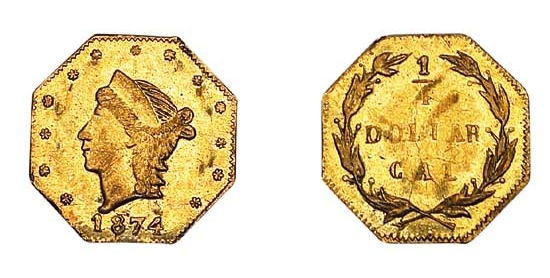
Obverse & Reverse
The 1874 BG-775 octagonal quarter dollar is a quintessential example of 'Period Two' California Fractional Gold. This era, spanning from 1859 to 1882, is distinct from the earlier 'Period One' (1852-1856) issues that were struck with higher intrinsic value to alleviate the severe shortage of small change during the initial Gold Rush boom. By the 1870s, the economic landscape of California had matured. The establishment of the San Francisco Mint in 1854 had largely solved the coinage crisis, and federal coins circulated widely. The privately issued fractional gold pieces of this later period, therefore, served a different purpose. They were not primarily instruments of commerce born of necessity, but rather souvenir and jewelry items, catering to a romanticized fascination with the Gold Rush. These pieces were often underweight and made of debased gold, intended as keepsakes for tourists, charms for watch chains, or gifts. The production of these denominated tokens existed in a legal gray area. The Coinage Act of 1864 had made private coinage illegal, but the law was not aggressively enforced against these small, low-value pieces until the early 1880s. This BG-775 variety was struck by Herman J. Brand, a prominent San Francisco jeweler and die sinker. Brand, like other jewelers of the era such as Robert B. Gray & Co. and the Levison Brothers, capitalized on the public's desire for tangible mementos of California's golden identity. These jewelers operated sophisticated workshops, capable of producing well-executed, if often artistically naive, miniature coins. The 1874 issue coincides with a period of significant growth and change in San Francisco, as the city rebuilt and redefined itself decades after the initial rush. These tiny gold pieces, though commercially insignificant, are powerful cultural artifacts, representing the commodification of the Gold Rush narrative and the entrepreneurial spirit of the city's craftsmen. Their extreme rarity today attests to a very limited original production, likely made in small batches within Brand's shop, and a high rate of attrition, as many were lost or incorporated into jewelry over the decades.
Associated EventPost-Gold Rush California Economy
Reason For MintingPrimarily struck as souvenirs and jewelry items for the tourist trade, not to alleviate a circulating coinage shortage.
Minter HistoryHerman J. Brand was a German immigrant jeweler, die sinker, and sculptor active in San Francisco during the latter half of the 19th century. He was a significant producer of 'Period Two' California Fractional Gold, known for creating both Liberty Head and Indian Head designs. His business catered to the robust market for souvenirs and keepsakes that recalled the Gold Rush era. Brand's operations eventually drew the attention of the U.S. Secret Service, which began cracking down on private coiners in the early 1880s for issuing pieces that resembled legal tender. To avoid prosecution, Brand and others shifted to producing non-denominated tokens, often featuring designs like a miner with a pickaxe, which clearly marked them as charms rather than coins. His work is cataloged extensively in the Breen-Gillio reference, signifying his importance as one of the key figures in the later history of this fascinating series.
Historical SignificanceThe BG-775 is historically significant not as a coin for circulation, but as a representation of the commercialization of the Gold Rush legacy. It is a tangible link to the jeweler-minters of San Francisco in the 1870s and the transition of fractional gold from a necessity to a nostalgic souvenir, a numismatic niche that operated in the legal shadows of federal coinage laws.
BG-775
Denomination25 Cents
Minting Period1874
Assayer/MinterHerman J. Brand
Geographic OriginSan Francisco, California
Obverse DescriptionA stylized Liberty Head facing left, her hair tied in a bun. The portrait is somewhat crude, typical of the jeweler-made issues of the period. The field is surrounded by thirteen small, five-pointed stars, unevenly spaced along the octagonal border. The date '1874' is positioned below the truncation of the neck.
Obverse Inscription1874
Reverse DescriptionThe reverse features the denomination '1/4' and 'DOLLAR' arranged in two lines at the center. This is enclosed within a wreath composed of two olive branches. The wreath is open at the top and tied with a bow at the bottom.
Reverse Inscription1/4 DOLLAR
CompositionGold
Stated Fineness Actual FinenessTypically debased, fineness varies but is generally lower than official U.S. Mint issues of the era.
Diameter9.80 mm
EdgePlain
Unknown, but extremely small.
Survival EstimateFewer than 10 known. Some sources suggest as few as 4-6 specimens have been accounted for.
Rarity ScaleHigh R-6 to High R-7
This coin's appeal lies in its extreme rarity and its connection to the specific San Francisco jeweler Herman J. Brand. As a 'Period Two' issue, it tells the story of the post-Gold Rush souvenir trade. High-grade examples with prooflike or reflective surfaces are particularly prized by specialists.
Key VarietiesThere are no major varieties, restrikes, or patterns specifically cataloged for the BG-775 die marriage. The primary collectability is focused on this single, extremely rare issue. One known example is designated as the 'Breen-Gillio Plate Coin,' giving it a special pedigree.
Authentication TipsAuthenticity should be confirmed by a major grading service. Key diagnostics include the specific die characteristics of the crude Liberty portrait, the unique spacing and shape of the thirteen stars, and the letter style on the reverse. Genuine pieces often have a slightly uneven strike and may exhibit die polish lines or minor planchet imperfections. Counterfeits are common in this series but often fail to replicate the precise die state of known originals; they may appear too perfect, have the wrong weight, or show a 'soapy' or cast-like texture.
Shopping ConsiderationsFor a premium quality example, a buyer should seek a piece with a sharp, well-centered strike, as many were weakly or unevenly impressed. Look for original, undisturbed surfaces with some remaining luster; many survivors have been cleaned or used as jewelry. Semireflective or prooflike surfaces are highly desirable and command a significant premium. Check carefully for evidence of removal from jewelry, such as tooling or smoothing on the edges. Given its rarity, any example is a major acquisition, but one with minimal handling marks and attractive olive-gold or peach-orange toning would be considered top-tier for its assigned grade. A CAC sticker would provide additional confidence in the coin's quality.
A coin's grade is its condition, rated on a 1-70 scale. For rare coins, this is the most critical factor in determining value, as a tiny difference in preservation can mean a huge difference in price.
Relevant Grade TypesOriginal period issues were business strikes, though not intended for widespread circulation. They are found in both Circulated (1-58) and Mint State (MS, 60-70) grades. Due to their nature as souvenirs, high-grade Mint State examples are more common than for circulating 'Period One' issues, though still exceptionally rare. No true Proofs were struck during the original period of issue, though some specimens are found with prooflike (PL) or deep prooflike (DPL) surfaces from being struck with polished dies.
Mint State CharacteristicsAn uncirculated BG-775 is defined by its luster and absence of wear. High-quality examples exhibit semi-reflective or 'prooflike' fields. The strike is often somewhat weak in the centers, particularly on the highest points of Liberty's hair and the leaves of the wreath. Small, light handling marks are common due to the softness of the gold and the way these pieces were handled as novelties. The color is typically a natural olive-gold or yellow-gold, sometimes with hints of orange toning.
Circulated Wear PatternsWear first appears on the highest points of Liberty's hair, specifically the strands above her ear and at the crown of her head. The cheek and the eyebrow line are also susceptible to early friction. On the reverse, the highest leaves of the wreath and the numerals of the fraction '1/4' will show the first signs of flattening. In lower circulated grades, the stars on the obverse will begin to merge with the fields, and the legends on the reverse will lose their sharpness.
Key Factors For ValueExtreme rarity is the primary value driver. Beyond that, surface quality is paramount; an example with original, lustrous, and mark-free surfaces will command a massive premium over a cleaned or damaged piece of the same grade. Strike sharpness is also key, as well-defined examples are rare. Eye appeal, enhanced by attractive natural toning and reflective fields, significantly increases value. Finally, a documented provenance to a major collection, especially being the plate coin for the Breen-Gillio reference, adds immense historical and monetary value. A CAC sticker confirming quality for the grade is a significant value-add for this issue.
PCGS Price Guide
| Grade | Price | Population |
|---|---|---|
| 55 | $500.00 | 2 |
| 55+ | $540.00 | N/A |
| 58 | $625.00 | 4 |
| 58+ | $650.00 | N/A |
| 60 | $700.00 | 1 |
| 61 | $750.00 | 2 |
| 62 | $1,250.00 | 5 |