1876 25C BG-799E (Regular Strike)
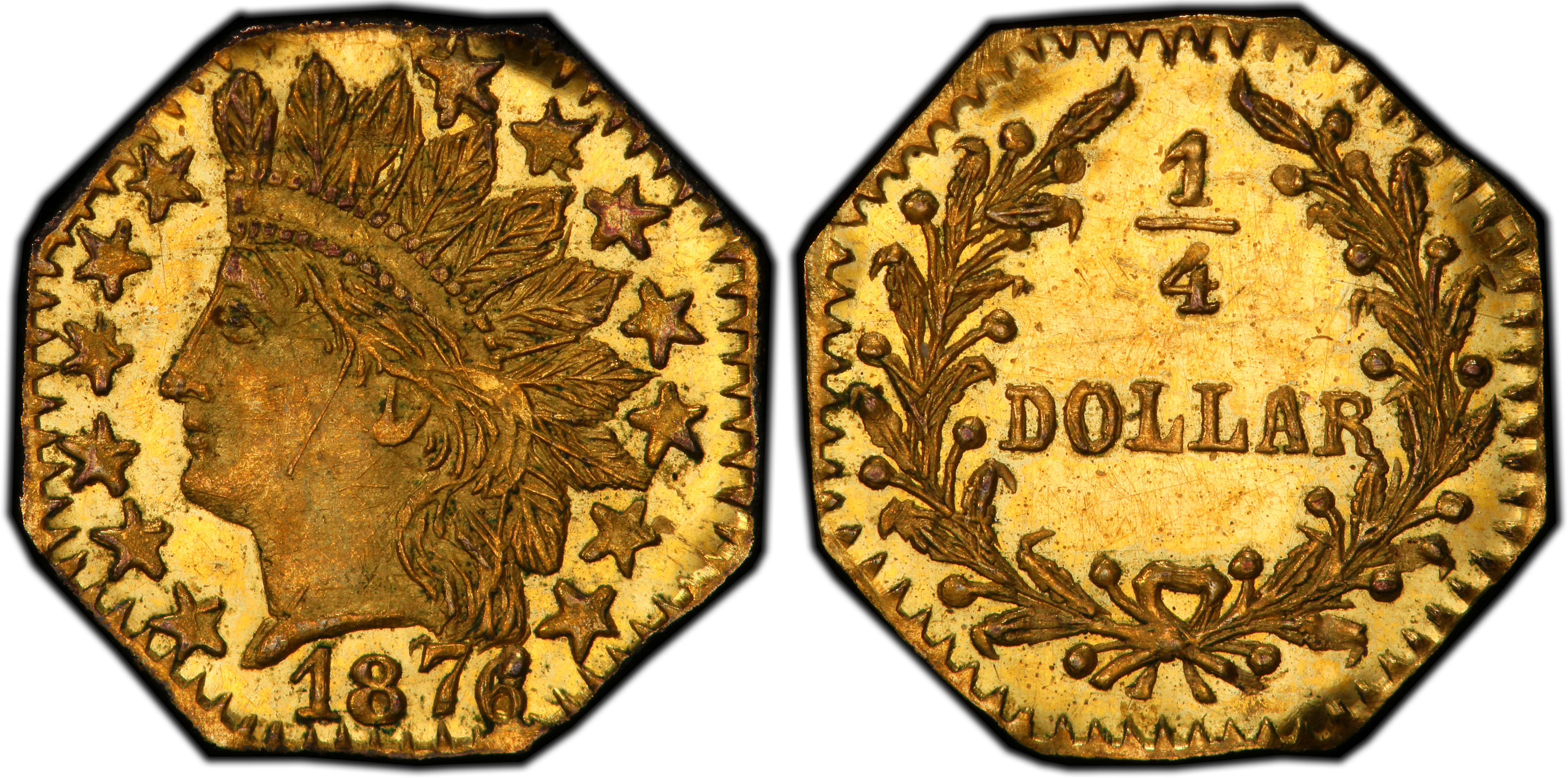
Obverse & Reverse
The BG-799E represents a fascinating and extremely rare specimen from the second period of California Fractional Gold production (1858-1882). Unlike the 'Period One' issues (1852-1857), which were struck with some earnest intent to alleviate the chronic shortage of small denomination coinage in the West, Period Two pieces were created in a shifting economic and legal landscape. By the late 1870s, the United States Mint in San Francisco was in full operation, supplying the region with ample federal coinage and rendering private issues obsolete for commerce. Furthermore, the Coinage Act of 1864 explicitly forbade the private production of currency. Although not strictly enforced by the Secret Service until 1883, this act pushed the creation of such pieces into a legally grey area. Consequently, jewelers and private minters in San Francisco shifted their focus from producing circulating coinage to creating souvenir and novelty items for tourists and the burgeoning numismatic community. These pieces, often backdated or muled with different dies, were keepsakes of the romanticized Gold Rush era. The BG-799E is a quintessential example of this later period. It is not a regular 1876 issue, but rather an 1878/6 overdate, created by re-punching a die. This act of die modification, combined with its minuscule survival rate, suggests it was not a large-scale production but a very limited, perhaps experimental, striking by an anonymous San Francisco jeweler. Its existence speaks to a cottage industry that catered to a niche market, leveraging the allure of gold and the mystique of the frontier to create numismatic curiosities rather than functional money. Its status as an R-7+ variety, with perhaps only one to three examples known, elevates it from a simple souvenir to one of the ultimate prizes for the advanced specialist in the field.
Associated EventPost-Gold Rush California Commerce
Reason For MintingPrimarily created as a souvenir or numismatic curiosity for collectors rather than for general circulation, circumventing but acknowledging federal anti-private coinage laws.
Minter HistoryThe specific minter for the BG-799 series of dies is unknown. During this period, many San Francisco-based jewelers produced fractional gold pieces, often anonymously to avoid potential legal repercussions from the Coinage Act of 1864. Their work is typically identified today only through die analysis and comparison, as codified in the Breen-Gillio reference.
Historical SignificanceThe BG-799E is significant not as a tool of commerce, but as a representation of the evolution of private minting in California. It showcases the transition from utilitarian issues to collector-focused novelties and demonstrates the technical aspects of die re-use and modification (overdating) within this clandestine industry. Its extreme rarity makes it a key artifact in understanding the twilight years of private gold coining in the United States.
BG-799E
Denomination25C
Minting Periodc. 1878
Assayer/MinterUnknown
Geographic OriginSan Francisco, California
Obverse DescriptionAn Indian Head motif, facing left, adorned with a feathered headdress. The portrait is surrounded by thirteen stars, representing the original colonies. The date, 1878 punched over a 6, is positioned below the bust. The diagnostic feature is the clear remnant of the underlying digit '6' visible within and around the '8'.
Obverse Inscription1878/6
Reverse DescriptionA simple wreath composed of two branches tied with a bow at the bottom. The denomination '1/4 DOL.' is located within the center of the wreath. The design is characteristic of many Period Two fractional gold pieces.
Reverse Inscription1/4 DOL.
CompositionGold
Stated Fineness Actual FinenessVaries, typically 10k-14k gold, but not consistently assayed.
EdgePlain
Unknown; extremely small
Survival Estimate1 to 3 known (Rarity-7+)
Rarity ScaleR-7+
The BG-799E is a trophy coin for the most advanced collectors of California Fractional Gold. Its appeal is threefold: it is an extreme rarity (R-7+), it is a clear and desirable overdate variety (1878/6), and it represents the intriguing later period of souvenir-driven private coinage. Ownership of this variety signifies a deep commitment to the series and a connoisseur's eye for significant die marriages.
Key VarietiesThe BG-799 die pairing is part of a larger family of related strikes. Known varieties include BG-799, BG-799A, BG-799C, BG-799D, BG-799F, BG-799G, and others, each representing a distinct die marriage or state. The BG-799E is distinguished as the specific 1878/6 overdate. No proof restrikes or special collector issues are known for this specific variety; all known examples are considered original business strikes from the period.
Authentication TipsAuthentic Period Two fractionals are characteristically thin and struck from low-purity gold. A key diagnostic for the BG-799E is the clear evidence of the 8 over 6 overdate. Genuine examples may exhibit a slightly weak or uneven strike, which is ironically a positive indicator, as modern counterfeits are often sharply and uniformly struck. Fakes are also frequently thicker, have a brassy color, and may feature incorrect design elements. Critically, authentic pieces must have a denomination (e.g., 'DOL.'); pieces that say 'CAL GOLD' with no denomination or feature a bear on the reverse are almost certainly later tokens or replicas.
Shopping ConsiderationsGiven its R-7+ rarity, any opportunity to acquire a BG-799E is a major event. A 'premium quality' example would be one certified by a top-tier grading service (PCGS or NGC) that explicitly recognizes the BG-799E attribution. Look for sharp confirmation of the overdate; this is the coin's key feature. While many fractionals have proof-like surfaces, originality is paramount. Avoid examples that have been cleaned, polished, or mounted in jewelry. Pay close attention to any marks or planchet flaws, as these tiny coins are easily damaged. Given the rarity, even a problem-free circulated example would be a major prize, but a Mint State specimen with clean surfaces and good luster would be a collection centerpiece.
A coin's grade is its condition, rated on a 1-70 scale. For rare coins, this is the most critical factor in determining value, as a tiny difference in preservation can mean a huge difference in price.
Relevant Grade TypesAll original examples of BG-799E were struck as business strikes, intended for sale as souvenirs, not circulation. They are found in both Circulated (1-58) and, more commonly for this later period, Mint State (MS, 60-70) grades. No proofs were struck during the original minting period. There are no known later-date Proof restrikes of this specific variety, making any authentic example an original 1870s product.
Mint State CharacteristicsUncirculated examples of BG-799E often exhibit proof-like or semi-proof-like fields, a common characteristic of late-period fractionals struck with polished dies. The strike can be inconsistent; while some elements may be sharp, it is common to see softness on the peripheral stars or within the wreath's details. Luster is typically bright and flashy rather than soft and satiny. Due to the nature of their production, even high-grade specimens may show minor planchet imperfections or die polish lines. Contact marks, though detrimental, are judged on the same scale as larger coins.
Circulated Wear PatternsOn this design, initial wear would appear on the highest points of the Indian's cheek, the feathers in the headdress, and the knot of the bow on the reverse wreath. As wear progresses, the finer details of the hair and feathers will merge. In lower grades (VF and below), the date and stars will begin to lose their sharpness and may become faint.
Key Factors For ValueFor the BG-799E, value is driven first by its sheer existence and authenticity as an R-7+ variety. Beyond that, the primary factors are the grade and surface quality. An example with original, undisturbed surfaces and strong proof-like contrast commands a significant premium. The clarity and boldness of the 8/6 overdate is a critical component of its eye appeal and desirability. A CAC sticker would provide further confidence in the coin's quality for the grade, adding another layer of value for this incredibly rare territorial issue.
PCGS Price Guide
| Grade | Price | Population |
|---|---|---|
| 60 | $1,750.00 | N/A |
| 61 | $1,825.00 | N/A |
| 62 | $1,900.00 | 1 |
| 62+ | $2,000.00 | N/A |
| 63 | $2,250.00 | 1 |
| 63+ | $2,500.00 | N/A |
| 64 | $3,250.00 | 2 |
| 64+ | $3,650.00 | N/A |
| 65 | $4,000.00 | 1 |
| 65+ | $4,500.00 | N/A |
| 66 | $5,250.00 | 1 |