1876 G25C BG-799A, PL (Regular Strike)
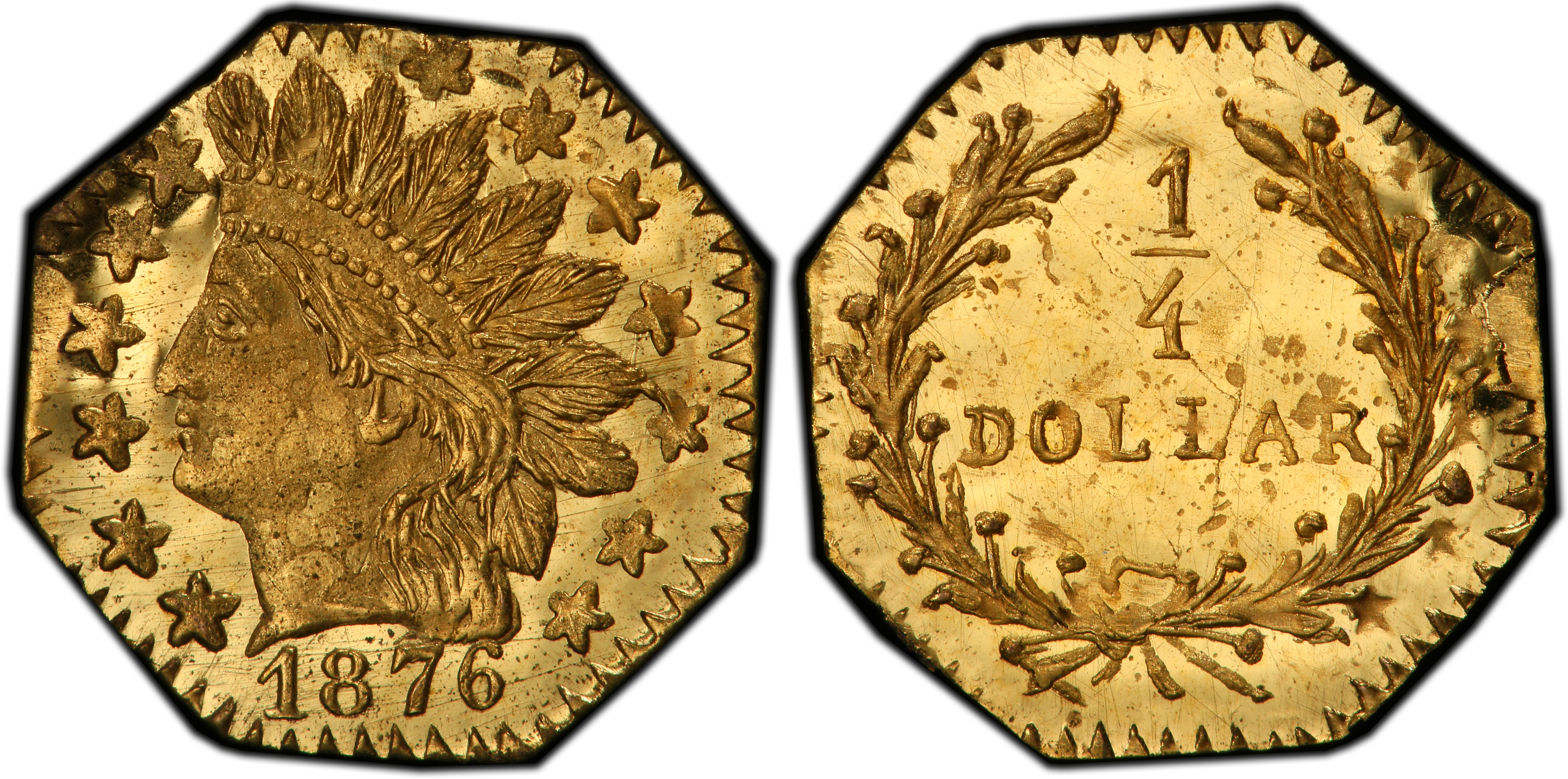
Obverse & Reverse
The 1876 Octagonal Indian Head 25 Cents, cataloged as Breen-Gillio 799A, is a fascinating and extremely rare artifact from the second period of California's private gold coinage. This era, spanning from 1859 to 1882, is distinct from the earlier 'Period One' issues which were struck out of necessity to alleviate a severe shortage of small change during the initial Gold Rush. By the mid-1870s, the San Francisco Mint was in full operation, supplying ample federal coinage for commerce. The rationale for producing these minuscule gold pieces had thus shifted from utility to novelty. These later issues, often termed 'jeweler's pieces,' were created not as essential currency but as souvenirs, keepsakes, and curiosities for tourists and locals enamored with the romanticism of the Gold Rush. The year 1876 was particularly significant in the United States, as the nation celebrated its Centennial with the grand International Exposition in Philadelphia. This patriotic fervor fueled a market for all manner of souvenirs, and it is highly probable that dated gold pieces like the BG-799A were struck to capitalize on this celebratory atmosphere, serving as a uniquely Western memento of a national milestone. Legally, these pieces existed in a grey area. The Coinage Act of 1864 had prohibited private coinage, but enforcement by the Secret Service was lax until the early 1880s. To circumvent potential legal trouble, minters of this period were typically anonymous, leaving no identifying marks on their products. These coins were intentionally produced with a gold content significantly below their face value, functioning more as tokens than true coins. Their diminutive size and intricate designs were a testament to the skill of the San Francisco jewelers who engraved the dies and struck the pieces, likely using hand-operated presses. The BG-799A is a prime example of this tradition, a miniature work of art whose survival to the present day is nothing short of miraculous.
Associated EventU.S. Centennial Year
Reason For MintingPrimarily struck as a souvenir or curio for the jewelry and tourist trade during the U.S. Centennial year, not for general circulation.
Minter HistoryThe specific minter for the BG-799A variety is unknown. During 'Period Two' (1859-1882), producers of fractional gold were typically San Francisco-based jewelers who struck the pieces anonymously to avoid prosecution under the loosely-enforced Private Coinage Act of 1864. Their work was intended for the souvenir market rather than to meet a commercial need.
Historical SignificanceThe BG-799A is a numismatic ghost, representing the tail end of the private gold coining tradition in California. It serves as a tangible link to the robust souvenir and jewelry trade of 1870s San Francisco and reflects the national pride of the Centennial year, all while embodying the legal and economic ambiguities that defined these fascinating 'jeweler's issues.' Its extreme rarity makes it a key piece for understanding the scope of the series.
Not Applicable
Denomination25 Cents
Minting Period1876
Assayer/MinterUnknown Private Minter
Geographic OriginSan Francisco, California
Obverse DescriptionFeatures a stylized Indian Head portrait facing left, wearing a feathered headdress. The portrait is surrounded by 13 six-pointed stars, representing the original colonies. The date, 1876, appears below the bust truncation.
Obverse Inscription1876
Reverse DescriptionA simple wreath composed of two branches tied with a ribbon at the bottom encircles the denomination. The denomination is expressed as '1/4' at the center.
Reverse Inscription1/4
CompositionGold
Stated Fineness Actual FinenessTypically debased, often ranging from 14 to 20 karats for Period Two issues.
Diameter9.00 mm
EdgePlain
Extremely low; likely struck in the dozens at most.
Survival EstimateFewer than 5 known. The NGC Census reports only 2 graded examples (MS62 and MS66).
Rarity ScaleR-8 (Unique or Nearly Unique)
This coin's appeal lies in its absolute rarity. As a key Breen-Gillio variety with only a couple of known examples, it is a trophy piece for the advanced specialist in California Fractional Gold. Its connection to the U.S. Centennial year adds a layer of historical interest.
Key VarietiesBG-799A is itself the key variety of the BG-799 die pairing. The Breen-Gillio reference catalogs numerous minor die variations within the broader series, but for BG-799, the 'A' designation is the critical identifier. No proof or special collector restrikes from a later period are known to exist for this specific variety.
Authentication TipsAuthenticity is paramount. Genuine Period Two pieces are characteristically thin and struck in real, albeit often low-karat, gold. They must bear a denomination (e.g., '1/4', 'DOLLAR', or 'CENTS'). Be wary of modern replicas, which are often thicker, have a soapy or cast-like appearance, and frequently feature a bear on the reverse—a motif never used on genuine 19th-century issues. Weak strikes are common on genuine pieces, while fakes are often sharply and uniformly struck. Any uncertified example should be approached with extreme caution and authenticated by an expert.
Shopping ConsiderationsFor a coin of this rarity, any opportunity to acquire one is significant. A 'premium quality' example would be one of the two known graded specimens. A buyer should prioritize sharpness of strike on the highest points, particularly the feathers of the headdress and the details of the wreath. Look for clean, lustrous surfaces; many Period Two issues come with prooflike (PL) surfaces, and this characteristic commands a significant premium. Given the small size, even minor marks can be distracting, so 'clean' fields are highly desirable. Avoid any pieces that have been holed, bent, or harshly cleaned, as this drastically impacts value. The NGC holder is the ultimate assurance of authenticity and grade.
A coin's grade is its condition, rated on a 1-70 scale. For rare coins, this is the most critical factor in determining value, as a tiny difference in preservation can mean a huge difference in price.
Relevant Grade TypesOriginal examples of BG-799A were produced as business strikes, though primarily for souvenir purposes rather than circulation. They are found in high Circulated (AU) grades and, more commonly for this series, Mint State (MS, 60-70) grades. The term Prooflike (PL) is often designated for examples with exceptionally reflective, mirror-like surfaces. No true Proofs were struck during the original period of issue, and no later-date restrikes are known.
Mint State CharacteristicsUncirculated examples of this type are defined by their luster, which is often bright and flashy, frequently earning a Prooflike (PL) designation. The strike can be inconsistent; a sharp strike on the central devices (Indian's cheek, headdress, wreath) is rare and highly desirable. Due to the thinness of the planchets and softness of the gold, even high-grade examples can show minor planchet irregularities or handling marks in the fields. A well-struck piece with clean surfaces and full luster would be considered the ultimate prize.
Circulated Wear PatternsOn circulated examples, wear first appears on the highest points of the design. For the obverse, this is the cheek and the upper feathers of the headdress. On the reverse, the highest points of the wreath's leaves and the bow's ribbon will show the first signs of friction. In lower grades, the stars and the date will begin to lose their sharpness.
Key Factors For ValueFor the BG-799A, the single most important factor is simply its existence and authenticity, given its profound rarity. Among the known examples, value is driven by the certified grade, with a premium for the higher-graded piece. Surface quality is critical: an example with original, lustrous, and mark-free surfaces will command a massive premium. The presence of a Prooflike (PL) designation significantly enhances its desirability and value. A CAC sticker on an already-graded coin would provide further third-party endorsement of its superior quality for the grade.
PCGS Price Guide
| Grade | Price | Population |
|---|---|---|
| 65 | $1,750.00 | 1 |