1880 G25C BG-799L, PL (Regular Strike)
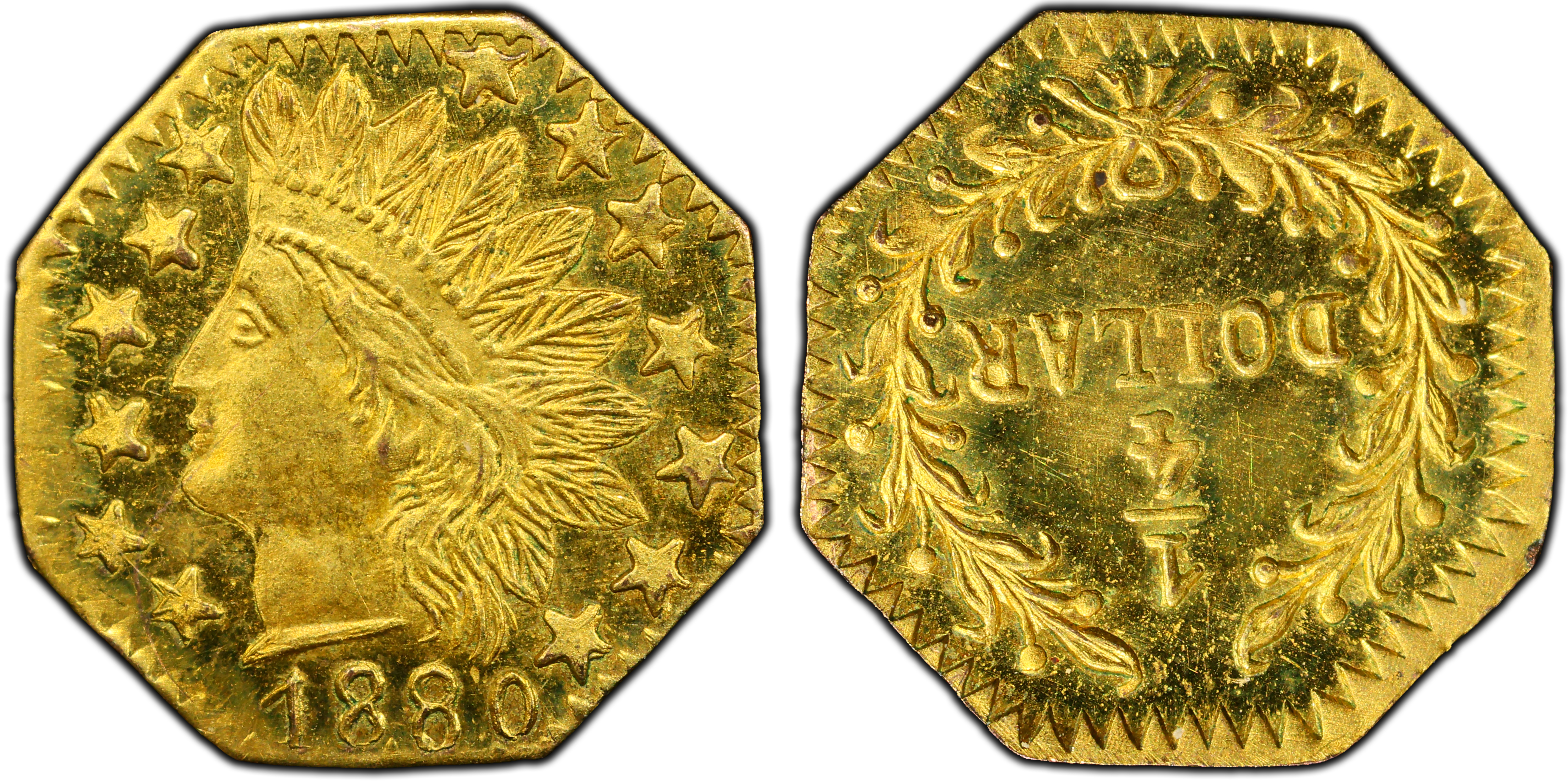
Obverse & Reverse
The 1880 Octagonal Indian Head 25 Cents, BG-799L, is a product of the second great wave of private California gold minting, known to numismatists as 'Period Two' (1859-1882). Unlike the 'Period One' issues (1852-1856), which were struck out of genuine necessity to alleviate a critical shortage of small change during the initial Gold Rush, these later pieces served a different purpose. By the 1870s and 1880s, the San Francisco Mint was in full operation, supplying the West Coast with ample federal coinage. The raison d'être for fractional gold had shifted from commerce to commemoration. San Francisco had become a major tourist destination, and visitors from the East and abroad were eager for souvenirs of the romanticized Gold Rush era. Local jewelers, many of whom were highly skilled German or French immigrants, stepped in to meet this demand by producing vast quantities of small, attractive gold 'coins'. These 'jeweler's issues' were not intended to circulate, though some inevitably did. Their production was a commercial enterprise aimed at the souvenir and gift market. This is evidenced by their often superior manufacturing quality compared to the crude, hurriedly-made Period One issues. The planchets were frequently prepared with polished dies to impart mirrored, Prooflike (PL) or even Deep Mirror Prooflike (DMPL) surfaces, enhancing their aesthetic appeal as keepsakes. Legally, their status was ambiguous. The Coinage Act of 1864 had prohibited private coinage, but enforcement by the U.S. Secret Service was inconsistent until a major crackdown in 1883 effectively ended the practice. To circumvent the law, many minters produced pieces that were technically tokens or charms, sometimes omitting a stated denomination. However, varieties like the BG-799L, which include a denomination, existed in a grey area. The pieces were typically underweight for their stated value, containing more gold than a gilt token but less than a proportional federal coin, yet their novelty and connection to the California Gold mystique ensured their popularity. The BG-799 series, with its classic 'Indian Head' motif, was a particularly popular design, struck with various dates and minor variations throughout the 1870s and early 1880s.
Associated EventCalifornia Gold Rush Tourism & Souvenir Trade
Reason For MintingPrimarily struck for sale as souvenirs and keepsakes for tourists, not for general circulation.
Minter HistoryThe specific minter of the BG-799L die marriage is unknown, as was common for 'Period Two' California Fractional Gold. Production of these pieces was dominated by a community of San Francisco jewelers who often created the dies and struck the coins in-house. While some minters of the era are known by name or initials (e.g., Herman J. Brand, Deriberpe & Nouizillet), many, like the producer of this variety, remain anonymous. They were skilled artisans responding to a commercial demand for mementos of the Gold Rush.
Historical SignificanceThis piece is significant not as a circulating coin but as a tangible artifact of how the California Gold Rush was memorialized and commercialized. It represents the transition of fractional gold from a necessary medium of exchange to a nostalgic souvenir, reflecting the maturation of the Californian economy and its growing tourism industry. As a 'Period Two' issue, it is a key component in understanding the full history of this fascinating and complex series.
BG-799L
Denomination25 Cents
Minting Period1880
Assayer/MinterUnknown San Francisco Jeweler
Geographic OriginSan Francisco, California
Obverse DescriptionAn Indian Princess head facing left, adorned with a feathered headdress. The portrait is encircled by 13 six-pointed stars representing the original colonies. The date '1880' is below the bust.
Obverse Inscription1880
Reverse DescriptionThe denomination '1/4' is at the center, surrounded by an ornate wreath of leaves and berries tied with a bow at the bottom. The legend 'CALIFORNIA GOLD' appears at the top, just inside the octagonal border.
Reverse InscriptionCALIFORNIA GOLD 1/4
CompositionGold
Stated Fineness Actual FinenessVariable, often ranging from .500 to .800 fine.
Weight0.25 grams
Diameter9.80 mm
EdgePlain
Unknown
Survival EstimateFewer than 75 believed to exist.
Rarity ScaleHigh R-5
The 1880 BG-799L is highly sought after for its attractive octagonal shape, classic Indian Head design, and the flashy eye appeal of its Prooflike surfaces. As a late-date 'jeweler's issue,' it is typically found in high grades (Mint State), making it an appealing type coin for collectors who want a pristine example of California Fractional Gold without the wear and impairments common on earlier, circulated issues.
Key VarietiesThe primary variations for this issue are the quality of its surfaces, designated as Regular Strike (MS), Prooflike (PL), or Deep Mirror Prooflike (DMPL). No major die varieties for the BG-799L pairing are widely recognized, nor are there known patterns or official restrikes. The entire series of 'Period Two' fractionals can be considered special collector issues, as they were made for numismatic and souvenir purposes from the outset.
Authentication TipsAuthentic pieces should exhibit a sharp, well-defined strike, characteristic of the jeweler-minters of the period. The surfaces, particularly on PL examples, should have genuine reflectivity from polished dies, not from recent polishing or cleaning. The details of the wreath on the reverse are a key diagnostic area. Counterfeits are rampant in this series; many are cast or have a soapy, indistinct appearance. Any piece with a bear on it is a modern fantasy piece. Weight and size can be inconsistent, but pieces that are excessively heavy or thick should be viewed with suspicion. Third-party grading and authentication by PCGS or NGC is highly recommended for any raw example.
Shopping ConsiderationsFor a premium quality example, a buyer should seek out a specimen with deep, watery Prooflike mirrors and a crisp strike on the highest points of the Indian's hair and the leaves of the wreath. Because these were made as souvenirs, they are typically found in Uncirculated condition; therefore, a circulating grade would be unusual and less desirable. Look for original, undisturbed surfaces with minimal distracting contact marks. The bright yellow-gold color should be consistent. Avoid examples that have been harshly cleaned, which destroys the delicate original surfaces and PL contrast. Also, be wary of pieces that have been removed from jewelry, looking for evidence of solder or mounting marks on the edge or rims.
A coin's grade is its condition, rated on a 1-70 scale. For rare coins, this is the most critical factor in determining value, as a tiny difference in preservation can mean a huge difference in price.
Relevant Grade TypesOriginal period issues of this variety were business strikes, but made with special preparation for collectors and tourists. They are found almost exclusively in Mint State (MS, 60-70) grades. No true Proofs (PR/PF) were struck. The key distinction for this issue is the surface characteristic: standard Mint State (MS), Prooflike (PL), where the fields are reflective, and Deep Mirror Prooflike (DMPL), which exhibits profound mirror-like qualities.
Mint State CharacteristicsUncirculated examples of BG-799L are defined by their surface quality. The strike is typically sharp, though minor weakness on the star points or wreath details is not uncommon. Luster on non-PL pieces is typically satiny. On PL and DMPL examples, the quality of the mirrored fields is paramount. Contact marks, even small ones, are magnified by the reflective surfaces and can significantly impact the grade and eye appeal. The ideal piece has 'clean' fields and a sharp contrast with the frosted devices.
Circulated Wear PatternsAs these were not intended for circulation, significant wear is almost never encountered. If a piece were to circulate, the first areas to show friction would be the high points of the Indian's cheek, the feathers in the headdress, and the highest leaves in the reverse wreath. In the unlikely event of finding a circulated example, even the slightest wear would dramatically reduce its value compared to the commonly available Mint State specimens.
Key Factors For ValueThe single most important factor for this specific coin is the quality and depth of its Prooflike surfaces; a DMPL coin will command a significant premium over a PL, which in turn is more valuable than a standard MS example of the same numerical grade. Surface preservation is critical—coins with clean, mark-free fields are prized. A sharp, well-centered strike adds to the appeal. Finally, an example verified by CAC (Certified Acceptance Corporation) as being premium quality for its grade will often sell for more than a non-CAC counterpart.
PCGS Price Guide
| Grade | Price | Population |
|---|---|---|
| 65 | $900.00 | 2 |