1871 G25C BG-765 (Regular Strike)
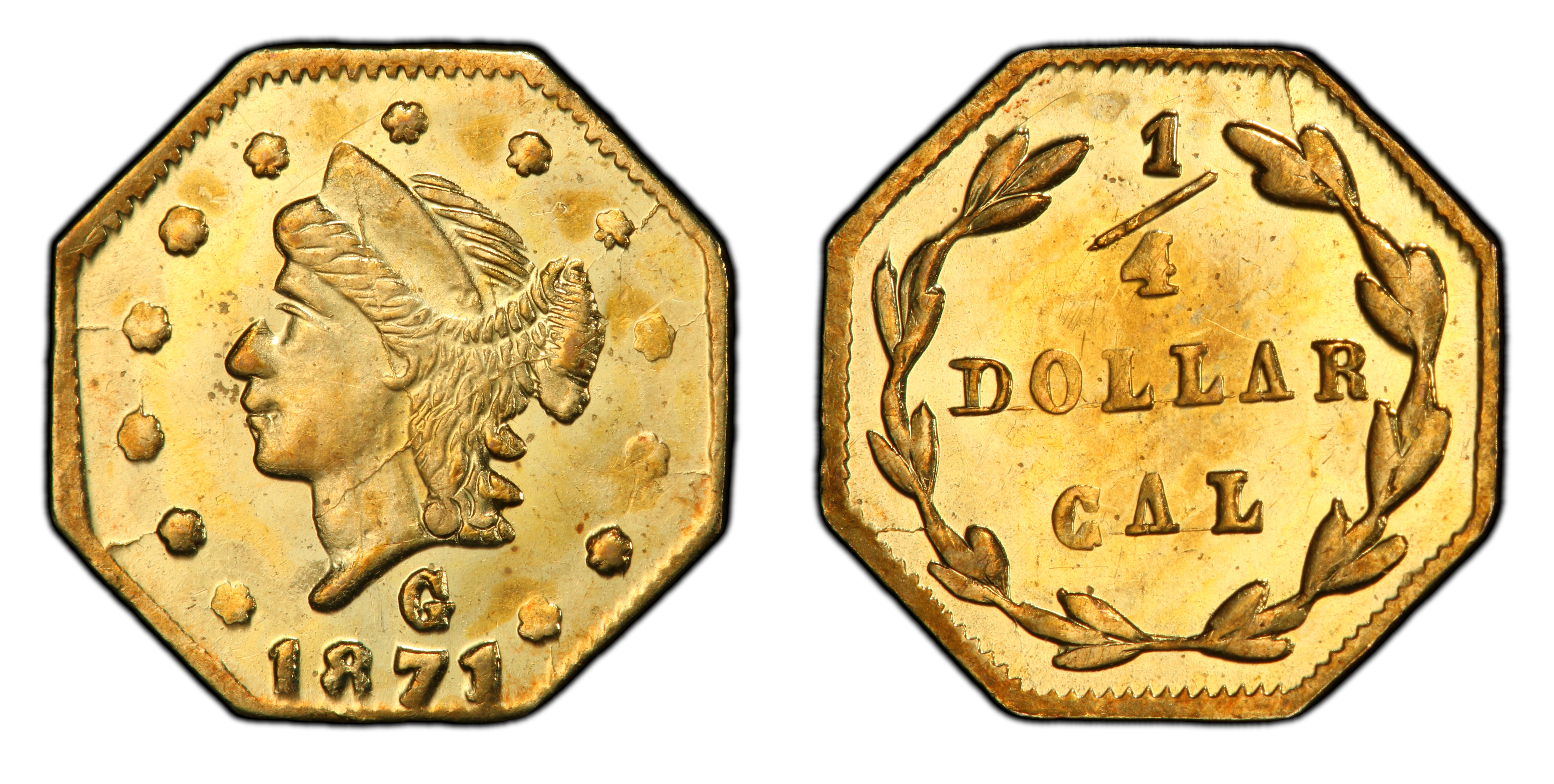
Obverse & Reverse
The 1871 BG-765 25 Cents represents a fascinating chapter in American numismatics, born from the economic aftermath of the great California Gold Rush. By the 1870s, the initial frantic rush of the '49ers had subsided into a more industrialized mining economy, and San Francisco had transformed from a chaotic boomtown into a sophisticated metropolis. The acute coinage shortage that prompted the first wave of territorial and fractional gold in the early 1850s had been largely resolved by the full-scale operation of the San Francisco Mint. Consequently, the pieces produced during this later era, known to numismatists as 'Period Two' (1859-1882), served a different purpose. They were no longer essential instruments of commerce but were instead primarily created as souvenirs, keepsakes, and jewelry items for a burgeoning tourist trade and a populace still captivated by the allure of gold. These 'jeweler's issues,' often of lighter weight and lower fineness than their Period One predecessors, were designed to be attractive and affordable mementos of California's golden identity. The firm of Frontier & Co., a successor to earlier partnerships involving Pierre Frontier and Eugene Deviercy, was a prolific producer during this time, creating a wide variety of these charming miniatures. The BG-765 was struck using dies engraved with a classic Liberty Head motif, echoing the designs of official U.S. gold coinage but on a minuscule, octagonal planchet. This familiar design lent the pieces a sense of legitimacy and nostalgia, making them popular purchases. The production method was typically manual, with dies struck by hammer, leading to significant variations in strike quality. While not intended to defraud, these tokens contained only a fraction of their face value in gold, a fact understood by the public who cherished them not for their intrinsic worth, but for their novelty and connection to the romanticized Gold Rush saga. Their existence traces the evolution of a frontier economy to a settled, image-conscious society eager to market its own history.
Associated EventPost-Gold Rush Economic Expansion & Tourism
Reason For MintingPrimarily struck as souvenirs and jewelry items for tourists and locals, not to alleviate a coinage shortage as earlier issues had.
Minter HistoryFrontier & Co. was a San Francisco jewelry firm active in the production of California Fractional Gold during the 'Period Two' era. The name is associated with Pierre Frontier, a French jeweler who was involved in several partnerships, including Frontier & Deviercy, beginning in the 1850s. By the late 1860s and early 1870s, the firm, known as Frontier & Co., was a key manufacturer of these popular gold tokens. They produced a variety of denominations and designs, often using standardized punches for stars and letters, indicating a systematic, albeit small-scale, production process. Their issues are characteristic of the later 'jeweler's pieces' which were sold as keepsakes rather than circulating currency.
Historical SignificanceThe BG-765 is significant as a tangible artifact of California's transition from a frontier economy to a commercial and tourist center. It represents the commodification of the Gold Rush legend, serving as an early example of souvenir coinage and demonstrating the continued private production of gold tokens long after their initial commercial necessity had passed.
BG-765
Denomination25 Cents
Minting Period1871
Assayer/MinterFrontier & Co.
Geographic OriginSan Francisco, California
Obverse DescriptionA left-facing bust of Liberty, her hair tied in a bun. She wears a coronet, and her head is surrounded by nine five-pointed stars. The design is a miniature rendition of the official U.S. gold coinage motifs of the era.
Obverse Inscription Reverse DescriptionThe date '1871' is prominent in the center. The date is enclosed within a wreath of two branches tied by a bow at the bottom. The denomination '1/4' appears above the date, and the inscription 'CALIFORNIA GOLD' encircles the wreath along the upper octagonal border.
Reverse Inscription1/4 CALIFORNIA GOLD 1871
CompositionGold
Stated Fineness Actual FinenessVariable, typically between .500 and .750 for Period Two issues, but not precisely documented for this variety.
Weight0.38 grams
Diameter9.60 mm
EdgePlain
Unknown
Survival Estimate150-250
Rarity ScaleR-3
BG-765 is popular among collectors for its classic Liberty Head design, octagonal shape, and its status as a relatively common and affordable entry point into the fascinating world of California Fractional Gold. Examples are often found with attractive proof-like or mirrored surfaces, enhancing their eye appeal.
Key VarietiesNo major, widely recognized die varieties are listed for the BG-765. As these were hand-produced, minor variations in die state, such as minute cracks or repunching, may exist but are not typically collected as distinct varieties. No special collector restrikes are known.
Authentication TipsAuthentic examples are struck on very thin planchets, often thinner than a modern business card. Many counterfeit or replica pieces are improperly thick and have a soapy, cast-like appearance. Look for sharp, albeit sometimes incomplete, details from a struck die, not the soft features of a cast. The stars and letters should be well-formed. A weak or uneven strike is common on genuine pieces and is not necessarily an indicator of a fake; in fact, perfectly struck examples should be viewed with extra caution. The gold color should be consistent, without the coppery core exposure often seen on plated replicas.
Shopping ConsiderationsA premium quality BG-765 will exhibit a sharp strike, particularly on the highest points of Liberty's hair and the numbers in the date. Seek out examples with clean, proof-like (PL) or deep mirror proof-like (DMPL) surfaces, as these are highly desired and command significant premiums. Due to the softness of the gold and their use in jewelry, these pieces are highly susceptible to scratches, rim bumps, and evidence of having been mounted. Carefully examine the surfaces and rims under magnification for signs of cleaning (hairlines), polishing, or repair. An example with original, undisturbed luster and a pleasing reddish-gold patina is far more desirable than a brighter, cleaned coin of the same technical grade.
A coin's grade is its condition, rated on a 1-70 scale. For rare coins, this is the most critical factor in determining value, as a tiny difference in preservation can mean a huge difference in price.
Relevant Grade TypesAll original 1871 BG-765 pieces were struck as business strikes, although many were produced with proof-like surfaces for souvenir sales. They are found in Circulated grades (About Good-3 to About Uncirculated-58) and, more commonly, in Mint State grades (MS-60 to MS-70). No true Proofs were struck during the original period of issue, and no later-date collector restrikes are known to exist.
Mint State CharacteristicsIn uncirculated condition, BG-765 often displays a vibrant, satiny luster, frequently with deep mirrored fields that earn a PL or DMPL designation from grading services. The strike can be inconsistent; many examples show some weakness on the high points of Liberty's hair above her ear and on the wreath leaves. Minor planchet flaws or striations from the manufacturing process are common and should not be confused with post-strike damage. Small, scattered contact marks are typical due to the softness of the gold alloy.
Circulated Wear PatternsOn circulated examples, wear first appears on the highest points of the design. For the obverse, this includes Liberty's cheek, the hair bun, and the coronet. On the reverse, the highest points of the wreath leaves and the fraction '1/4' will show the first signs of friction. In lower grades (VF and below), the finer details of the hair will merge, and the legends will begin to soften and wear into the fields.
Key Factors For ValueThe primary value driver for BG-765 is surface quality. An example with original, mark-free, proof-like surfaces will command a much higher price than a similarly graded piece with hazy or scratched fields. Strike is the second key factor; a coin with a full, sharp strike on both sides is rare and highly prized. Eye appeal, including attractive original toning and deep reflectivity, plays a major role. A sticker from CAC (Certified Acceptance Corporation) indicating premium quality for the grade will add a significant premium for this issue.
PCGS Price Guide
| Grade | Price | Population |
|---|---|---|
| 50 | $200.00 | 1 |
| 50+ | $210.00 | N/A |
| 53 | $225.00 | 5 |
| 53+ | $235.00 | N/A |
| 55 | $250.00 | 14 |
| 55+ | $260.00 | N/A |
| 58 | $275.00 | 35 |
| 58+ | $285.00 | N/A |
| 60 | $300.00 | 16 |
| 61 | $325.00 | 39 |
| 62 | $350.00 | 93 |
| 62+ | $375.00 | N/A |
| 63 | $400.00 | 81 |
| 63+ | $425.00 | N/A |
| 64 | $600.00 | 29 |
| 64+ | $750.00 | N/A |
| 65 | $1,250.00 | 4 |
| 65+ | $1,500.00 | N/A |
| 66 | $1,850.00 | N/A |