1874 25C BG-799P2 (Regular Strike)
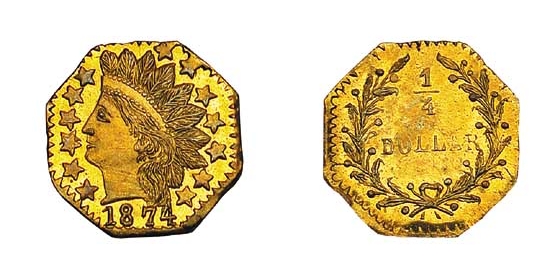
Obverse & Reverse
The 1874 25C BG-799P2 is a quintessential example of a 'Period Two' California Fractional Gold piece, a classification delineated by numismatic scholars Walter Breen and Ronald Gillio. These later-period issues (1858-1882) are fundamentally different in character and intent from their 'Period One' predecessors. While the earlier pieces of 1852-1857 were struck out of genuine commercial necessity to alleviate a severe shortage of small-denomination coinage in Gold Rush California, the Period Two pieces were created primarily as souvenirs and novelty items. By 1874, the San Francisco Mint was in full operation, and the state's economy was well-supplied with federal coinage, rendering private issues for circulation obsolete. Instead, these miniature gold tokens catered to a burgeoning tourist trade and a national fascination with the 'Wild West.' Jewelers in San Francisco, inheritors of the private minting tradition, recognized a lucrative market in selling these tiny, intricate pieces as keepsakes. The BG-799P2 was struck during this era of commercial mementos. Its minter is attributed to the California Jewelry Company, which had acquired the business interests of Robert B. Gray & Co. in 1871. These pieces were often produced with a lower gold content than their face value would suggest, reinforcing their status as tokens rather than true circulating money. The Coinage Act of 1864 had technically outlawed private coinage, but enforcement was lax until the U.S. Secret Service began a major crackdown in the early 1880s, which ultimately ended the production of these fascinating historical footnotes. Thus, the BG-799P2 represents not the raw necessity of the Gold Rush, but its romantic and commercialized memory.
Associated EventPost-Gold Rush California Tourism
Reason For MintingPrimarily struck for sale to tourists and collectors as souvenirs of the California Gold Rush.
Minter HistoryThe California Jewelry Company was the successor to the fractional gold minting operations of Robert B. Gray & Co., a significant producer of Period Two issues. After Gray sold his interests in 1871, the California Jewelry Co. continued the practice, likely using some of Gray's existing equipment and dies, while also creating new ones. Some coins from this firm bear a small letter 'L', a reference to its Levison Brothers watch division. They were a prominent San Francisco jeweler that capitalized on the souvenir market for these miniature gold pieces until federal enforcement halted the industry in the early 1880s.
Historical SignificanceThe BG-799P2 is historically significant as a tangible artifact of how the California Gold Rush was memorialized and commercialized. It represents the transition of fractional gold from a necessary form of local currency to a popular souvenir, reflecting a more settled and nostalgic view of the state's chaotic early years. Its high rarity today underscores the limited production and ephemeral nature of these jewelers' issues.
BG-799P2
Denomination25C
Minting Period1874
Assayer/MinterCalifornia Jewelry Company
Geographic OriginSan Francisco, California
Obverse DescriptionAn Indian Head motif, facing left. The portrait is typically rendered with stylized features and a feathered headdress. The field is often prooflike or semi-prooflike, a common characteristic of these later-date souvenir issues. Thirteen stars encircle the portrait along the octagonal border.
Obverse Inscription Reverse DescriptionA wreath composed of two branches tied together by a bow at the bottom. Within the wreath, the denomination '25 CENTS' is inscribed. The word 'CALIFORNIA' appears above the wreath, hugging the upper octagonal edge. The date '1874' is positioned below the bow of the wreath.
Reverse InscriptionCALIFORNIA 25 CENTS 1874
CompositionGold
Stated Fineness Actual FinenessOften below the federal standard of .900, with fineness varying between issues from 14 to 22 karats.
EdgePlain
Unknown, but certainly very small.
Survival EstimateFewer than 10; possibly as few as 3-5 known specimens.
Rarity ScaleR-7 (4 to 12 known)
This variety is highly sought after by specialists in California Fractional Gold due to its extreme rarity. As a 'Period Two' piece, it appeals to those interested in the souvenir and token aspect of the series. High-grade, prooflike examples are particularly prized for their jewel-like quality.
Key VarietiesThe BG-799 designation covers a number of die marriages for the 1874 octagonal 25 cent denomination. The 'P2' reverse is a specific die pairing noted in the Breen-Gillio reference. No special collector issues, restrikes, or patterns are known for this specific variety; all known examples are considered business strikes, though many were produced with prooflike surfaces for collector sale.
Authentication TipsAuthenticity is paramount. Genuine pieces exhibit sharp, precise details from die striking, even if parts of the design are weak. The fields should be flat and reflective, not bumpy or porous like many cast counterfeits. The style of the Indian head and the wreath's details should be compared to known genuine examples. Modern replicas often feature incorrect designs (e.g., a bear on the reverse) or are made of gilt base metal. Weight and specific gravity tests can be useful, as many counterfeits are incorrect in this regard. Third-party grading and authentication by PCGS or NGC is highly recommended for any potential purchase.
Shopping ConsiderationsFor a premium quality example, seek a specimen with deeply mirrored, prooflike fields and minimal distracting marks. Strike quality varies, but pieces with a sharp Indian Head and a fully defined wreath command a significant premium. Original, uncleaned surfaces with a hint of reddish-gold or coppery toning are highly desirable. Avoid examples that have been cleaned, whizzed, or exhibit evidence of being mounted in jewelry, such as solder marks or rim damage. Given the extreme rarity, any example, even one with minor impairments, is considered significant, but surface quality and eye appeal are the primary drivers of value among the few known survivors.
A coin's grade is its condition, rated on a 1-70 scale. For rare coins, this is the most critical factor in determining value, as a tiny difference in preservation can mean a huge difference in price.
Relevant Grade TypesOriginal issues were business strikes, though many were struck with special care to create prooflike surfaces for sale to collectors. Therefore, they are found in Circulated (1-58) and Mint State (MS, 60-70) grades. The 'PL' (Prooflike) or 'DMPL' (Deep Mirror Prooflike) designators are highly relevant and add significant value. There were no true Proofs struck during the original minting period, and no later-date restrikes are known to exist.
Mint State CharacteristicsAn uncirculated BG-799P2 is defined by its pristine, prooflike surfaces. Luster is typically flashy and reflective rather than satiny. The strike can be variable; often, the very highest points of the design may show some softness due to the challenges of striking such small pieces. The most common marks are tiny ticks or hairlines in the fields from minor handling, which are magnified by the mirrored surfaces. A truly 'Gem' example would have virtually mark-free fields and a sharp strike.
Circulated Wear PatternsOn this design, wear first appears on the high points of the Indian's cheek, brow, and the feathers in the headdress. On the reverse, the highest points of the wreath's leaves and the bow will show initial friction and flattening. In lower grades (VF and below), the finer details of the feathers and leaves will merge, and the legends will begin to soften.
Key Factors For ValueExtreme rarity is the primary value driver. Among the few known specimens, the key differentiators are surface quality and eye appeal. An example with clean, original, deeply prooflike surfaces will command a massive premium over a cleaned or circulated counterpart. A sharp, well-centered strike adds to the value. A CAC sticker on a certified example would be a significant value enhancer, confirming premium quality for the assigned grade.
PCGS Price Guide
| Grade | Price | Population |
|---|---|---|
| 64 | $4,250.00 | 3 |