1880 25C BG-799X (Regular Strike)
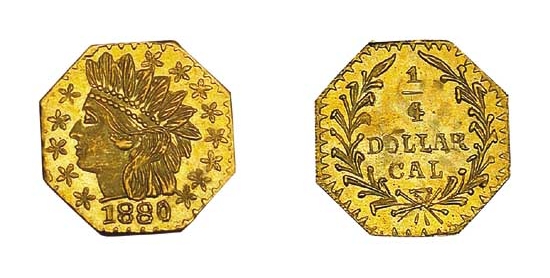
Obverse & Reverse
The 1880 25C BG-799X is a fascinating product of the twilight years of America's private coinage era, specifically classified within 'Period Two' (1859-1882) of California Fractional Gold production. By 1880, the chaotic, early days of the Gold Rush, which had necessitated private minters to strike coins for commerce due to a severe shortage of federal small change, were long past. The San Francisco Mint, operating since 1854, now produced ample coinage for the region's needs. The motivation for producing these tiny gold pieces had shifted entirely from commerce to collectibles. They were no longer essential monetary instruments but rather souvenirs, keepsakes, and jewelry items that capitalized on the romantic allure of the California Gold Rush. The Coinage Act of 1864 had explicitly forbidden private coinage, but enforcement by the Secret Service was inconsistent and primarily focused on pieces intended to deceive or circulate widely. Jewelers and private manufacturers continued to produce small, denominated 'tokens' by exploiting this lax enforcement, often backdating them or, in this case, producing them far from California. Research by numismatists Robert Leonard, Bob Lande, and Ken Glickman, documented in the Breen-Gillio reference, uncovered that F.H. Noble & Co., a manufacturing jeweler based in Chicago, was the source of BG-799X and related varieties. A Secret Service investigation in 1881 confirmed the company was striking these 1880-dated pieces. This geographic origin is significant, illustrating that the market for 'California Gold' souvenirs was national. These pieces were never intended for circulation in the boomtowns of California; instead, they were marketed to a public enchanted by the lore of the West. Their low gold content and status as tokens rather than true coins reflect the legal and economic realities of the period, a stark contrast to the high-purity, circulating issues of 'Period One.'
Associated EventPost-Gold Rush Souvenir Market
Reason For MintingTo serve as a souvenir or jewelry charm capitalizing on the romanticism of the California Gold Rush, rather than to circulate as money.
Minter HistoryF.H. Noble & Co. was a manufacturing jeweler and producer of badges, emblems, and other small metal goods, based in Chicago, Illinois. Unlike the pioneer assayers and minters of the early Gold Rush, F.H. Noble was not involved in processing raw gold dust or serving the monetary needs of miners. Their business model focused on the production of novelty and souvenir items. Their involvement in striking 'California Fractional Gold' pieces in the early 1880s highlights the commercialization of the Gold Rush legend and the national demand for such mementos. A Secret Service visit in 1881 confirmed their production of these items, which, despite bearing a denomination, were understood to be tokens.
Historical SignificanceThe BG-799X is historically significant not as a coin, but as a cultural artifact. It represents the shift in the purpose of California Fractional Gold from utilitarian coinage (Period One) to commercial souvenir (Period Two). Its manufacture in Chicago demonstrates the widespread, national mythologizing of the California Gold Rush. Numismatically, it is a key example of the 'jeweler's issues' that characterize the later years of the series, produced in a legally gray area until the Secret Service crackdown in 1883 effectively ended the production of all denominated private pieces.
BG-799X
Denomination25C
Minting Period1880
Assayer/MinterF.H. Noble & Co.
Geographic OriginChicago, Illinois
Obverse DescriptionThe obverse features a stylized Native American head facing left, often referred to by numismatists as an 'Aztec Head' due to its distinct features. The portrait is surrounded by thirteen stars, representing the original colonies. The date, 1880, is centered below the bust.
Obverse Inscription1880
Reverse DescriptionThe reverse is dominated by a simple, open wreath. Inside the wreath, the denomination is expressed as '1/4'. The inscription 'CAL.' is positioned above the wreath, notable for its use of flat-topped 'A's, a key diagnostic for this variety.
Reverse InscriptionCAL. 1/4
CompositionGold Plated
Stated Fineness Actual FinenessPlated in 9 karat (.375 fine) gold over a base metal core.
EdgePlain
Unknown
Survival Estimate501-1,250 (Corresponds to R-3)
Rarity ScaleR-3
This variety appeals to collectors specializing in the extensive Breen-Gillio series of California Fractional Gold. Its attribution to a non-California minter (F.H. Noble of Chicago) adds a layer of historical interest. High-grade examples are particularly sought after for their sharp details and often deeply mirrored, proof-like surfaces, which make these tiny pieces miniature works of art.
Key VarietiesThe primary variety is the BG-799X as described. There are no known major variations from the original minting period, nor are there any known later-date restrikes or special collector issues. The diagnostics, such as the 'Aztec Head' and the flat-topped 'A's on the reverse, are consistent for the variety.
Authentication TipsAuthentication requires comparison to known genuine examples, ideally referencing the images in the Breen-Gillio catalog. Key diagnostics include the specific style of the 'Aztec Head,' the crudely recut wreath bow on some examples, and the distinctive flat-topped 'A's in 'CAL.'. Genuine Period Two pieces are often very thin and can have weak strikes in areas, whereas modern replicas are often thicker and more uniformly struck. As these were gold-plated, any wear showing a different colored base metal underneath is a major red flag. All genuine pieces of this era must be denominated; pieces without a denomination are tokens or charms made after the 1883 crackdown.
Shopping ConsiderationsA premium quality example for its grade will possess deeply mirrored, proof-like (PL) or deep mirror proof-like (DMPL) fields, which are characteristic of this issue and command a significant premium. Look for a sharp strike on the high points of the Indian's hair and the details of the wreath. As these pieces were sold as souvenirs, they are typically found in Mint State grades, so circulated examples are uncommon. Avoid specimens with spotting, noticeable plating wear, or evidence of having been mounted in jewelry. Because of their small size, even minor scratches or rim bumps can be highly distracting and should be factored into the price. Third-party certification from PCGS or NGC is highly recommended to guarantee authenticity and accurate grading.
A coin's grade is its condition, rated on a 1-70 scale. For rare coins, this is the most critical factor in determining value, as a tiny difference in preservation can mean a huge difference in price.
Relevant Grade TypesOriginal issues of BG-799X were business strikes, but as they were produced as souvenirs and not intended for circulation, they are almost exclusively found in Mint State (MS, 60-70) grades. No true Proofs (PR/PF) were struck during the original period of issue. The highly polished dies used by F.H. Noble often resulted in coins with proof-like (PL) or deep mirror proof-like (DMPL) surfaces, which are noted on the grading certificate and add significant value.
Mint State CharacteristicsUncirculated examples are defined by the quality of their luster and the presence, or absence, of contact marks. For BG-799X, the luster is typically very flashy and reflective, often earning a PL or DMPL designation. The strike can be variable, but high-quality examples will show full detail in the hair and feathers of the headdress. Due to the manufacturing process, some crudeness, like a recut wreath bow, can be present and is considered characteristic, not a flaw. Small planchet flaws or die polish lines may be visible under magnification.
Circulated Wear PatternsAlthough not intended for circulation, mishandling can cause wear. The highest points of the design would be the first to show friction. Wear would first appear on the cheek, brow, and the feathers of the headdress on the obverse. On the reverse, the highest points of the wreath leaves and the fraction would exhibit the first signs of rubbing, causing the mirrored fields to become dull in those areas.
Key Factors For ValueThe single most important value factor for this issue is the surface quality, specifically the depth of the mirrored fields. A DMPL example will command a substantial premium over a standard MS or even a PL coin in the same numerical grade. A sharp, complete strike is also highly desirable. Eye appeal is critical; coins with clean, mark-free surfaces and a vibrant gold color are prized. A CAC sticker for this issue is highly sought after, as it confirms premium quality for the assigned grade and can add a significant multiplier to the coin's value.
PCGS Price Guide
| Grade | Price | Population |
|---|---|---|
| 55 | $200.00 | 1 |
| 55+ | $215.00 | N/A |
| 58 | $230.00 | 2 |
| 58+ | $245.00 | N/A |
| 60 | $275.00 | 3 |
| 61 | $300.00 | 9 |
| 62 | $350.00 | 35 |
| 62+ | $400.00 | N/A |
| 63 | $475.00 | 66 |
| 63+ | $525.00 | N/A |
| 64 | $575.00 | 78 |
| 64+ | $625.00 | N/A |
| 65 | $725.00 | 24 |
| 65+ | $850.00 | N/A |
| 66 | $1,550.00 | 1 |
| 66+ | $2,000.00 | N/A |
| 67 | $3,000.00 | N/A |
| 70 | N/A | N/A |