1876 25C BG-786 (Regular Strike)
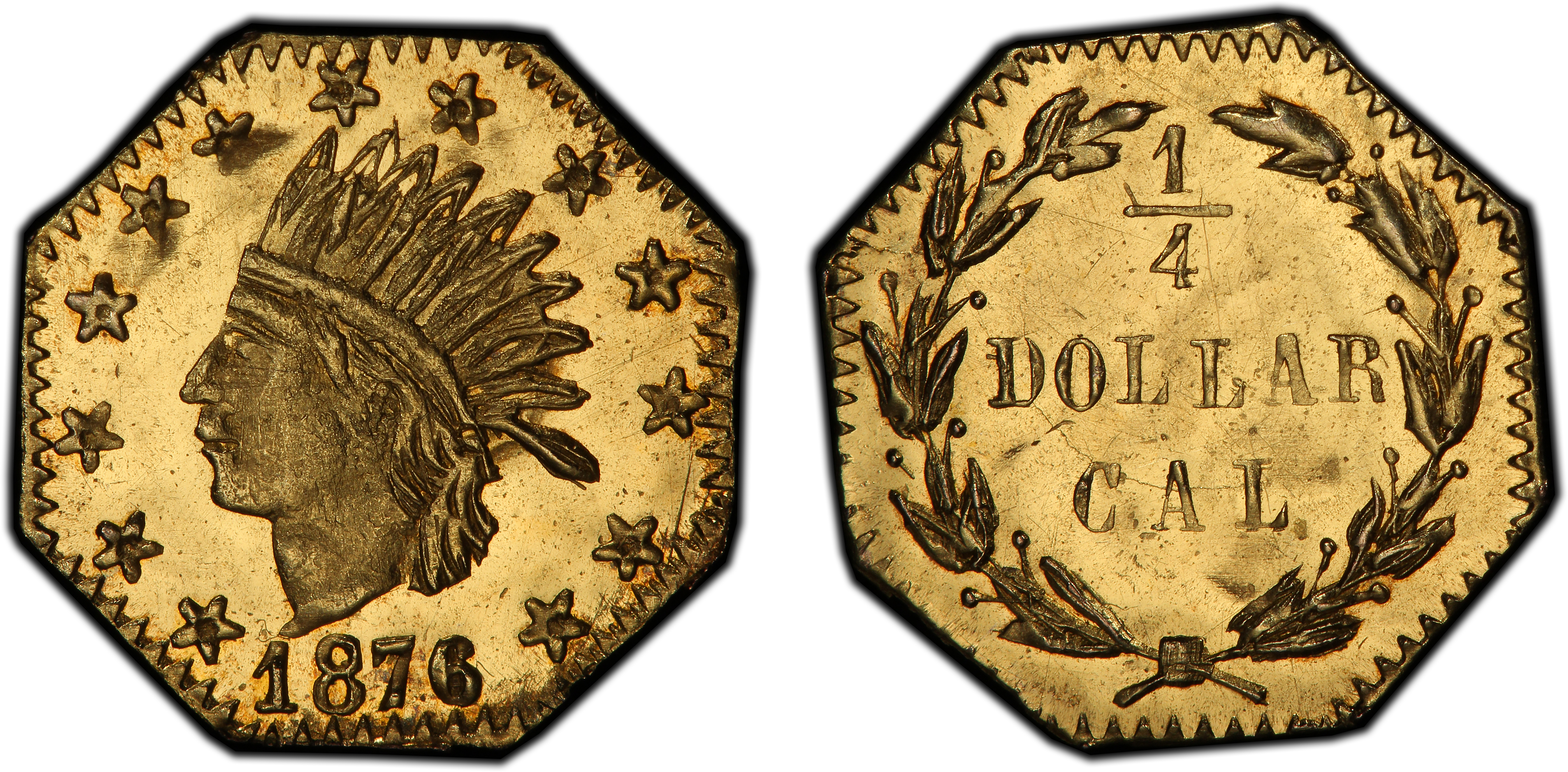
Obverse & Reverse
The 1876 BG-786 25 Cent piece emerges from the second major phase of California's private gold coinage, a period numismatists classify as 'Period Two' (1859-1882). Unlike the 'Period One' issues struck out of commercial necessity to alleviate the chronic shortage of small change during the initial Gold Rush boom, the context for these later pieces had shifted dramatically. By the mid-1870s, the San Francisco Mint was in full operation, supplying ample quantities of federal silver and gold coinage for daily transactions. The original impetus for fractional gold had vanished. Instead, these small, often underweight gold tokens were produced primarily as souvenirs, jewelry, and keepsakes. San Francisco had become a major tourist destination, and visitors from the East and Europe were fascinated by the romanticism of the Gold Rush. Jewelers like Herman J. Brand capitalized on this by creating a dazzling variety of miniature gold 'coins' that evoked the frontier spirit. These 'jeweler's issues' were technically illegal following the Private Coinage Act of 1864, but the law was weakly enforced for nearly two decades. Minter-jewelers operated in a grey market, producing pieces that looked enough like coins to be desirable but were understood locally to be tokens. The BG-786, with its popular Indian Head motif, was a classic example of a design intended to appeal to the public's fascination with the American West. Production of these pieces was often crude, employing the 'hammer method' where dies were struck by hand, leading to variability in strike quality. However, this production was not without risk. The U.S. Secret Service, under its zealous chief James J. Brooks, viewed these pieces as a potential threat for fraud. Brooks initiated a crackdown in the late 1870s and early 1880s, investigating and pressuring jewelers to cease production. This pressure eventually culminated in the end of fractional gold production by 1883, making the 1876 BG-786 one of the later-dated issues from this fascinating and legally ambiguous chapter of American numismatics. Its existence is a testament not to a shortage of currency, but to a clever commercial response to the enduring legacy of the Gold Rush.
Associated EventPost-Gold Rush California Commerce and Tourism
Reason For MintingPrimarily created as a souvenir and novelty item for the tourist trade, not for general circulation.
Minter HistoryHerman J. Brand was a prominent San Francisco jeweler and one of the most prolific producers of 'Period Two' California fractional gold. Active in the 1870s and early 1880s, he was known for creating numerous die varieties of fractional tokens, often featuring Liberty and Indian Head motifs. Brand, along with other jewelers, operated in the shadow of the 1864 Private Coinage Act. He faced increasing scrutiny from the Secret Service, which sought to suppress the manufacture of anything resembling official coinage. To circumvent prosecution, Brand and his contemporaries would sometimes use ambiguous legends or designs. Numismatic research by Walter Breen and Ronald Gillio attributes the BG-786, a die marriage using the obverse of BG-785 and the reverse of BG-779, directly to Brand. His operations ceased around 1883 when federal enforcement action effectively shut down the entire fractional gold token industry.
Historical SignificanceThe BG-786 is an important artifact of the 'souvenir phase' of fractional gold production, illustrating the transition from coins of necessity to commercial tokens that romanticized the Gold Rush era for a new generation of visitors to California.
BG-786
Denomination25C
Minting Period1876
Assayer/MinterHerman J. Brand
Geographic OriginSan Francisco, California
Obverse DescriptionAn Indian Head portrait facing left, reminiscent of the design on contemporary federal coinage, surrounded by 13 six-pointed stars. The date '1876' appears below the bust.
Obverse Inscription1876
Reverse DescriptionA wreath of two branches tied with a bow at the bottom, encircling the denomination '1/4'. The word 'CAL.' is positioned above the wreath.
Reverse InscriptionCAL. 1/4
CompositionGold
Stated Fineness Actual FinenessVariable, typical for Period Two issues, often ranging from 14 to 22 karats. Less than the intrinsic value of 25 cents.
Weight0.25 grams
Diameter9.50 mm
EdgePlain
Unknown, but very low.
Survival Estimate50-75 coins
Rarity ScaleR-5
The BG-786 is highly popular due to its classic Indian Head design, octagonal shape, and status as a genuine artifact from the romantic post-Gold Rush era. It represents an accessible yet scarce variety from a famous and widely collected series.
Key VarietiesThe BG-786 is itself a key variety, defined as a specific die marriage (Obverse of BG-785, Reverse of BG-779). No major variations or special collector restrikes from the period are known. All genuine examples are considered business strikes, though some may exhibit prooflike surfaces from freshly polished dies.
Authentication TipsGenuine pieces will have a specific die marker: the '1' in the fraction is high and touches a wreath leaf. The stars on the obverse should be sharp and distinct, not mushy or rounded as seen on many replicas. Counterfeits are common; many are brass or gold-plated and often feature a bear on the reverse, a design never used on genuine fractional gold. Authentic pieces, especially those made via hammer striking, may show areas of weak strike, which is actually an indicator of originality, whereas modern fakes are often perfectly struck.
Shopping ConsiderationsA premium quality BG-786 will exhibit a sharp strike, particularly on the details of the Indian's headdress and the leaves of the wreath. Look for clean, original surfaces with some remaining mint luster; many survivors are graded between MS62 and MS64. Avoid examples that have been harshly cleaned, polished, or show evidence of being mounted in jewelry (solder marks, rim damage, or holes). Attractive, original toning, often with reddish-gold or steel-blue highlights, adds significantly to eye appeal and value. Central striking weakness is common and should be expected, but pieces with fully struck-up dates and legends command a premium.
A coin's grade is its condition, rated on a 1-70 scale. For rare coins, this is the most critical factor in determining value, as a tiny difference in preservation can mean a huge difference in price.
Relevant Grade TypesOriginal period issues were business strikes intended for sale as souvenirs, not circulation. They are found in both Circulated (1-58) and, more commonly, Mint State (MS, 60-70) grades. No official Proofs (PR/PF) were struck during the original minting period, although some early strikes from polished dies can have prooflike (PL) surfaces. These should not be confused with true Proof coinage.
Mint State CharacteristicsUncirculated examples of BG-786 often display a soft, satiny luster. The strike can be inconsistent due to hand-hammering; central weakness on the Indian's cheek and the bow of the wreath is common and not a major detriment unless severe. The gold is soft, so even high-grade MS examples will typically show small, scattered contact marks. The overall sharpness of the stars and lettering is a key determinant of grade.
Circulated Wear PatternsOn circulated examples, wear first appears on the high points of the Indian's cheekbone, the feathers in the headdress, and the eyebrow. On the reverse, the highest points of the wreath leaves and the bow will show initial friction and flattening. In lower grades (VF and below), the date and the individual letters in 'CAL.' will begin to lose their sharpness and merge with the fields.
Key Factors For ValueFor the BG-786, the primary value drivers are grade and surface quality. An example with original, uncleaned surfaces and some remaining luster will always be worth more than a brighter, cleaned coin of the same grade. Strike quality is the next factor; a sharply struck piece with full details is highly desirable. Finally, eye appeal, which includes attractive toning and a lack of distracting marks, plays a major role. A CAC sticker for this issue indicates premium quality for the grade and will command a significant price premium.
PCGS Price Guide
| Grade | Price | Population |
|---|---|---|
| 58 | $325.00 | 5 |
| 58+ | $350.00 | N/A |
| 60 | $375.00 | N/A |
| 61 | $400.00 | 3 |
| 62 | $625.00 | 7 |
| 62+ | $750.00 | N/A |
| 63 | $875.00 | 9 |
| 63+ | $950.00 | N/A |
| 64 | $1,200.00 | 11 |
| 64+ | $1,750.00 | 1 |
| 65 | $3,250.00 | 1 |
| 66 | N/A | N/A |