1870 G25C BG-761 (Regular Strike)
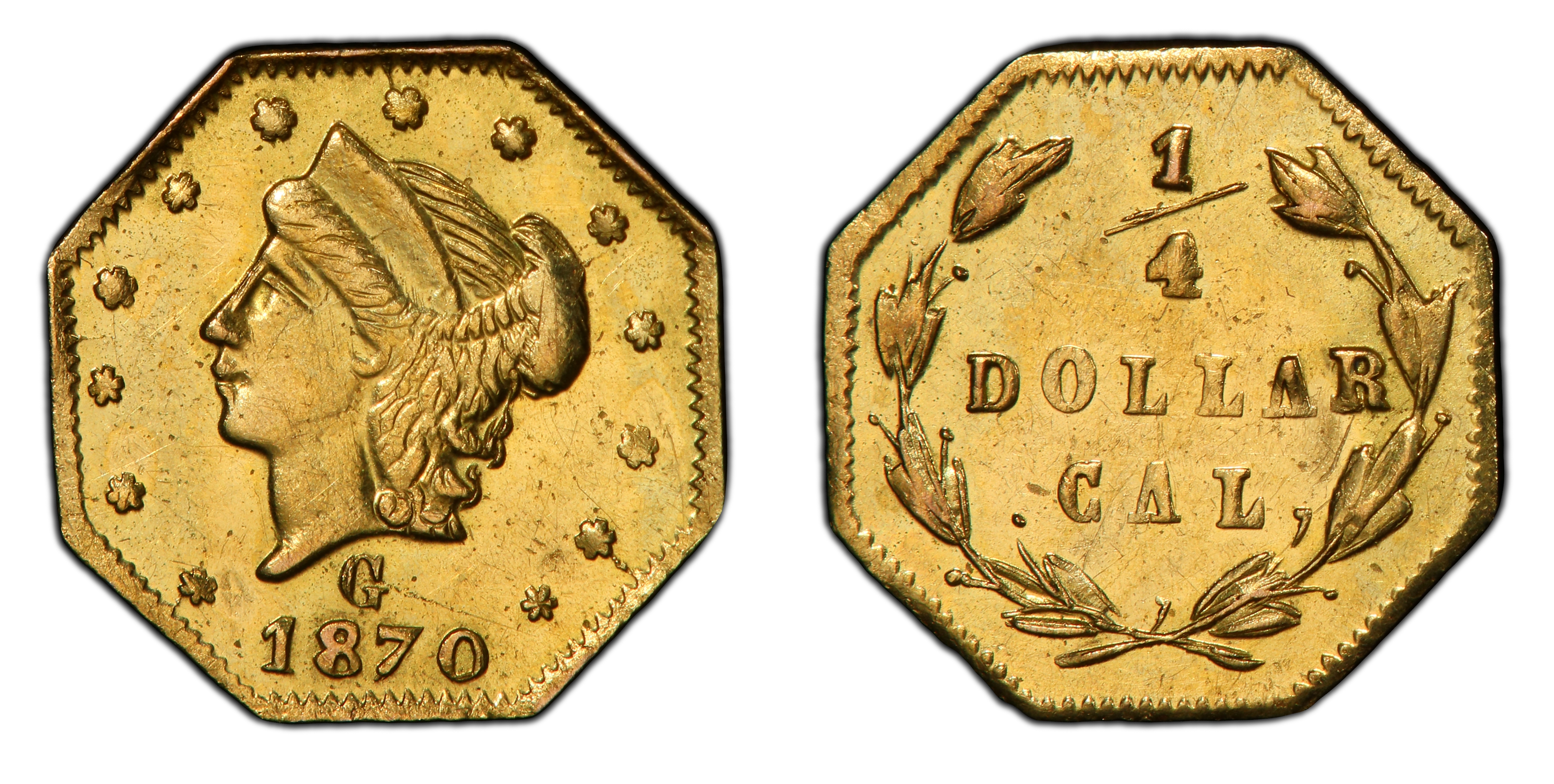
Obverse & Reverse
The 1870 Octagonal Gold 25 Cents, cataloged as BG-761 in the Breen-Gillio reference, is a product of the second major phase of California's private gold coinage. The 'Period Two' (1859-1882) issues, unlike their 'Period One' predecessors, were not primarily struck to alleviate a shortage of small change, as the San Francisco Mint had been in full operation for years. Instead, they catered to a burgeoning market for souvenirs and keepsakes that recalled the excitement of the Gold Rush. San Francisco jewelers, many of French origin, recognized that tourists and locals alike desired small, affordable gold tokens to send to relatives in the East or to keep as mementos. These tiny octagonal and round pieces, often lighter and of less consistent fineness than their face value would imply, became a popular form of wearable wealth and nostalgia. The Coinage Act of 1864 had made private coinage illegal, but enforcement was lax until the early 1880s. This legal gray area led most Period Two minters to operate anonymously, deliberately omitting any identifying initials or marks from their dies. The BG-761 is a classic example of these 'suppressed jewelers' issues.' Struck by the primitive 'hammer method'—where a planchet was placed on an anvil die and struck with a hand-held punch die and a sledgehammer—their quality could vary dramatically. The existence of multiple die pairings from this era, like the BG-761, attests to a competitive cottage industry of private minters vying for the souvenir trade in post-Gold Rush California.
Associated EventPost-Gold Rush California Souvenir Trade
Reason For MintingPrimarily created to satisfy the demand for gold souvenirs and keepsakes rather than for general circulation.
Minter HistoryThe specific minter of the BG-761 die pair is unknown. During this 'Period Two' of fractional gold production, the Private Coinage Act of 1864 was in effect, making such issues legally tenuous. To avoid scrutiny from federal authorities, most jewelers who produced these pieces did so anonymously, leaving no identifying marks on their products.
Historical SignificanceThe BG-761 is a tangible artifact of the commercialization of the Gold Rush legacy. It represents a shift from coinage of necessity to coinage of novelty, embodying the romanticism that the '49er era had already acquired just two decades after its peak. These pieces are a key part of the broader Territorial and Private Gold series, illustrating a fascinating chapter in America's monetary history.
N/A
Denomination25 Cents
Minting Period1870
Assayer/MinterUnknown Private Minter
Geographic OriginSan Francisco, California
Obverse DescriptionFeatures a Liberty Head portrait facing left, stylistically similar to contemporary federal gold coinage but often more crudely engraved. The head is surrounded by thirteen stars, representing the original colonies.
Obverse InscriptionNo inscriptions are present on the obverse die.
Reverse DescriptionA wreath of leaves and berries encircles the denomination. The wreath is open at the top. The date '1870' is located within the wreath, below the denomination.
Reverse Inscription1/4 CENTS 1870
CompositionGold
Stated Fineness Actual FinenessVaries, typical for Period Two issues, often between .500 and .800 fine.
EdgePlain
Unknown
Survival EstimateFewer than 35 known examples. Based on combined NGC (19) and PCGS population reports, with an allowance for unsubmitted or raw coins.
Rarity ScaleR-6 (13 to 30 known). Note: Some sources, like Greysheet, list it as R-4, while a Heritage Auctions listing from 1993 cites R-6. Given the low certified population, R-6 is the more likely and accepted rating.
The BG-761 appeals to collectors of California Fractional Gold for its defined scarcity (R-6), classic octagonal shape, and its role as a representative 'suppressed jeweler's issue' from Period Two. Its affordability relative to Period One circulating issues makes it an accessible entry point for a rare variety.
Key VarietiesThe BG-761 itself is a specific die marriage and represents a single variety. No major sub-varieties, patterns, or restrikes from this die pair are known to exist. Collectors may encounter Proof-Like (PL) or Deep Mirror Proof-Like (DMPL) examples, which are not distinct varieties but rather represent coins struck from freshly polished dies and command a premium.
Authentication TipsAuthentic examples are struck, not cast, and should exhibit die-striking characteristics. The reverse lettering and date are often softly struck and may show weakness. The surfaces of genuine pieces can be slightly wavy or uneven due to the hammer-striking process. Be wary of modern replicas, which are often gold-plated, have a soapy or unnatural luster, and may feature a bear on the reverse—a motif never used on genuine fractional gold. Reference the Breen-Gillio photographic plates for die markers specific to the BG-761 pairing.
Shopping ConsiderationsA premium quality BG-761 is defined by a sharp strike, especially on Liberty's hair details and the reverse wreath. Seek out examples with minimal contact marks and original, undisturbed luster; many Period Two issues were polished for jewelry and should be avoided. A slightly off-center strike is common and generally accepted for the series. Coins with proof-like or deep mirror proof-like surfaces are highly desirable and carry a significant premium. Given the high number of counterfeits in the fractional gold series, purchasing examples certified by PCGS or NGC is strongly recommended.
A coin's grade is its condition, rated on a 1-70 scale. For rare coins, this is the most critical factor in determining value, as a tiny difference in preservation can mean a huge difference in price.
Relevant Grade TypesOriginal examples of BG-761 were business strikes, although intended as souvenirs rather than for hard circulation. They are found in Circulated grades (AU-58 and below) and, more commonly, in Mint State (MS, 60-70) grades. Due to their nature as collectibles from the start, many were preserved in high grade. The Proof (PR/PF) designation is not applicable as no true proofs were struck during the original minting period. However, coins from highly polished dies may receive PL (Proof-Like) or DMPL (Deep Mirror Proof-Like) designations from grading services, which are distinct from true Proofs.
Mint State CharacteristicsUncirculated examples are judged on the quality of their strike, luster, and marks. The BG-761 often exhibits some softness of strike in the central devices due to the nature of hammer striking. Luster is typically satiny and can be quite vibrant. Higher-grade examples (MS-63 and above) will have minimal distracting marks on the delicate fields and high points of the design. The presence of watery or reflective fields (PL/DMPL) significantly increases desirability and value.
Circulated Wear PatternsOn circulated examples, wear first appears on the high points of Liberty's hair, cheek, and the coronet. On the reverse, the highest points of the wreath and the digits of the date will show friction first. In lower grades (below AU-50), the stars and peripheral lettering will begin to merge with the fields.
Key Factors For ValueThe primary value drivers for a BG-761 are grade and surface quality. An original, uncleaned coin with vibrant luster will always be prized. The strike is a critical factor; a sharply struck example is rare and commands a strong premium. Eye appeal, including any attractive reddish-gold toning, enhances value. A CAC sticker, indicating a premium-quality example for the grade, adds a significant premium for this and other fractional gold issues.
PCGS Price Guide
| Grade | Price | Population |
|---|---|---|
| 40 | $175.00 | 1 |
| 45 | $185.00 | 1 |
| 45+ | $190.00 | N/A |
| 50 | $200.00 | 2 |
| 50+ | $205.00 | N/A |
| 53 | $210.00 | 1 |
| 53+ | $220.00 | N/A |
| 55 | $240.00 | 14 |
| 55+ | $250.00 | N/A |
| 58 | $260.00 | 16 |
| 58+ | $270.00 | N/A |
| 60 | $280.00 | 1 |
| 61 | $300.00 | 8 |
| 62 | $350.00 | 26 |
| 62+ | $400.00 | N/A |
| 63 | $475.00 | 10 |
| 63+ | $525.00 | N/A |
| 64 | $750.00 | 4 |