1871 G25C BG-771 (Regular Strike)
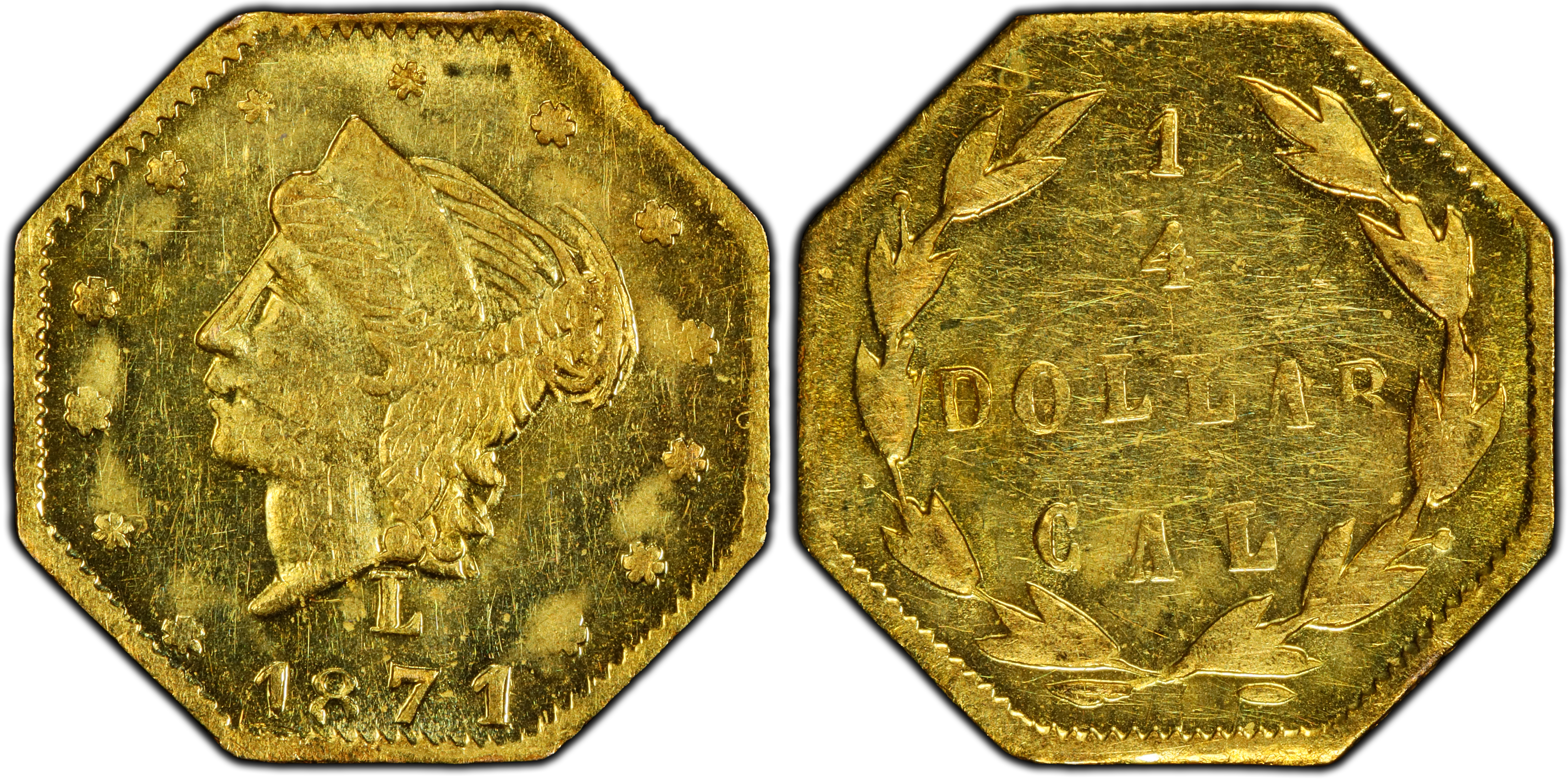
Obverse & Reverse
The 1871 Octagonal Liberty 25 Cents, cataloged as Breen-Gillio 771, is a quintessential example of a 'Period Two' California Fractional Gold piece. By 1871, the initial, desperate need for small denomination coinage that characterized the California Gold Rush had long subsided. The San Francisco Mint, operating since 1854, was in full production, supplying the West with ample federal silver and gold coins. The impetus for producing these tiny, privately-struck gold pieces had shifted entirely from commerce to curiosity. These later issues, often called 'jeweler's pieces,' were not intended to circulate as money but were created to satisfy a burgeoning tourist and souvenir market. San Francisco had transformed from a chaotic boomtown into a sophisticated city, a destination for travelers from the Eastern states and Europe who were captivated by the romanticism of the Gold Rush. These miniature gold coins served as perfect mementos of their visit. Legally, their production existed in a gray area. The Private Coinage Act of 1864 had made such private minting illegal, but the law was not aggressively enforced by the Secret Service until the early 1880s. This legal ambiguity allowed numerous anonymous jewelers and craftsmen, primarily in San Francisco, to continue striking a wide variety of designs. Unlike the earlier 'Period One' (1852-1857) issues, which were generally of honest weight and intended to alleviate a genuine coin shortage, Period Two pieces were notoriously underweight for their stated denomination. Their artistic quality also varied, with some being finely crafted while others were crude. The BG-771, with its traditional Liberty Head motif, harkened back to federal designs, lending it a veneer of legitimacy that appealed to buyers, even though its function was purely novelty. Their small size and gold content made them affordable keepsakes. Many were mounted into jewelry, such as stickpins, cufflinks, and watch fobs, which explains why many surviving examples are found holed, looped, or with evidence of solder. Today, the BG-771 is a tangible link to this secondary chapter of the Gold Rush story, representing the commercialization of its legacy and the entrepreneurial spirit of California's craftsmen.
Associated EventPost-Gold Rush California Tourism
Reason For MintingPrimarily struck for use as souvenirs and jewelry for the tourist trade, not for monetary circulation.
Minter HistoryThe specific minter or jeweler who produced the BG-771 variety is unknown. This is characteristic of most 'Period Two' California Fractional Gold issues, as the makers were operating in a legally questionable space and rarely signed their work to avoid potential prosecution by the U.S. government.
Historical SignificanceThis coin is significant not as a circulating medium, but as a historical artifact representing the transition of the California Gold Rush from a frantic event into a romanticized memory. It showcases the continued private production of gold tokens for a souvenir market, defying federal laws for nearly two decades and capturing the enduring allure of gold in 19th-century America.
N/A
Denomination25 Cents
Minting Period1871
Assayer/MinterUnknown Private Minter
Geographic OriginSan Francisco, California
Obverse DescriptionA beaded border encloses a Liberty Head facing left, similar in style to the contemporary U.S. gold coinage but often of simpler execution. Thirteen stars encircle the head.
Obverse Inscription Reverse DescriptionA beaded border encloses a wreath of two branches tied with a bow at the bottom. The denomination '25 CENTS' is within the wreath, and the date '1871' is positioned above the wreath.
Reverse Inscription25 CENTS 1871
CompositionGold
Stated Fineness Actual FinenessVariable, but typically less pure than federal coinage and often debased, a common trait for Period Two issues.
EdgePlain
Unknown
Survival Estimate31-75 (per rarity scale)
Rarity ScaleLow R-6
The BG-771 appeals to collectors for its specific date, octagonal shape, and status as a scarce 'Low R-6' variety. It is a key representative of the fascinating 'Period Two' issues, which are more affordable than their Period One counterparts but offer a much wider range of designs and historical context related to post-Gold Rush California.
Key VarietiesThe primary variety is the regular business strike. No known proof strikings, patterns, or official restrikes exist for this specific variety from the period. All known examples are considered business strikes, though some may exhibit prooflike surfaces due to fresh dies. Collectors should be aware of modern replicas and fantasy pieces which are not contemporary to the 1871 minting period.
Authentication TipsGenuine Period Two pieces like BG-771 often have a slightly crude, handmade feel. Look for die characteristics consistent with known genuine examples (consulting the Breen-Gillio plates is essential). The strike may be uneven, with some softness in the centers or legends. Replicas are often thicker, have a soapy or cast-like texture, incorrect die markers, and may feature a bear on the reverse, a design element not found on genuine 19th-century issues. Be wary of pieces with perfect, uniform strikes and fields, as they may be modern copies. Third-party grading is highly recommended for authentication.
Shopping ConsiderationsA premium quality example of BG-771 for its grade will possess a sharp strike, especially on the stars, Liberty's hair details, and the numerals of the date and denomination. Seek out coins with original, lustrous surfaces and a pleasing reddish-gold or yellow-gold patina. Many examples were cleaned or used in jewelry; avoid those with harsh abrasions, deep scratches, evidence of solder, or notable rim damage. Since many were made for jewelry, examples that have escaped being holed or mounted are particularly desirable and command a significant premium. A smooth, problem-free surface, even with some light circulation, is far preferable to a higher-grade coin that has been damaged or improperly cleaned.
A coin's grade is its condition, rated on a 1-70 scale. For rare coins, this is the most critical factor in determining value, as a tiny difference in preservation can mean a huge difference in price.
Relevant Grade TypesOriginal 1871 BG-771 issues were produced as business strikes. Although they were not intended for widespread circulation, they can be found in a range of conditions from lightly circulated (AU grades) to uncirculated (Mint State, or MS, 60-70). Because they were primarily sold as souvenirs, a higher proportion survive in Mint State compared to Period One issues. No official Proof (PR/PF) examples were struck during the original period of issue, and no later-date official restrikes are known.
Mint State CharacteristicsIn uncirculated grades, the BG-771 typically displays a soft, satiny luster. Some examples from fresh dies may exhibit semi-prooflike or prooflike fields. The overall strike is often average, with potential weakness on the high points of Liberty's hair and the center of the wreath. Small, mint-made planchet flaws or adjustment marks are not uncommon and should be assessed for their impact on eye appeal. Contact marks are common due to the softness of the gold.
Circulated Wear PatternsWear first appears on the highest points of the design: Liberty's cheek, the hair just above the ear, and the leaves and bow of the wreath on the reverse. On lower-grade circulated examples (VF and below), the finer details of the hair and the individual leaves of the wreath will begin to merge. The stars and legends will then show progressive flatness.
Key Factors For ValueThe primary value drivers for an 1871 BG-771 are grade and surface preservation. An example with original, undisturbed luster and minimal contact marks will always command a premium. Strike quality is a major factor; a well-struck piece with full details is highly sought after. Eye appeal, encompassing attractive original color and a lack of distracting flaws, is crucial. Finally, coins certified by top-tier grading services (PCGS or NGC) are more liquid and trusted in the marketplace, with a CAC sticker adding a further premium for exceptional quality within the assigned grade.
PCGS Price Guide
| Grade | Price | Population |
|---|---|---|
| 50 | $275.00 | 1 |
| 50+ | $285.00 | N/A |
| 53 | $300.00 | N/A |
| 53+ | $310.00 | N/A |
| 55 | $325.00 | 4 |
| 55+ | $335.00 | N/A |
| 58 | $400.00 | 3 |
| 58+ | $410.00 | N/A |
| 60 | $425.00 | N/A |
| 61 | $475.00 | 1 |
| 62 | $575.00 | 8 |
| 62+ | $775.00 | N/A |
| 63 | $1,125.00 | 6 |
| 63+ | $1,300.00 | N/A |
| 64 | $1,850.00 | 1 |
| 64+ | $2,350.00 | N/A |
| 65 | $3,000.00 | 1 |