1873 G25C BG-793 (Regular Strike)
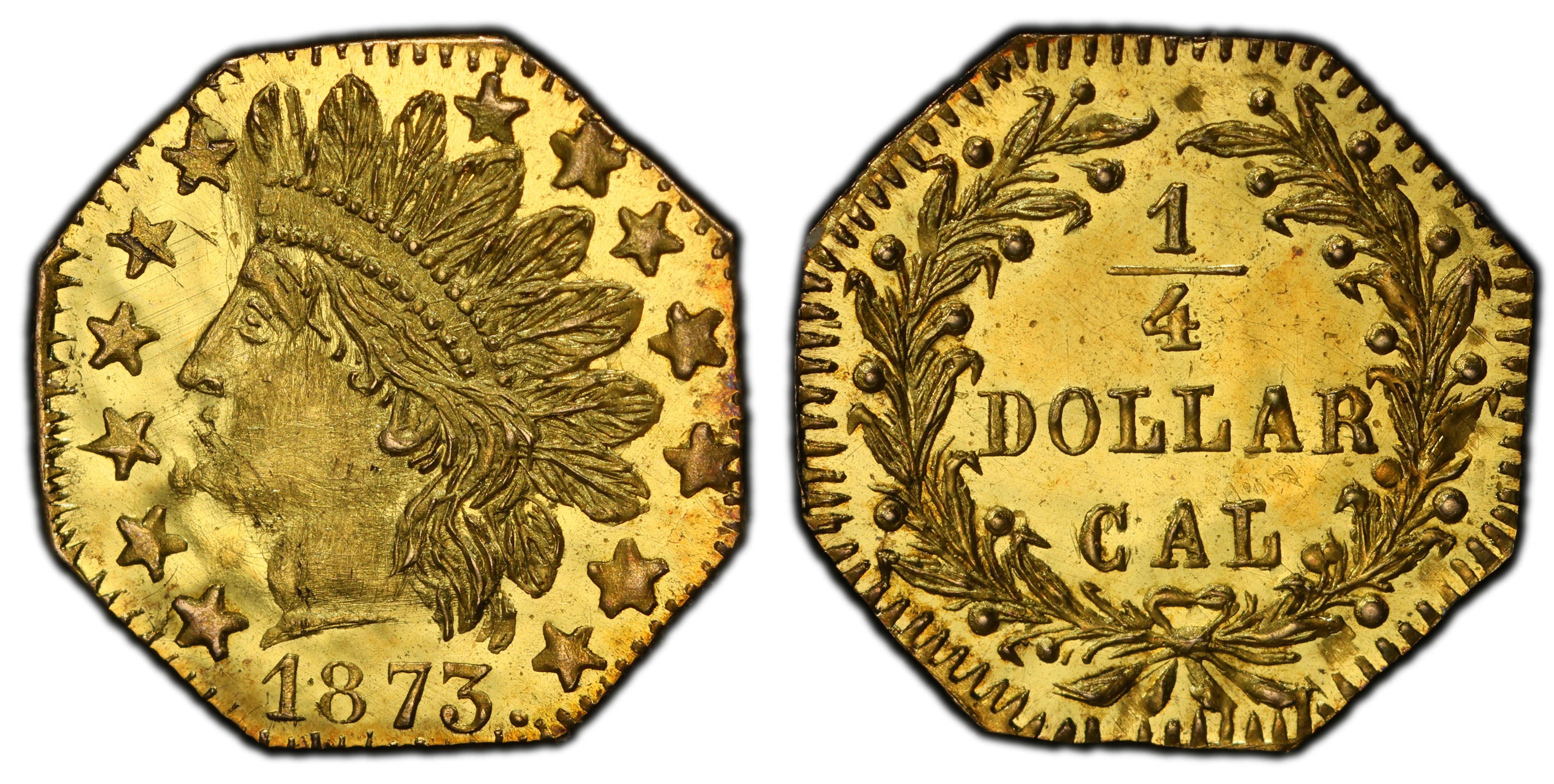
Obverse & Reverse
The 1873 25 Cents, cataloged as Breen-Gillio 793, is a quintessential example of 'Period Two' California Fractional Gold. The story of these fascinating tokens begins with the California Gold Rush, which commenced in 1848. The massive influx of population and gold dust created a severe shortage of small-denomination coinage for daily transactions. To fill this void, private jewelers and metallurgists began striking their own small gold coins in 25-cent, 50-cent, and one-dollar denominations starting in 1852. These initial issues, known as 'Period One' (1852-1857), were genuinely intended to and did circulate as a necessary medium of exchange. However, the opening of the San Francisco Mint in 1854 and its subsequent production of federal silver coinage soon alleviated the shortage. By the late 1850s, the original purpose for fractional gold had vanished. Instead of disappearing, the practice evolved. Jewelers recognized a burgeoning market for these miniature gold pieces as souvenirs and keepsakes of the Gold Rush era. This gave rise to 'Period Two' (1858-1882) issues, of which the BG-793 is a prime example. Struck in 1873, long after the commercial need had ceased, this piece was created not for the cash drawer, but for the tourist's pocket or the jewelry maker's bench. The Coinage Act of 1864 had made private coinage illegal, but enforcement was lax, and producers of these souvenir tokens continued their work, often carefully designing them to resemble currency while technically being tokens. They became popular mementos, easily mailed back East as a tiny, glittering symbol of California's wealth. The BG-793, with its classic Indian Head design, tapped into the popular numismatic and cultural motifs of the day, making it an attractive collectible then as it is now. These Period Two pieces are often characterized by cruder engraving and lower gold fineness compared to their Period One predecessors, reflecting their altered purpose from functional coin to commercial novelty.
Associated EventCalifornia Gold Rush Aftermath
Reason For MintingPrimarily struck as a souvenir or curio for the tourist and jewelry trade, capitalizing on the romanticism of the California Gold Rush.
Minter HistoryThe specific minter of the BG-793 die pair is not definitively known, a common trait for many Period Two California Fractional Gold varieties. They were produced by various San Francisco-based jewelers and artisans who had the equipment to strike small gold tokens. These minters operated semi-anonymously, often producing a variety of designs for the robust souvenir market. Their work was driven more by commercial appeal than the strict standards of a government mint, resulting in a wide array of artistic styles and technical quality.
Historical SignificanceThe BG-793 represents the transition of California Fractional Gold from a necessary form of currency to a popular collectible and souvenir. It is a tangible artifact of the post-Gold Rush California economy, where the legacy of the boom was commercialized. Numismatically, it is part of a complex and widely collected series that offers a window into the unregulated and entrepreneurial spirit of 19th-century America.
BG-793
Denomination25 Cents
Minting Period1873
Assayer/MinterUnknown Private Minter
Geographic OriginSan Francisco, California
Obverse DescriptionFeatures a stylized Indian Head facing left, a popular motif of the era. The portrait is surrounded by 13 six-pointed stars, representing the original colonies. The date, 1873, appears below the bust truncation.
Obverse Inscription1873
Reverse DescriptionThe central device is the denomination '25 CENTS' contained within a decorative wreath. The wreath is composed of two branches tied together with a bow at the bottom.
Reverse Inscription25 CENTS
CompositionGold
Stated Fineness Actual FinenessVariable, but generally lower than the .900 fineness of federal coinage of the era.
EdgePlain
Unknown
Survival EstimateFewer than 100 known; estimates based on rarity ratings suggest a population of approximately 30-75 pieces.
Rarity ScaleR-5 / R-6 (Very Rare)
The BG-793 is sought after for its classic octagonal shape, iconic Indian Head design, and its status as a genuine 'Period Two' California Fractional Gold piece. Its defined rarity makes high-grade examples a significant prize for specialists in the series.
Key VarietiesThe BG-793 is a specific die marriage and does not have major recognized varieties from the original minting period. There are no known official restrikes or patterns associated with this variety. Collectors may focus on different die states, with a known late die state showing a prominent bulge in the field in front of the Indian's profile.
Authentication TipsGenuine BG-793 pieces are denominated '25 CENTS' and have a distinct, somewhat crude but sharp style. Many contemporary counterfeits and modern replicas are either unmarked with a denomination, are poorly cast with mushy details, or have a soapy, unnatural luster. Be wary of pieces with incorrect weight or a brassy, non-gold color. A key diagnostic for a late die state example is a heavy bulge or swelling in the obverse field in front of the Indian's face.
Shopping ConsiderationsA premium quality example of BG-793 will exhibit a sharp strike, particularly on the stars and the details of the wreath. Many examples are weakly struck in areas due to the thinness of the planchet and the crude minting process. Look for pieces with minimal distracting marks and original, uncleaned surfaces. Luster is a key value component; many high-grade examples are described as 'prooflike' with reflective fields, which command a significant premium. Avoid coins that have been harshly cleaned, show evidence of being mounted in jewelry (solder marks, excessive rim damage), or have been tooled to hide imperfections.
A coin's grade is its condition, rated on a 1-70 scale. For rare coins, this is the most critical factor in determining value, as a tiny difference in preservation can mean a huge difference in price.
Relevant Grade TypesAll original 1873 BG-793 pieces were struck as business strikes, intended for sale as souvenirs rather than circulation. They are found in Circulated (1-58) grades, though this is less common, and more frequently in Mint State (MS, 60-70) grades. No true Proofs were struck during the original period of issue. The term 'Prooflike' (PL) is often used to describe Mint State examples with unusually reflective, mirror-like surfaces, and these are highly desirable.
Mint State CharacteristicsIn uncirculated grades, BG-793 often displays a slightly satiny to prooflike luster. The strike is a critical factor; many are softly struck, especially on the highest points of the Indian's hair and the leaves in the wreath. A well-struck example with full details is rare. Small, as-made planchet flaws or light adjustment marks are not uncommon and should be evaluated for their impact on eye appeal. The gold color can range from a light yellow-gold to a deeper reddish or greenish-gold.
Circulated Wear PatternsOn circulated examples, wear first appears on the high points of the Indian's cheek, hair feathers, and the tips of the leaves and the bow on the reverse wreath. As wear progresses, the stars on the obverse will begin to lose their sharpness, and the fine details of the reverse legend will soften.
Key Factors For ValueThe primary driver of value for BG-793 is the certified grade. Surface quality is paramount; an example with original, lustrous, and uncleaned surfaces will always be worth more than a cleaned or damaged coin of the same grade. Strike sharpness is the next key factor, with well-defined central devices commanding a premium. Eye appeal, which encompasses toning (attractive original gold hues), luster, and the absence of distracting marks, is crucial. The presence of a CAC sticker, indicating premium quality for the grade, adds a significant premium for this and other Cal Gold issues.
PCGS Price Guide
| Grade | Price | Population |
|---|---|---|
| 61 | $300.00 | 1 |
| 62 | $325.00 | 2 |
| 62+ | $340.00 | N/A |
| 63 | $425.00 | 13 |
| 63+ | $450.00 | N/A |
| 64 | $550.00 | 14 |
| 64+ | $675.00 | 1 |
| 65 | $1,350.00 | 4 |
| 65+ | $1,550.00 | N/A |
| 66 | $2,000.00 | 1 |