1876 G25C BG-778 (Regular Strike)
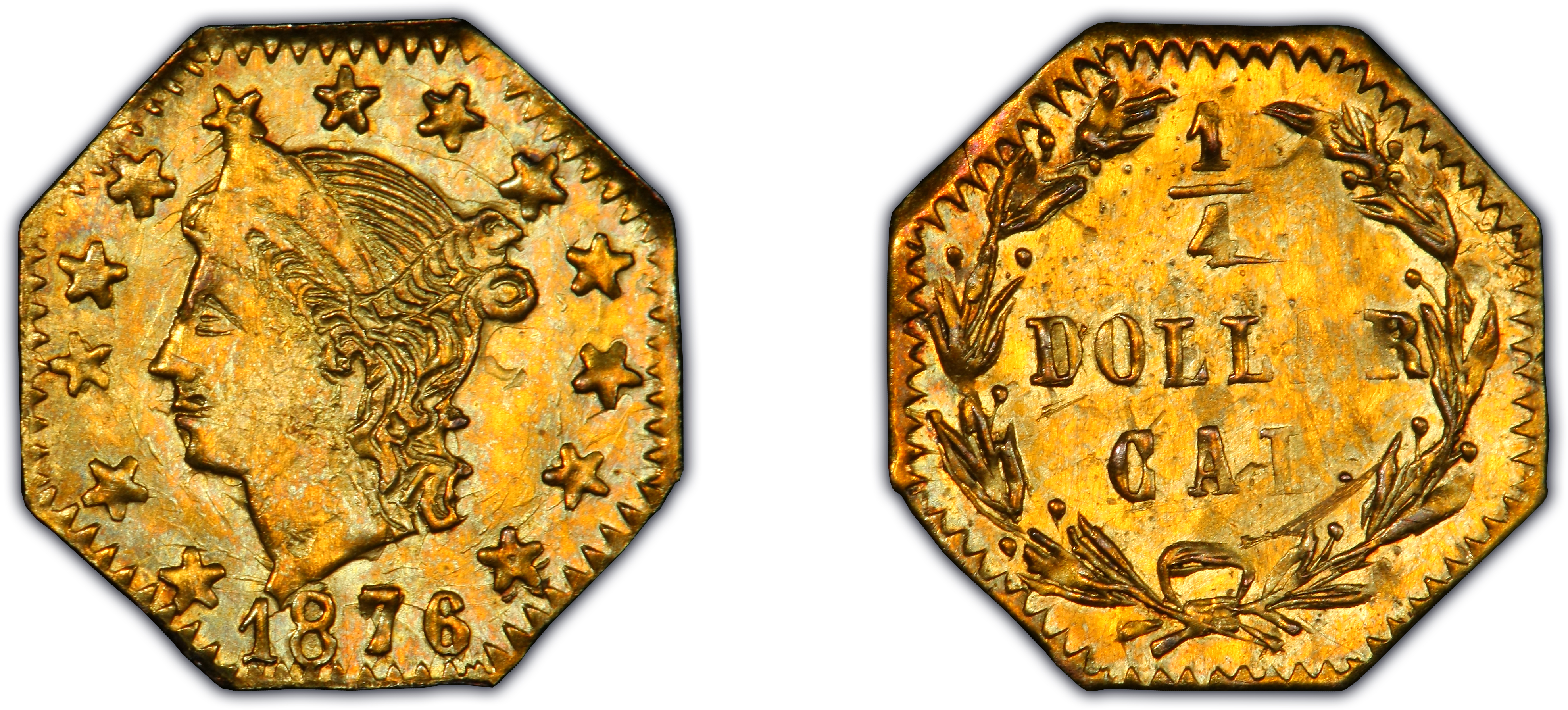
Obverse & Reverse
The 1876 BG-778 25 Cents is a quintessential example of a 'Period Two' California Fractional Gold piece. The story of these fascinating miniature coins begins with the California Gold Rush. The massive influx of over 300,000 people to California after 1848 created a dynamic, booming economy, but one severely hampered by a chronic shortage of small-denomination coinage for everyday transactions. Initially, miners and merchants relied on imprecise 'pinches' of gold dust, a system fraught with inconsistency. While private assayers began producing larger gold coins ($5 and up) to facilitate large-scale commerce, the need for pocket change remained acute. Between 1852 and 1856 ('Period One'), jewelers and metalworkers in San Francisco began striking their own 25-cent, 50-cent, and dollar pieces to fill this void. These early issues were generally of good weight and intended for actual circulation. However, by the time the BG-778 was struck in 1876, the landscape had changed dramatically. The San Francisco Mint was in full operation, producing ample federal silver coinage, obviating the original commercial need for fractional gold. The Coinage Act of 1864 had also officially made private coinage illegal. Consequently, the 'Period Two' pieces (1859-1882) are understood by numismatists to have been produced not as circulating currency, but primarily as souvenirs, keepsakes, and jewelry items for a burgeoning tourist trade and for locals proud of California's gold heritage. These later issues, often called 'jeweler's pieces,' were typically underweight for their stated value and featured a wider variety of designs than the more utilitarian first period coins. The makers of these coins operated in a legal gray area, often omitting their own identifying marks to avoid scrutiny from the Secret Service, which viewed their activities as a violation of federal coining authority. This clandestine nature is why the minters of most Period Two pieces, including the BG-778, remain anonymous.
Associated EventCalifornia Gold Rush Aftermath and Tourism Boom
Reason For MintingPrimarily created as a souvenir or jewelry item during a period when the original commercial need for such coins had subsided.
Minter HistoryThe minter of BG-778, like most producers of 'Period Two' California Fractionals, is unknown. During this era (1859-1882), private minting was illegal, so manufacturers, predominantly San Francisco jewelers, deliberately left their identifying marks off their products to avoid prosecution by the U.S. Secret Service. These artisans catered to the demand for Gold Rush souvenirs, creating a wide variety of designs that were often underweight and not intended for serious circulation.
Historical SignificanceThe BG-778 represents the evolution of California Fractional Gold from a necessary medium of exchange to a popular collectible and souvenir. It is a tangible artifact of the post-Gold Rush era in California, reflecting a period of growing tourism and nostalgia for the state's recent dramatic history, all while navigating a climate of increasing federal opposition to private coinage.
N/A
Denomination25 Cents
Minting Period1876
Assayer/MinterUnknown Private Minter
Geographic OriginSan Francisco, California
Obverse DescriptionA head of Liberty, facing left, with coronet. The portrait is encircled by 13 stars, representing the original colonies.
Obverse InscriptionNo textual inscription, only the date 1876 below the bust of Liberty.
Reverse DescriptionThe denomination '1/4' is enclosed within a wreath of leaves and berries. The term 'DOLLAR' and 'CAL' are typically not present on this variety.
Reverse Inscription1/4
CompositionGold
Stated Fineness Actual FinenessVariable, but generally lower purity than official U.S. coinage of the era.
Diameter10.00 mm
EdgePlain
Unknown; likely very small.
Survival EstimateFewer than 15 known specimens.
Rarity ScaleR-7 (4 to 12 known)
This coin is highly sought after for its extreme rarity (R-7) and classic Liberty Head design. As an octagonal 'Period Two' piece, it embodies the souvenir-driven era of fractional gold production, making it a key representative of the series' later history. The small surviving population ensures persistent demand from advanced collectors.
Key VarietiesThe BG-778 is itself a specific die variety cataloged in the Breen-Gillio reference. Within the broader 1876 25C series, numerous other obverse and reverse die pairings exist (e.g., Indian Head types, different wreath styles), creating a complex field for specialists. No proof restrikes or patterns are known for this specific variety.
Authentication TipsGenuine BG-778 examples exhibit a specific strike character, with sharp details on Liberty's coronet and the wreath's leaves, though overall strike can vary. The numerals in the date have a distinct style that should be compared to known genuine examples. Be wary of modern replicas, which often have a soapy, cast appearance, incorrect weight, or lettering/design details that are too soft or tool-finished. Third-party certification by PCGS or NGC is highly recommended for any potential purchase.
Shopping ConsiderationsFor a premium quality BG-778, a buyer should look for a sharp, well-centered strike. Luster is paramount; a coin with bright, original satiny fields will command a significant premium over one that is dull or has been cleaned. Given their use in jewelry, examine the edges and surfaces carefully under magnification for evidence of mounting, removal, or tooling. Eye appeal is critical for these tiny coins; seek out examples with smooth, mark-free surfaces and a pleasing original gold color. Due to its R-7 rarity, any example, even in circulated grades like AU, is a significant find.
A coin's grade is its condition, rated on a 1-70 scale. For rare coins, this is the most critical factor in determining value, as a tiny difference in preservation can mean a huge difference in price.
Relevant Grade TypesAll original examples of BG-778 were struck as business strikes, primarily for souvenir purposes rather than circulation. They are found in both Circulated grades (AU-50 to AU-58 are most common for the type) and Mint State (MS, 60-70). No proofs were struck during the original period of issue, and there are no known later-date restrikes or special collector strikings for this variety.
Mint State CharacteristicsAn uncirculated BG-778 will exhibit full, unbroken mint luster, often with a slightly reflective or prooflike surface from polished dies. The strike is a key factor; high points on Liberty's hair and coronet should be sharp. Because they were not intended for heavy commercial use, contact marks are often light, but can still be present from handling. A top-grade example will have minimal marks and blazing luster.
Circulated Wear PatternsWear on a BG-778 will first appear on the highest points of the design: Liberty's cheek, the hair just above the ear, and the tips of the leaves in the wreath. As wear progresses, the stars surrounding Liberty will begin to lose their definition, and the finer details of the wreath will become flat. In lower grades, the date and the fraction on the reverse will show significant weakness.
Key Factors For ValueRarity is the primary driver of value for the BG-778. Beyond that, the grade and surface quality are paramount. An example with original, undisturbed surfaces and strong luster (often described as 'lustrous yellow-orange') is far more valuable than a cleaned or polished coin of the same grade. The sharpness of the strike is crucial, as some were weakly produced. Exceptional eye appeal, free of distracting marks or jewelry-related damage, adds a significant premium. A CAC sticker on a certified coin would confirm its premium quality for the grade and further enhance its value.
PCGS Price Guide
| Grade | Price | Population |
|---|---|---|
| 53 | $550.00 | N/A |
| 53+ | $585.00 | N/A |
| 55 | $650.00 | N/A |
| 55+ | $685.00 | N/A |
| 58 | $750.00 | 2 |
| 58+ | $800.00 | N/A |
| 60 | $900.00 | N/A |
| 61 | $1,200.00 | N/A |
| 62 | $1,500.00 | N/A |
| 62+ | $2,000.00 | N/A |
| 63 | $2,500.00 | 5 |
| 63+ | $3,500.00 | N/A |
| 64 | $5,250.00 | 3 |