1852 25C BG-799V (Regular Strike)
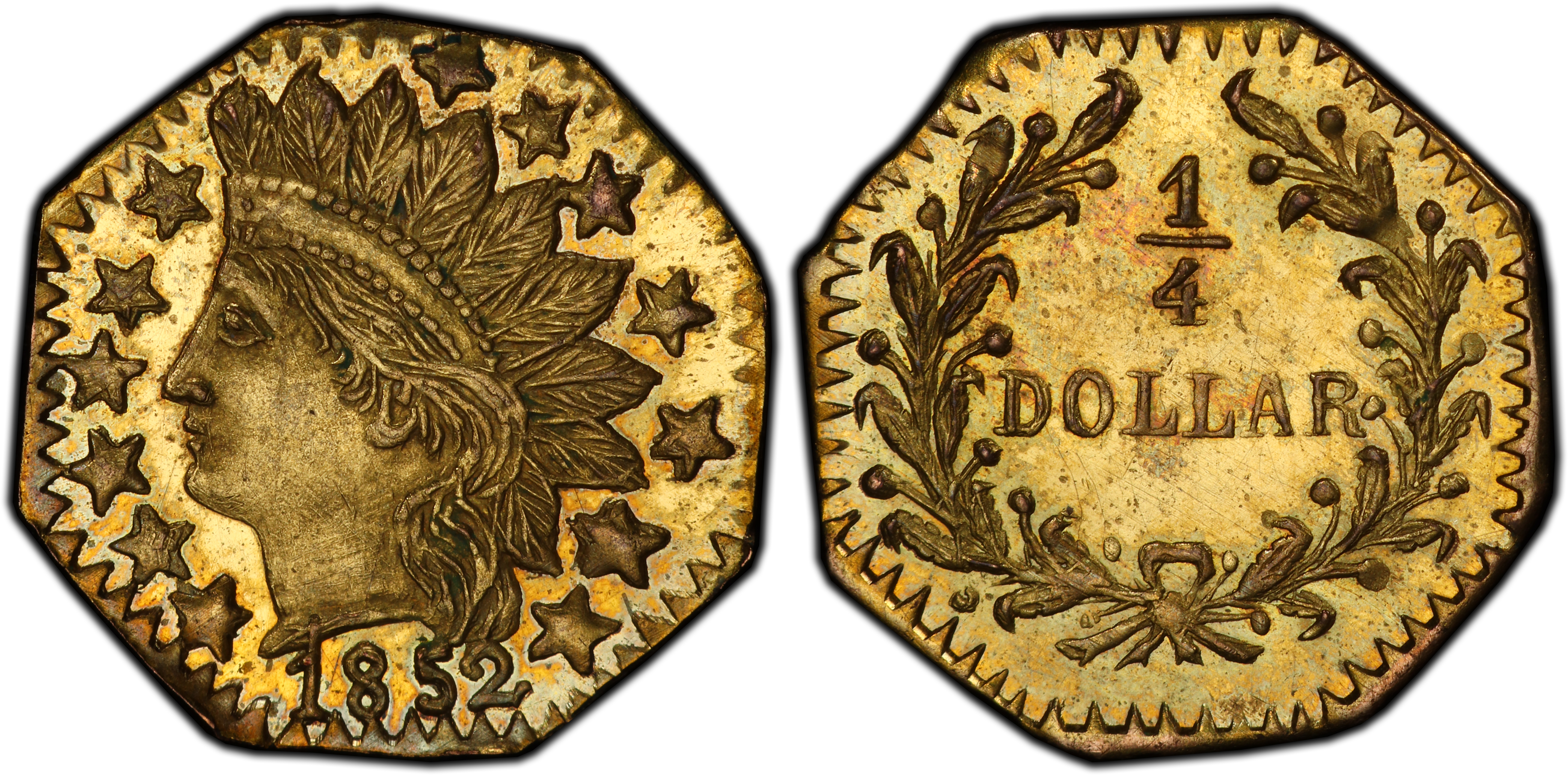
Obverse & Reverse
The 1852 25C BG-799V is a tangible artifact from the chaotic genesis of California's economy. The Gold Rush, beginning in 1848, precipitated one of the most significant demographic and economic shifts in American history, flooding the remote territory with hundreds of thousands of prospectors and merchants. This explosive growth created an immediate and severe monetary crisis. The primary form of wealth, gold dust, was impractical and wildly inconsistent for daily transactions; a 'pinch' of dust for a drink at a saloon varied with the size of the bartender's thumb and forefinger. Federal coinage was scarce, as the nearest mint was in New Orleans, a treacherous journey away. Larger private gold coins, such as $5 and $10 pieces, began to appear but failed to address the critical lack of small change for minor purchases. Into this void stepped jewelers and metallurgists in San Francisco, who saw both a public need and a business opportunity. Among the most prominent of these was Antoine Louis Nouizillet, a French jeweler who applied his skills to produce some of the earliest and most needed 'fractional' gold coins. These Period One issues, struck from 1852 to 1857, were not souvenirs but were intended to and did function as circulating currency, eagerly accepted by a commerce-starved public despite being privately issued and often slightly underweight. The BG-799V was struck in this very first year of fractional production. It was likely manufactured using a crude hammer-press method, where dies were struck by hand, resulting in frequent imperfections and variability. These tiny, octagonal coins, with their distinctive Indian Head design, facilitated everyday trade, allowing for standardized pricing for bread, tools, and services. However, their small size made them easy to lose, and the establishment of the San Francisco Mint in 1854, which began producing official federal silver and gold coins, quickly rendered them obsolete. By 1857, the production of these circulating fractionals had ceased, with many being melted down. Today, the BG-799V is a numismatic treasure of profound rarity, representing the desperate, innovative, and uniquely American solution to the absence of a foundational element of civilization—small change—on the nation's raw frontier.
Associated EventCalifornia Gold Rush
Reason For MintingTo alleviate a severe shortage of small-denomination coinage for daily commercial transactions in Gold Rush-era California.
Minter HistoryAntoine Louis Nouizillet was a French jeweler and watchmaker who established a business in San Francisco during the Gold Rush. Recognizing the acute need for small change, he became one of the most significant producers of Period One (1852-1856) California Fractional Gold. His issues are noted for their relatively high quality of design and execution compared to some contemporaries. He operated independently and also in partnerships, including with M. Deriberpe. Nouizillet's business, including his dies and punches, was eventually sold to another jeweler, Robert B. Gray, around 1859, marking a transition to the 'Period Two' souvenir era of fractional gold.
Historical SignificanceAs a 'Period One' issue from the first year of production, the BG-799V is a direct link to the initial phase of fractional coinage when these pieces served a vital, albeit brief, role as circulating money. It represents the private enterprise that provided monetary stability in the absence of federal infrastructure and is a key piece in understanding the economic development of the American West.
BG-799V
Denomination25 Cents
Minting Period1852
Assayer/MinterAntoine Louis Nouizillet
Geographic OriginSan Francisco, California
Obverse DescriptionAn Indian Head portrait facing left, with a feathered headdress. The portrait is somewhat crude, typical of early hammered issues. The head is surrounded by thirteen five-pointed stars, often unevenly spaced and struck, arranged along the octagonal border.
Obverse InscriptionNo inscription. The date 1852 appears below the bust truncation.
Reverse DescriptionThe denomination '25 CENTS' is displayed within a wreath. The wreath is composed of two branches tied together at the bottom with a bow. The design of the wreath, particularly the leaves and berries, can be a key diagnostic for the variety.
Reverse Inscription25 CENTS
CompositionGold
Stated Fineness Actual FinenessTypically varied, but generally between .800 and .900 fine.
Weight0.25 grams
Diameter9.50 mm
EdgePlain
Unknown; likely a few hundred at most.
Survival EstimateFewer than 10; the NGC census lists only 5 graded examples.
Rarity ScaleR-7+ (4-6 known)
The BG-799V is a classic rarity in American numismatics. Its appeal stems from being a first-year, Period One circulating issue, its extreme rarity (R-7+), the popular Indian Head design, and its octagonal shape which evokes the larger pioneer 'slugs' of the era. It is a trophy coin for advanced specialists in Territorial gold.
Key VarietiesThe primary variety is the regular business strike. No known proof strikings or special collector issues were made during the period of issue. The Breen-Gillio classification system for the BG-799 series denotes different dies and mules, often identified by minute details in star placement, date numerals, or reverse wreath characteristics. The 'V' designation distinguishes this specific die pairing from others in the BG-799 series, though detailed public descriptions of the die markers are sparse and typically confined to specialized reference works.
Authentication TipsGenuine examples are very thin and struck in high-karat gold, giving them a distinct color and feel. Many counterfeits are thicker, have a brassy appearance, or are gold-plated. Look for a somewhat crude, hand-struck appearance; machine-perfect strikes are suspect. The style of the Indian portrait and the wreath must match known genuine examples. Due to its high rarity and value, authentication by a top-tier grading service (PCGS or NGC) is essential for any transaction.
Shopping ConsiderationsFor a coin of this rarity, any example is a major acquisition. A 'premium quality' specimen would be one that is well-centered and sharply struck for the issue, as many were weakly or unevenly impressed. Seek out examples with minimal planchet flaws and original, uncleaned surfaces that show a hint of reddish-gold toning. Evidence of jewelry use (holed, soldered) is common in the series but would drastically reduce the value of a great rarity like this unless it is the only specimen available. Given the tiny population, eye appeal and surface preservation are paramount, and a CAC sticker would command a significant premium, confirming the quality for the assigned grade.
A coin's grade is its condition, rated on a 1-70 scale. For rare coins, this is the most critical factor in determining value, as a tiny difference in preservation can mean a huge difference in price.
Relevant Grade TypesAll original 1852 BG-799V pieces were business strikes intended for circulation and are found in Circulated (1-58) and Mint State (MS, 60-70) grades. Given their function and crude manufacture, even high-grade examples often show handling marks. No proofs were struck during the original minting period, and there are no known later-date proof restrikes of this specific variety.
Mint State CharacteristicsAn uncirculated BG-799V will exhibit some degree of mint luster, though it may be more of a soft, satiny texture rather than a blazing cartwheel effect due to the crude production. The strike is a key variable; examples are rarely perfectly struck. Weakness is common on the high points of the headdress feathers and the center of the wreath. Small planchet laminations or adjustment marks are not uncommon and may not detract significantly given the rarity. Contact marks are expected, but large, distracting gouges will limit the grade.
Circulated Wear PatternsWear first appears on the highest points of the design: the cheek and brow of the Indian portrait, and the feathers of the headdress. On the reverse, the highest leaves of the wreath and the bow will show initial flatness. In lower grades (VF and below), the finer details of the feathers and hair will merge, and the legends will begin to soften, though the octagonal shape remains distinct.
Key Factors For ValueFor the BG-799V, rarity is the dominant value factor. Beyond that, the primary driver is surface quality. An example with original, unmolested surfaces and pleasing eye appeal will command a massive premium over a cleaned, scratched, or otherwise damaged piece of the same grade. Strike sharpness is the next consideration; a coin with a bold strike on the portrait and wreath is highly desirable. Finally, given the extremely low population, any example certified by PCGS or NGC is highly sought after, with a CAC sticker adding a further significant premium as a mark of superior quality.
PCGS Price Guide
| Grade | Price | Population |
|---|---|---|
| 63 | $1,000.00 | 1 |
| 63+ | $1,200.00 | N/A |
| 64 | $1,650.00 | 6 |
| 64+ | $1,800.00 | N/A |
| 65 | $2,500.00 | 2 |
| 65+ | $3,250.00 | N/A |
| 66 | $4,000.00 | N/A |
| 66+ | $4,750.00 | N/A |
| 67 | $5,500.00 | N/A |
| 68 | N/A | N/A |