1880 25C BG-799K, PL (Regular Strike)
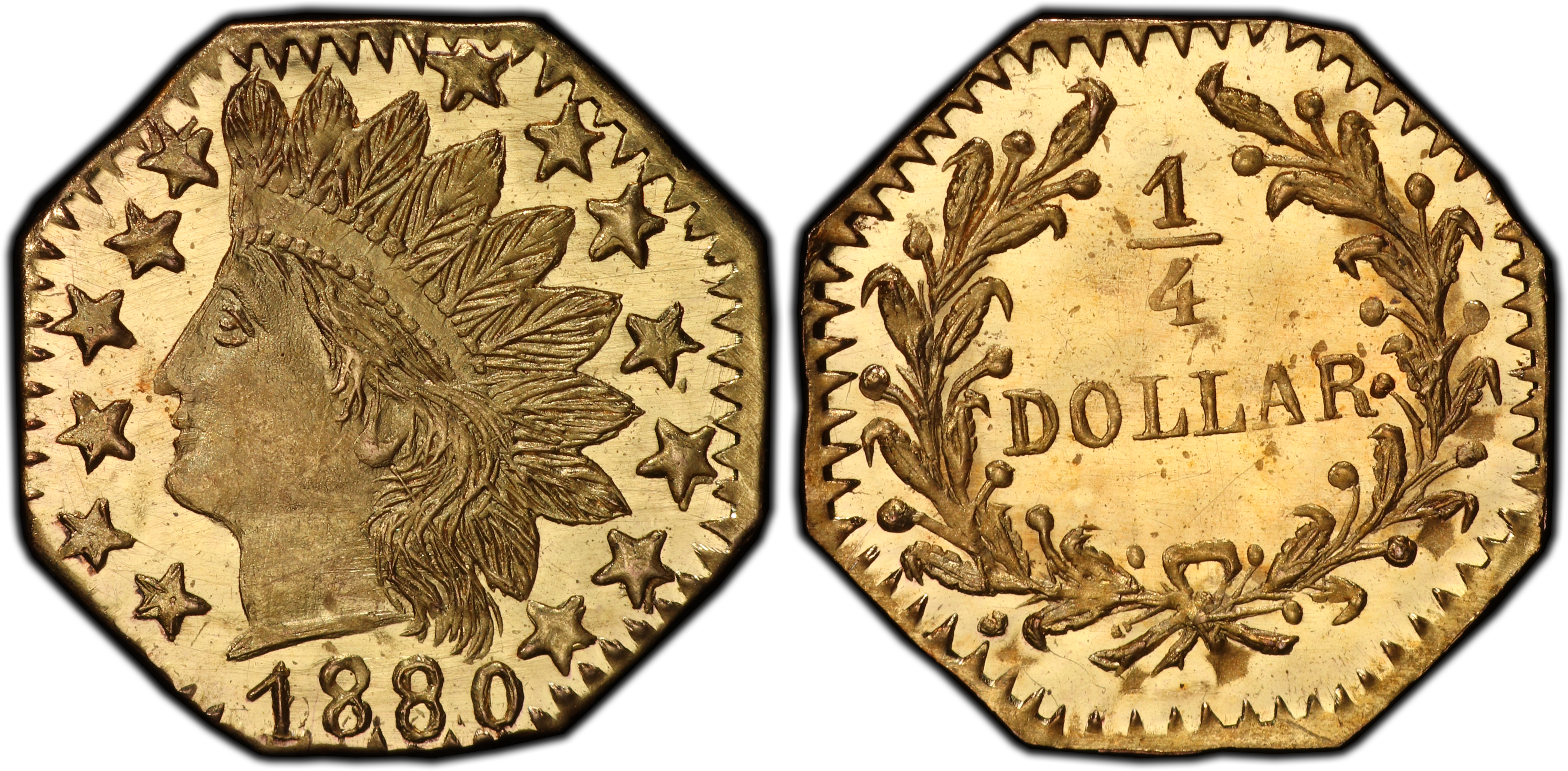
Obverse & Reverse
The 1880 BG-799K 25 Cents is a quintessential example of a 'Period Two' California Fractional Gold piece. By 1880, the frantic necessity for small circulating coinage that defined the Gold Rush's early years ('Period One,' 1852-1857) had long since subsided. The San Francisco Mint, operating in full swing since the mid-1850s, was producing ample federal silver and gold coins for daily commerce. The impetus for creating these minuscule gold pieces had shifted dramatically from utility to novelty. They were now produced almost exclusively as souvenirs, keepsakes for tourists, and adornments for jewelry. This era, from 1858 to 1882, is often called the 'Jewelers' Issue' period because San Francisco jewelers were the primary manufacturers. Unlike their Period One predecessors, which were intended to circulate and contained gold value close to their denomination, Period Two pieces were deliberately made underweight and often of a lower fineness. Their designs became more fanciful and varied, departing from the direct imitations of federal coinage. The production method remained primitive, typically involving a hand-hammered strike. An upper die was placed on a planchet resting on a lower die (set in an anvil or block), and then struck with a sledgehammer. This process resulted in inconsistent strike quality, with many pieces showing weakness in some areas and better definition in others. The 1880 date on this coin is representative of its time of manufacture, just before the U.S. Secret Service began to more strictly enforce the Coinage Act of 1864, which prohibited private coinage. This crackdown, beginning in 1883, effectively ended the production of denominated fractional gold and ushered in 'Period Three,' where makers produced undenominated 'charms' or backdated their pieces to avoid prosecution. Today, the BG-799K is a tangible link to the romantic memory of the Gold Rush, a memento crafted not for the forty-niner's purse, but for the Victorian tourist's curio cabinet.
Associated EventPost-Gold Rush California Tourism
Reason For MintingPrimarily created as a novelty item or souvenir for the tourist trade, not for general circulation as money.
Minter HistoryThe specific minter for the BG-799K variety is not definitively known, which is common for many 'Period Two' issues. Unlike some earlier pieces marked with initials (e.g., 'G' for Robert B. Gray & Co.), this variety is anonymous. It was likely produced by one of the many skilled but uncredited jewelers operating in San Francisco who catered to the robust market for Gold Rush memorabilia.
Historical SignificanceThe coin is significant not as a medium of exchange, but as a numismatic artifact representing the commercialization of the Gold Rush legacy. It illustrates the transition of fractional gold from a necessary form of local currency to a popular souvenir item, reflecting California's evolving economy and its burgeoning identity as a tourist destination.
N/A
Denomination25 Cents
Minting Period1880
Assayer/MinterUnknown Jeweler
Geographic OriginSan Francisco, California
Obverse DescriptionFeatures a stylized Indian Head portrait facing left, adorned with a feathered headdress. The portrait is surrounded by thirteen stars, representing the original colonies. The date '1880' is below the bust truncation.
Obverse Inscription1880
Reverse DescriptionThe central device is the denomination '1/4' surrounded by an ornate wreath of leaves and berries. The inscription 'CALIFORNIA GOLD' encircles the wreath along the upper periphery. The 'K' of the Breen-Gillio variety designation refers to specific die characteristics, such as the positioning of letters and wreath elements.
Reverse InscriptionCALIFORNIA GOLD 1/4
CompositionGold
Stated Fineness Actual FinenessVariable, typically between 14k and 22k for Period Two issues.
Weight0.25 grams
Diameter10.00 mm
EdgePlain
Unknown
Survival EstimateFewer than 75
Rarity ScaleR-5 (Very Scarce)
The BG-799K appeals to collectors for its classic Indian Head design, octagonal shape, and status as a late-date 'Period Two' issue. The 'PL' (Prooflike) designation is a major draw, as fully reflective surfaces are uncommon for the series and create exceptional eye appeal for such a minuscule coin.
Key VarietiesThe primary varieties for this issue relate to surface characteristics: 1. **Regular Strike:** Business strike with typical frosty or satiny luster. 2. **Prooflike (PL):** A business strike produced from polished dies, resulting in mirror-like fields. 3. **Deep Mirror Prooflike (DMPL):** A business strike with exceptionally deep and clear mirrored fields. No known patterns or special collector restrikes exist for this specific Breen-Gillio number.
Authentication TipsGenuine Period Two pieces like the BG-799K are characteristically thin and lightweight. Many contemporary counterfeits and modern replicas are thicker, heavier, and have a 'soapy' or cast-like appearance with mushy details. Look for sharp, albeit sometimes unevenly impressed, die work. All genuine pieces of this era must be denominated (e.g., '1/4', 'DOLLAR'). Pieces that say 'CAL GOLD' with no denomination are typically later tokens or fakes. Authentication by a major third-party grading service (PCGS or NGC) is highly recommended.
Shopping ConsiderationsFor a premium quality BG-799K, especially a PL example, look for sharp, uninterrupted reflectivity in the fields. The strike is often weak on the high points of the headdress feathers and the center of the wreath; examples with strong detail in these areas command significant premiums. Avoid coins that have been harshly cleaned, which destroys the delicate original surfaces and any prooflike contrast. Also, be wary of pieces that have been removed from jewelry, checking the rims carefully under magnification for any evidence of solder, tooling, or mounting marks. Eye appeal is paramount; a coin with attractive, original reddish-gold toning is far more desirable than a bright, dipped-out specimen.
A coin's grade is its condition, rated on a 1-70 scale. For rare coins, this is the most critical factor in determining value, as a tiny difference in preservation can mean a huge difference in price.
Relevant Grade TypesOriginal 1880 issues were all business strikes, technically intended for sale as souvenirs rather than circulation. They are found in Circulated (1-58) grades, though this is uncommon, and more frequently in Mint State (MS, 60-70). No true Proofs were struck during the original period of issue. The 'Prooflike' (PL) and 'Deep Mirror Prooflike' (DMPL) designations are applied to business strikes made with specially prepared, polished dies and are highly sought after, but they are not a separate striking method like true Proofs.
Mint State CharacteristicsIn Mint State, quality is defined by the strength of the strike and the quality of the luster. The BG-799K often exhibits strike weakness on the Indian's cheek and the highest feathers of the headdress. Luster on regular strikes is typically subdued and satiny. For PL examples, the key is the contrast between the frosted devices (the portrait and wreath) and the mirrored fields. Due to the primitive minting process, even high-grade specimens can show minor planchet flaws or unstruck areas, which should be considered characteristic rather than disqualifying.
Circulated Wear PatternsAlthough most did not circulate, if wear is present, it will first appear on the highest points: the cheekbone of the Indian portrait, the eyebrow, and the details of the headdress feathers. On the reverse, the leaves and berries in the center of the wreath will show initial flatness. In lower grades (VF and below), the stars on the obverse and the letters in 'CALIFORNIA GOLD' will begin to merge with the fields.
Key Factors For ValueThe most significant value driver for the BG-799K is the surface designation; PL and DMPL coins carry a massive premium over regular strikes. Beyond that, a sharp, well-centered strike is paramount. Surface quality is critical; examples free of distracting marks, carbon spots, or evidence of cleaning are prized. Eye appeal, driven by original luster and attractive toning, plays a huge role. A CAC sticker for this issue indicates superior quality for the grade and will add a substantial premium, as it confirms the coin's strong visual appeal and originality.
PCGS Price Guide
| Grade | Price | Population |
|---|---|---|
| 65 | $1,500.00 | 1 |
| 65+ | $1,800.00 | N/A |
| 66 | $2,300.00 | N/A |
| 66+ | $2,500.00 | N/A |
| 67 | $2,750.00 | 1 |