1880/70 25C BG-799I (Regular Strike)
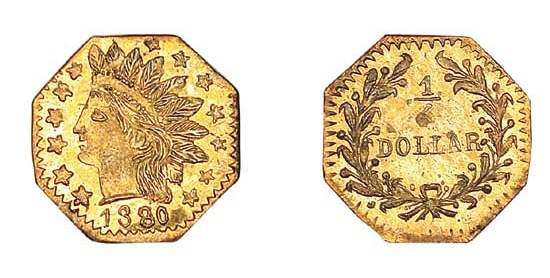
Obverse & Reverse
The 1880/70 25 Cents, cataloged as Breen-Gillio 799I, is a quintessential example of a 'Period Two' California Fractional Gold piece. The story of these fascinating numismatic artifacts begins with the California Gold Rush of 1849. The massive influx of population and gold dust created a dynamic but chaotic economy desperately short of small-denomination coinage for daily transactions. To fill this void, private jewelers and metallurgists began striking their own coins in 25-cent, 50-cent, and dollar denominations starting in 1852. These initial 'Period One' (1852-1857) issues were generally of good faith, containing close to their face value in gold and intended to alleviate the coinage shortage. However, by the late 1850s, the establishment of the San Francisco Mint and the influx of federal coinage rendered the original purpose of fractional gold obsolete. A new market emerged, driven by tourism and a national fascination with the 'Wild West.' Jewelers began producing a second generation of fractionals, known as 'Period Two' issues (1858-1882). These pieces, including the BG-799I, were often underweight, struck in lower-fineness gold, and intended primarily as souvenirs and keepsakes rather than circulating money. The Coinage Act of 1864 explicitly outlawed private coinage, but enforcement in the West was lax, allowing production to continue for nearly two more decades. Many producers from this era remain anonymous to avoid legal trouble. The BG-799I is a classic example of the cost-saving and expedient measures used by these later minters; it is an 'overdate,' created by re-punching an '80' over the '70' on a leftover die from a decade prior. This not only saved the expense of creating a new die but also inadvertently created a rare and historically telling variety for future collectors. These late-date issues represent the final chapter of a uniquely American response to economic necessity, which evolved into a cottage industry for mementos of the gold rush era.
Associated EventCalifornia Gold Rush (Later Souvenir Period)
Reason For MintingPrimarily struck as a souvenir or keepsake for the tourist trade, capitalizing on the romantic appeal of the California Gold Rush.
Minter HistoryThe minter of BG-799I is unknown, a common characteristic for 'Period Two' and 'Period Three' California Fractional Gold. After the Coinage Act of 1864, producers often worked anonymously to avoid prosecution by federal authorities. These minters were typically jewelers in San Francisco who had the skills and equipment for such small, detailed work. Their business model shifted from fulfilling a monetary need to satisfying a growing demand for collectible souvenirs.
Historical SignificanceThis coin is significant as an artifact of the post-Gold Rush souvenir trade in California. The overdate feature (1880/70) provides a tangible link to the manufacturing practices of the era's private coiners, demonstrating their frugality in re-using old dies. It represents the twilight of private coinage in the United States, a period when the lines between currency, token, and souvenir were blurred.
BG-799I
Denomination25 Cents
Minting Period1880
Assayer/MinterUnknown
Geographic OriginSan Francisco, California
Obverse DescriptionThe obverse features a stylized head of an Indian princess facing left, adorned with a feathered headdress. Thirteen stars encircle the portrait along the octagonal border, with the date '1880' below. The '0' in the date is clearly punched over a '7' from an older die.
Obverse Inscription1880
Reverse DescriptionThe reverse features the denomination '25 CENTS' within a wreath composed of two branches tied together with a bow at the bottom. The legend 'CALIFORNIA GOLD' is inscribed above the wreath, following the upper octagonal border.
Reverse InscriptionCALIFORNIA GOLD 25 CENTS
CompositionGold
Stated Fineness Actual FinenessVariable, typical for Period Two issues, often between .500 and .900.
Weight0.24 grams
Diameter9.60 mm
EdgePlain
Unknown
Survival EstimateFewer than 25 known
Rarity ScaleR-6
The BG-799I is highly sought after due to the combination of its status as a scarce Period Two fractional, its attractive Indian Head design, and most importantly, its clear 1880/70 overdate. Overdates provide a fascinating glimpse into the minting process and are a popular collecting specialty.
Key VarietiesThe primary variety is the 1880/70 overdate itself. No major sub-varieties, patterns, or official restrikes of BG-799I are known. It is part of the larger BG-799 die family, which includes other dates and varieties made by the same anonymous minter.
Authentication TipsAuthentication requires careful examination of the overdate; the underlying '7' should be visible within the final '0' of 1880, often with a small tip of the '7' protruding. The style of the Indian portrait, lettering, and wreath should match known genuine examples. The weight and specific gravity should be consistent with period gold pieces. Due to the high number of counterfeits in this series, third-party certification by PCGS or NGC is strongly recommended.
Shopping ConsiderationsA premium quality example will exhibit a sharp, well-centered strike, particularly on the details of the headdress and the leaves of the wreath. Look for clean, original surfaces with some remaining mint luster; these pieces were often poorly produced and handled, making high-grade examples rare. The visibility and clarity of the overdate is a key value driver. Avoid examples that have been harshly cleaned, show evidence of mounting for jewelry (a common fate for these items), or have scratches that impair the aesthetic appeal. A CAC sticker on a certified coin would indicate superior quality for the grade.
A coin's grade is its condition, rated on a 1-70 scale. For rare coins, this is the most critical factor in determining value, as a tiny difference in preservation can mean a huge difference in price.
Relevant Grade TypesOriginal examples of BG-799I were struck as business strikes, although their intended purpose was more for souvenir sales than circulation. They are found in Circulated (1-58) and, more commonly, Mint State (MS, 60-70) grades. No proofs were struck during the original period of issue, and there are no known later-date proof restrikes.
Mint State CharacteristicsIn uncirculated condition, this variety often shows weakness in the strike, particularly on the highest points of the Indian's cheek and the center of the wreath. Luster is typically satiny rather than deeply prooflike. Due to the softness of the gold and primitive production methods, it is common to find Mint State examples with light planchet flaws or minor contact marks that do not significantly detract from the overall eye appeal.
Circulated Wear PatternsWear first appears on the high points of the design. On the obverse, check the cheekbone and the feathers of the headdress. On the reverse, the highest leaves of the wreath and the bow will show the first signs of friction. In lower grades (VF and below), the finer details of the feathers will merge and the legends will begin to soften.
Key Factors For ValueThe primary factors determining value are grade and surface preservation. An example with original, uncleaned surfaces and minimal contact marks will command a significant premium. The strength and clarity of the strike are crucial, especially on the central devices. Finally, the boldness of the underlying '7' in the overdate adds to the coin's desirability and value; a clear, easily discernible overdate is always preferred by specialists.
PCGS Price Guide
| Grade | Price | Population |
|---|---|---|
| 62 | $425.00 | 2 |
| 62+ | $475.00 | N/A |
| 63 | $525.00 | 4 |
| 63+ | $625.00 | N/A |
| 64 | $900.00 | 6 |
| 64+ | $1,250.00 | N/A |
| 65 | $2,250.00 | 1 |
| 65+ | $2,750.00 | N/A |
| 66 | $4,000.00 | 1 |